Promotional price valid on web orders only. Your contract pricing may differ. Interested in signing up for a dedicated account number?
Learn More
Learn More
Invitrogen™ PKC theta Polyclonal Antibody

Description
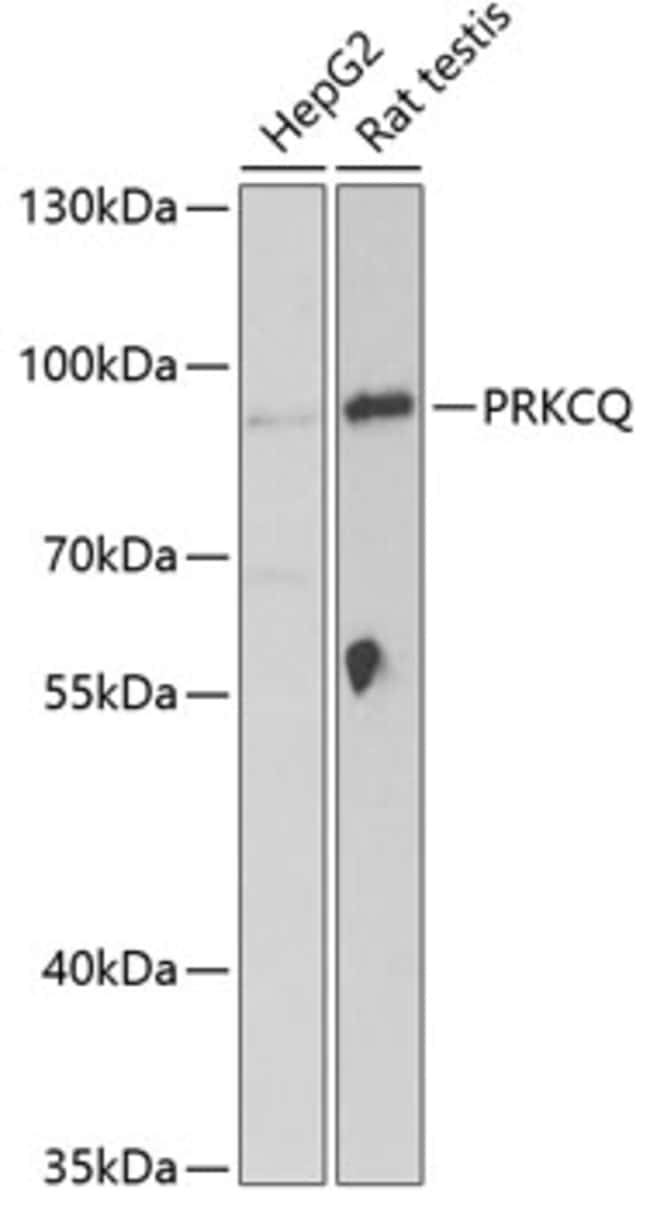
Immunogen sequence: MSPFLRIGLS NFDCGSCQSC QGEAVNPYCA VLVKEYVESE NGQMYIQKKP TMYPPWDSTF DAHINKGRVM QIIVKGKNVD LISETTVELY SLAERCRKNN GKTEIWLELK PQGRMLMNAR YFLEMSDTKD MNEFETEGFF ALHQRRGAIK QAKVHHVKCH EFTATFFPQP TFCSVCHEFV WGLNKQGYQC RQCNAAIHKK CIDKVIAKCT GSAINSRETM FHKERFKIDM; Positive Samples: HepG2, Rat testis; Cellular Location: Cell membrane, Cytoplasm, Peripheral membrane protein.
Protein Kinase C (PKC) isoforms are serine/threonine kinases involved in signal transduction pathways that govern a wide range of physiological processes including differentiation, proliferation, gene expression, brain function, membrane transport and the organization of cytoskeletal and extracellular matrix proteins. Increasing evidence from studies using in vitro and in vivo systems points to PKC as a key regulator of critical cell cycle transitions, including cell cycle entry and exit and the G1 and G2 checkpoints. PKC-mediated control of these transitions can be negative or positive, depending on the timing of PKC activation during the cell cycle and on the specific PKC isozymes involve. There have been at least 12 different PKC isoforms identified in humans to date, including alpha, beta I, beta II, gamma, delta, epsilon, zeta, eta, theta, iota, lambda, and mu. The different PKC isoforms vary in structure, subcellular localization, tissue distribution and response to extracellular signals. PKC beta II has been shown to be expressed, in part, in cardiac muscle, intestinal epithelium, kidney and pancreas. PKC beta II has been shown to be involved in cell cycle progression and cancer proliferation.

Specifications
Specifications
| Antigen | PKC theta |
| Applications | ELISA, Western Blot |
| Classification | Polyclonal |
| Concentration | 0.14 mg/mL |
| Conjugate | Unconjugated |
| Formulation | PBS with 50% glycerol and 0.02% sodium azide; pH 7.3 |
| Gene | PRKCQ |
| Gene Accession No. | Q02111, Q04759, Q9WTQ0 |
| Gene Alias | A130035A12Rik; AW494342; EC 2.7.11.13; kinase nPKC-theta; KPCT; MGC126514; MGC141919; nPKC-theta; PKC theta; PKC-0; Pkcq; PKCtheta; PKC-theta; PRKCQ; PRKCT; protein kinase C theta; protein kinase C theta type; protein kinase C, theta; RP11-563J2.1; si:ch211-239o15.1 |
| Gene Symbols | PRKCQ |
| Show More |
Product Title
By clicking Submit, you acknowledge that you may be contacted by Fisher Scientific in regards to the feedback you have provided in this form. We will not share your information for any other purposes. All contact information provided shall also be maintained in accordance with our Privacy Policy.
Spot an opportunity for improvement?