Learn More
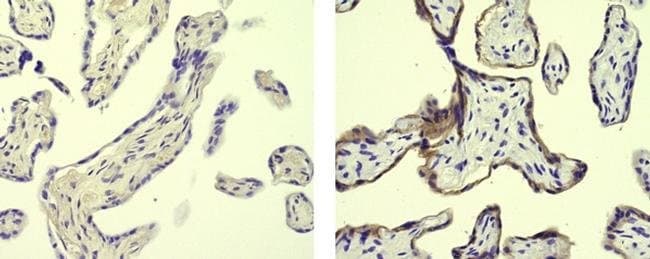
Invitrogen™ Placental Alkaline Phosphatase Monoclonal Antibody (8B6), Biotin, eBioscience™


Description
The monoclonal antibody 8B6 recognizes human Placental Alkaline Phosphatase (PLAP), a 130 (or 130 with 65 kDa) enzyme expressed by placental syncytiotrophoblastoid cells. This enzyme has slightly different enzyme kinetics from other phosphatases. PLAP can be found anchored to the plasma membrane in addition to the cytoplasm. Expression is found in several germ line cancers; ovarian and testicular. Expression is also present in human embryonic stem cells and bone marrow-derived mesenchymal stromal cells. This 8B6 antibody reacts with both the Regan and Nagao isozymes. Applications Reported: This 8B6 antibody has been reported for use in immunohistochemical staining of frozen (IHC-F) and formalin-fixed paraffin embedded (IHC-P) tissue, and ELISA. Applications Tested: This 8B6 antibody has been tested by immunohistochemistry on formalin-fixed paraffin embedded (FFPE) human placenta with trypsin digestion. This antibody can be used at less than or equal to 20 μg/mL. It is recommended that the antibody be carefully titrated for optimal performance in the assay of interest. Filtration: 0.2 μm post-manufacturing filtered.

Specifications
Specifications
| Antigen | Placental Alkaline Phosphatase |
| Applications | ELISA, Immunohistochemistry (Frozen), Immunohistochemistry (Paraffin) |
| Classification | Monoclonal |
| Clone | 8B6 |
| Concentration | 0.5 mg/mL |
| Conjugate | Biotin |
| Formulation | PBS with 0.09% sodium azide; pH 7.2 |
| Gene | ALPP |
| Gene Accession No. | P05187 |
| Gene Alias | Alkaline phosphatase placental type; Alkaline phosphatase Regan isozyme; alkaline phosphatase, placental; alkaline phosphatase, placental type; alkaline phosphomonoesterase; ALP; Alp1; ALPP; AP-TNAP; DOA1; FLJ11281; FLJ40094; FLJ61142; FLJ93059; Germ-cell alkaline phosphatase; glycerophosphatase; HOPS; MGC161443; MGC167935; nagao Isozyme; P PLAP; PALP; PLA2P; PLAA; placental alkaline phosphatase 1; placental heat-stable alkaline phosphatase; PLAP; PLAP1; PLAP-1; rCG23846-like; Regan isozyme; TNAP; TNSALP |
| Show More |
By clicking Submit, you acknowledge that you may be contacted by Fisher Scientific in regards to the feedback you have provided in this form. We will not share your information for any other purposes. All contact information provided shall also be maintained in accordance with our Privacy Policy.