Promotional price valid on web orders only. Your contract pricing may differ. Interested in signing up for a dedicated account number?
Learn More
Learn More
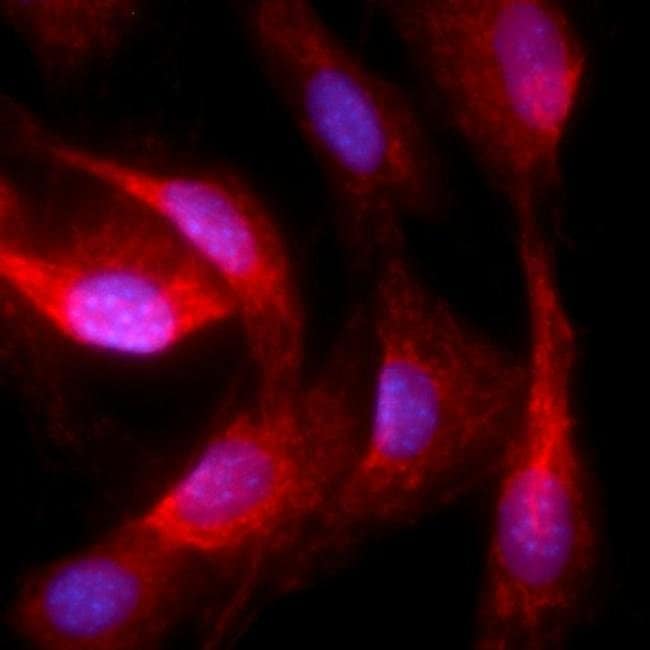


Description
PA1-824 detects peroxisome proliferator activated receptor (PPAR) gamma 2 from human and mouse tissues. This antibody does not detect PPAR alpha or PPAR delta. PA1-824 immunogen is a synthetic peptide corresponding to residues M(1) G E T L G D S P I D P E S D S(16) C of human PPAR gamma-2. This sequence is not conserved in PPAR gamma-1.
Peroxisome proliferators are non-genotoxic carcinogens which are purported to exert their effect on cells through their interaction with members of the nuclear hormone receptor family, termed peroxisome proliferator activated receptors (PPARs). Nuclear hormone receptors are ligand-dependent intracellular proteins that stimulate transcription of specific genes by binding to specific DNA sequences following activation by the appropriate ligand. Studies indicate that PPARs are activated by peroxisome proliferators such as clofibric acid, nafenopin, and WY-14,643, as well as by some fatty acids. It has also been shown that PPARs can induce transcription of acyl coenzyme A oxidase and cytochrome P450 A6 (CYP450 A6) through interaction with specific response elements. PPAR alpha is activated by free fatty acids including linoleic, arachidonic, and oleic acids. Induction of peroxisomes by this mechanism leads to a reduction in blood triglyceride levels. PPAR alpha is expressed mainly in skeletal muscle, heart, liver, and kidney and is thought to regulate many genes involved in the beta-oxidation of fatty acids. Activation of rat liver PPAR alpha has been shown to suppress hepatocyte apoptosis. PPAR gamma 2, like several other nuclear hormone receptors, heterodimerizes with retinoic X receptor (RXR) alpha to form a transcriptionally competent complex.

Specifications
Specifications
| Antigen | PPAR gamma-2 |
| Applications | Immunocytochemistry |
| Classification | Polyclonal |
| Concentration | 1.0 mg/mL |
| Conjugate | Alexa Fluor 647 |
| Formulation | PBS with 1.0mg/mL BSA and 0.05% sodium azide |
| Gene | PPARG |
| Gene Accession No. | P37231, P37238 |
| Gene Alias | CIMT1; GLM1; Nr1c3; nuclear receptor subfamily 1 group C member 3; peroxisome proliferator; peroxisome proliferator activated receptor; peroxisome proliferator activated receptor gamma; peroxisome proliferator activated receptor gamma 2; peroxisome proliferator activated receptor gamma 4; peroxisome proliferator-activated nuclear receptor gamma variant 1; peroxisome proliferator-activated receptor gamma; PPARG; PPARG1; PPARG2; PPARgamma; PPAR-gamma; PPARgamma2; PPAR-gamma2 |
| Gene Symbols | PPARG |
| Show More |
Safety and Handling
WARNING: Cancer - www.P65Warnings.ca.gov
Product Title
By clicking Submit, you acknowledge that you may be contacted by Fisher Scientific in regards to the feedback you have provided in this form. We will not share your information for any other purposes. All contact information provided shall also be maintained in accordance with our Privacy Policy.
Spot an opportunity for improvement?