Learn More
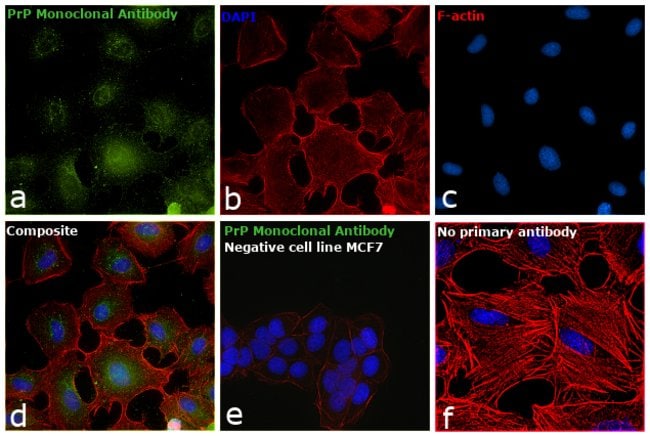

Invitrogen™ PrP Monoclonal Antibody (F89/160.1.5)


Description
MA1-750 detects prion protein (PrP) protein from a variety of species that have the conserved n-IHFG-c epitope, including agriculturally important animal species such as sheep, bovine, deer, and elk. MA1-750 has been successfully used in Western blot, immunohistochemistry and ELISA procedures. By Western blot, this antibody detects a 33-35 kDa protein from normal animals and a 27-30 kDa protein which represents PrP in brain protease treated tissue extracts from infected animals. Immunohistochemical staining of PrP(Sc) in infected sheep brain with MA1-750 results in intense staining of the spongiform lesions. In immunohistochemical procedures this antibody detects only the PrP(Sc) and not PrP(C). The MA1-750 immunogen is a synthetic peptide corresponding to residues S(146) R P L I H F G S D Y E D R(159) of bovine PrP. This peptide (Cat. # PEP-051) is available for use in neutralization and control experiments. MA1-750 is known to specifically recognize a conserved epitope of the PrP(Sc) protein comprising the amino acids n-IHFG-c.

Specifications
Specifications
| Antigen | PrP |
| Applications | ELISA, Immunohistochemistry (Paraffin), Western Blot, Immunocytochemistry |
| Classification | Monoclonal |
| Clone | F89/160.1.5 |
| Concentration | 1 mg/mL |
| Conjugate | Unconjugated |
| Formulation | PBS with 1mg/mL BSA and 0.05% sodium azide |
| Gene | PRNP |
| Gene Accession No. | F7VJQ1, P04156, P04925, P10279, P23907 |
| Gene Alias | AA960666; AI325101; Alternative prion protein; alternative prion protein; major prion protein; AltPrP; ASCR; BSE; CD230; CD230 antigen; CJD; GSS; KURU; major prion protein; major prion protein; alternative prion protein; major scrapie-associated fibril protein 1; MGC26679; p27-30; PK resistant core; prion protein; prion protein (p27-30) (Creutzfeldt-Jakob disease, Gerstmann-Strausler-Scheinker syndrome, fatal familial insomnia); prion protein precursor; prion protein precursor PrP; prion protein PrP; prion protein variant a; prion protein variant b; prion protein, PrP; prion protein, structural; prion-related protein; PRIP; Prn; Prn-i; Prnp; Prn-p; PrP; PrP>C>; PrP27-30; PrP33-35C; PrPc; PrPSc; Sinc; SIP; TSE |
| Show More |
By clicking Submit, you acknowledge that you may be contacted by Fisher Scientific in regards to the feedback you have provided in this form. We will not share your information for any other purposes. All contact information provided shall also be maintained in accordance with our Privacy Policy.