Promotional price valid on web orders only. Your contract pricing may differ. Interested in signing up for a dedicated account number?
Learn More
Learn More
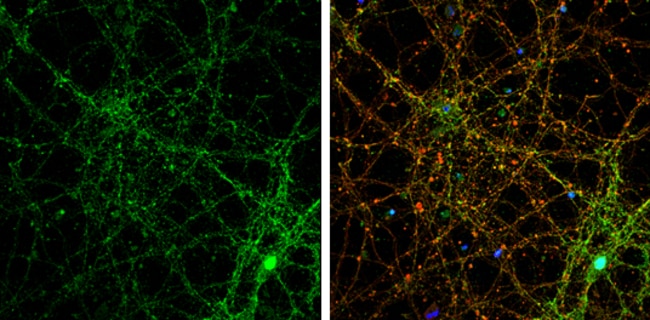

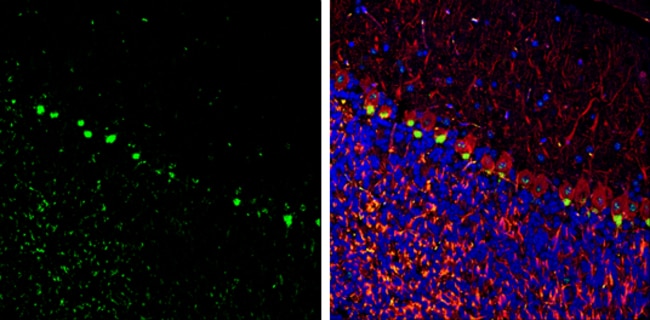
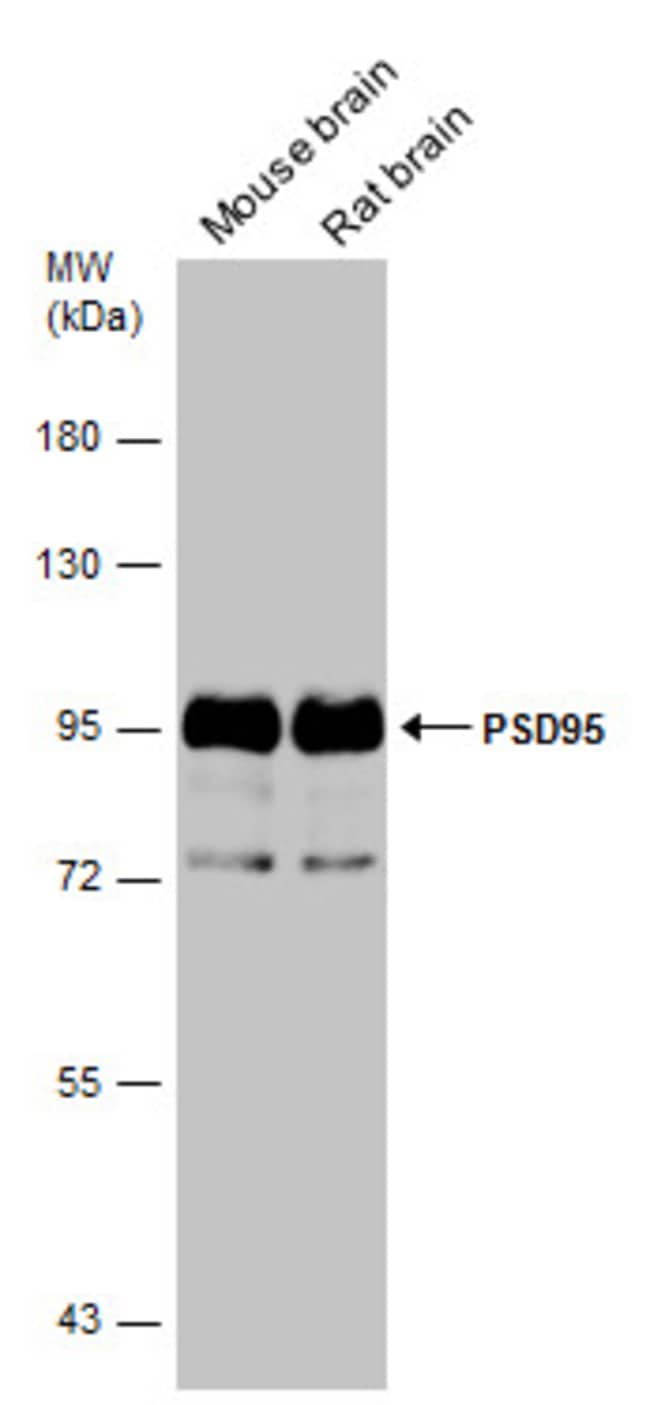


Description
Keep as concentrated solution. Predicted reactivity: Mouse (100%), Rat (100%), Rhesus Monkey (100%), Bovine (100%). Positive Control: mouse brain, rat brain. Store product as a concentrated solution. Centrifuge briefly prior to opening the vial.
Post Synaptic Density 95 kDa (PSD-95), also known as synapse associated protein 90 kDa (SAP90), is one of a family of membrane-associated proteins found in the postsynaptic density in forebrain neurons and certain presynaptic structures in the cerebellum. Like other members of the family, PSD-95 has three 90 amino acid repeats called PDZ domains followed by an SH3 domain and a yeast guanylate kinase homology (GuK) domain. PSD-95 is believed to participate in the clustering of certain proteins, including NMDA receptors, Shaker-type potassium channels at the synaptic membrane in central nervous system (CNS) neurons. There are two principal modes of interaction between PSD-95 and other proteins. NMDA receptors and shaker-type potassium channels both share C-terminal sequence homology consisting of a threonine/serine-X-valine-COOH (T/SXV) motif. Other neuronal proteins that share this motif (beta 1 adrenergic receptor, some serotonin receptors, some sodium channel subunits, and additional potassium channel subunits), and some of these proteins may interact with PSD-95 by binding to its PDZ domains. Neuronal nitric oxide synthase (nNOS), which lacks the T/SXV motif but which has its own PDZ domain, has been shown to associate with PSD-95 in vitro through a pseudo-homotypic PDZ-PDZ interaction.

Specifications
Specifications
| Antigen | PSD-95 |
| Applications | Immunohistochemistry (Frozen), Immunohistochemistry (Paraffin), Western Blot, Immunocytochemistry |
| Classification | Polyclonal |
| Concentration | 0.98 mg/mL |
| Conjugate | Unconjugated |
| Formulation | PBS with 20% glycerol and 0.025% ProClin 300; pH 7 |
| Gene | DLG4 |
| Gene Accession No. | P31016, Q62108 |
| Gene Alias | discs large homolog 4; discs large MAGUK scaffold protein 4; discs, large homolog 4; discs, large homolog 4 (Drosophila); disks large homolog 4; Dlg4; Dlgh4; FLJ97752; FLJ98574; post synaptic density; postsynaptic density protein 95; post-synaptic density protein 95; PSD95; PSD-95; PSD-95 alpha 2b; PSD-95 beta; Sap90; SAP-90; SAP90A; Synapse-associated protein 90; synapse-associated protein SAP90; Tax interaction protein 15 |
| Gene Symbols | DLG4 |
| Show More |
Product Title
By clicking Submit, you acknowledge that you may be contacted by Fisher Scientific in regards to the feedback you have provided in this form. We will not share your information for any other purposes. All contact information provided shall also be maintained in accordance with our Privacy Policy.
Spot an opportunity for improvement?