Learn More
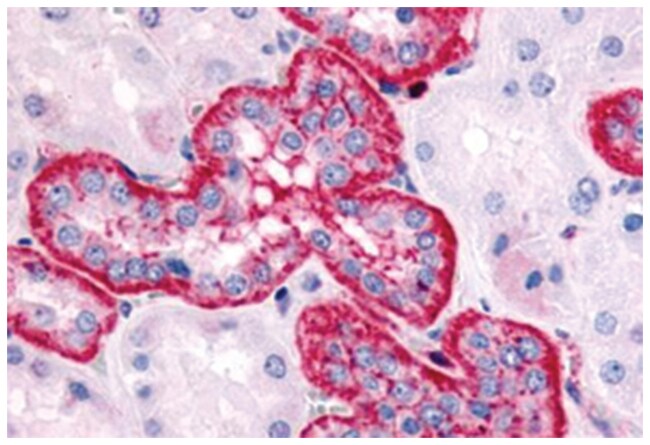
Description
Serotonin (5-hydroxytryptamine, 5-HT), a neurotransmitter, elicits a wide array of physiological effects by binding to several receptor subtypes, including the 5-HT2 family of seven-transmembrane-spanning, G-protein-coupled receptors, which activate phospholipase C and D signaling pathways. This gene encodes the 2C subtype of serotonin receptor and its mRNA is subject to multiple RNA editing events, where genomically encoded adenosine residues are converted to inosines. RNA editing is predicted to alter amino acids within the second intracellular loop of the 5-HT2C receptor and generate receptor isoforms that differ in their ability to interact with G proteins and the activation of phospholipase C and D signaling cascades, thus modulating serotonergic neurotransmission in the central nervous system. Studies in humans have reported abnormalities in patterns of 5-HT2C editing in depressed suicide victims. [provided by RefSeq
Specifications
Specifications
| Antigen | HTR2C |
| Applications | Immunohistochemistry (PFA fixed) |
| Classification | Polyclonal |
| Conjugate | Unconjugated |
| Description | Rabbit polyclonal antibody raised against synthetic peptide of HTR2C. |
| Dilution | Immunohistochemistry (Formalin/PFA-fixed paraffin-embedded sections) (3.8 ug/mL) The optimal working dilution should be determined by the end user. |
| Formulation | In PBS (0.09% sodium azide) |
| Gene | HTR2C |
| Gene Alias | 5-HT2C/5-HTR2C/HTR1C |
| Gene Symbols | HTR2C |
| Show More |
For Research Use Only
By clicking Submit, you acknowledge that you may be contacted by Fisher Scientific in regards to the feedback you have provided in this form. We will not share your information for any other purposes. All contact information provided shall also be maintained in accordance with our Privacy Policy.