Learn More
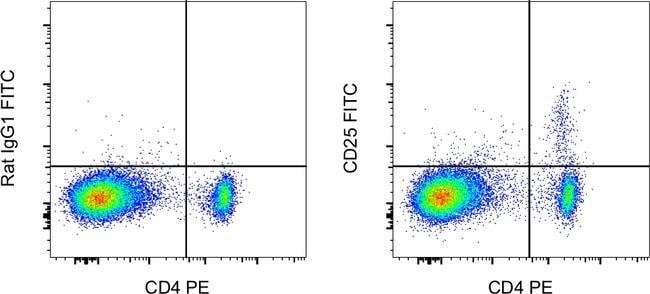

Invitrogen™ Rat IgG1 kappa Isotype Control (eBRG1), FITC, eBioscience™, Invitrogen™


Description
Description: The monoclonal rat IgG1, kappa is useful as an isotype control immunoglobulin. Applications Reported: This rat IgG1 isotype control has been reported for use in immunohistochemistry, immunocytochemistry, flow cytometric analysis, and ELISA. Applications Tested: Rat IgG1 Isotype Control has been tested by flow cytometric analysis of mouse splenocyte suspensions. It should be used at the same concentration as the experimental antibody. Excitation: 488 nm; Emission: 520 nm; Laser: Blue Laser. Filtration: 0.2 μm post-manufacturing filtered.

Specifications
Specifications
| Antigen | Rat IgG1 kappa |
| Applications | Control, Flow Cytometry, Immunohistochemistry, Immunocytochemistry, Immunohistochemistry |
| Classification | Monoclonal |
| Clone | eBRG1 |
| Concentration | 0.5 mg/mL |
| Conjugate | FITC |
| Formulation | PBS with 0.09% sodium azide; pH 7.2 |
| Gene Alias | Immunoglobulin G; Immunoglobulin G1; ImmunoglobulinG; ImmunoglobulinG1 |
| Host Species | Rat |
| Purification Method | Affinity chromatography |
| Show More |
Frequently Asked Questions (FAQs)
No. Many users are using unstained cells in combination with FMO controls to identify their positive populations.
The flow cytometry field is moving away from using isotype controls as they are not necessarily the most appropriate way to control for non-specific binding. Instead, they are using unstained cells to define the negative population, single stained controls to set compensation, and flow minus one (FMO) controls to set regions and gates.
You may want to consider whether using an isotype control is something you need to do. Here are some references you might want to look at:
-O'Gorman MR, Thomas J. (1999) Isotype controls-time to let go? Cytometry 38:78-80.
-Keeney M, Gratama JW, Chin-Yee IH et al. (1998) Isotype controls in the analysis of lymphocytes and CD34+ stem/progenitor cells by flow cytometry- time to let go! Cytometry 34:280-283.
-Hulspas R, O'Gorman MR, Wood BL et al. (2009) Considerations for the control of background fluorescence in clinical flow cytometry. Cytometry B Clin Cytom 76:355–364.
-Enumeration of Immunologically Defined Cell Populations by Flow Cytometry; Approved Guideline - Second Edition. Clinical and Laboratory Standards Institute, (CLSI). Document H42-A2 Volume 27 No.16, 2007.
-Clinical Flow Cytometric Analysis of Neoplastic Hematolymphoid Cells; Approved Guideline - Second Edition. Clinical and Laboratory Standards Institute, (CLSI). Document H43-A2 Volume 27 No. 11, 2007.
If you do wish to use isotype controls, we offer a wide variety of species and fluorophores, search our Web site under "isotype antibody control."
Safety and Handling
For Research Use Only.
By clicking Submit, you acknowledge that you may be contacted by Fisher Scientific in regards to the feedback you have provided in this form. We will not share your information for any other purposes. All contact information provided shall also be maintained in accordance with our Privacy Policy.