Promotional price valid on web orders only. Your contract pricing may differ. Interested in signing up for a dedicated account number?
Learn More

Invitrogen™ Rat TGF beta-1 ELISA Kit

Catalog No. 501125465
Encompass_Preferred
Change view
Click to view available options
Quantity:
2 x 96 Tests
96 Tests
2 product options available for selection
Product selection table with 2 available options. Use arrow keys to navigate and Enter or Space to select.
Catalog No. Quantity
50-112-5465 96 Tests
BMS6233TWO 2 x 96 Tests
Use arrow keys to navigate between rows. Press Enter or Space to select a product option. 2 options available.
2 options
Catalog No. 50-112-5465 Supplier Invitrogen™ Supplier No. BMS6233
Only null left
Add to Cart
Add to Cart

Includes

Aluminium pouch(es) with a Microwell Plate coated with monoclonal antibody to rat TGF-beta1
Biotin-Conjugate anti-rat TGF-beta1 polyclonal antibody
Streptavidin-HRP
Rat TGF-beta1 Standard lyophilized, 4000pg/mL upon reconstitution
Assay Buffer Concentrate 20x (PBS with 1% Tween 20 and 10% BSA)
Wash Buffer Concentrate 20x (PBS with 1% Tween 20)
Substrat Solution (tetramethyl-benzidine)
Stop Solution (1M Phosphoric acid)
Adhesive Films

ELISA

The Rat Transforming Growth Factor beta 1 (Rt TGFβ1) ELISA quantitates Rt TGFβ1in rat serum, plasma, buffered solution, or cell culture medium. The assay will exclusively recognize both natural and recombinant Rat TGFβ1. Principle of the method The Rat TGFβ1 solid-phase sandwich ELISA (enzyme-linked immunosorbent assay) is designed to measure the amount of the target bound between a matched antibody pair. A target-specific antibody has been pre-coated in the wells of the supplied microplate. Samples, standards, or controls are then added into these wells and bind to the immobilized (capture) antibody. The sandwich is formed by the addition of the second (detector) antibody, a substrate solution is added that reacts with the enzyme-antibody-target complex to produce measurable signal. The intensity of this signal is directly proportional to the concentration of target present in the original specimen. Rigorous validation Each manufactured lot of this ELISA kit is quality tested for criteria such as sensitivity, specificity, precision, and lot-to-lot consistency. See manual for more information on validation.

TGF beta-1 (TGFB1, Transforming Growth Factor Beta 1) is a polypeptide member of the transforming growth factor beta superfamily of cytokines, found almost ubiquitously in tissues. Transforming growth factor (TGF)-b is stored in the extracellular matrix as a latent complex with its pro-domain. Activation of TGF beta-1 requires the binding of aV integrin to an RGD sequence in the prodomain and exertion of force on this domain, which is held in the extracellular matrix by latent TGF-b binding proteins. Latent forms are complexes of TGF beta-1, an amino-terminal portion of the TGF-beta precursor, designated TGF-LAP (TGF-latency associated peptide), and a specific binding protein, known as LTBP. TGF beta-1 helps regulates proliferation, differentiation, adhesion, migration in many cell types. Many cells have TGF beta receptors, and the protein positively and negatively regulates many other growth factors. TGF beta-1 is cleaved into a latency-associated peptide and a mature TGF beta-1 peptide, and is found in either a latent form composed of a TGFB1 homodimer, a LAP homodimer, and a latent TGFB1-binding protein, or in an active form composed of a TGF beta-1 homodimer. The mature peptide may also form heterodimers with other TGF beta family members. The gene for TGF beta-1 is frequently upregulated in tumor cells, and mutations in this gene result in Camurati-Engelmann disease and cystic fibrosis.
TRUSTED_SUSTAINABILITY

Specifications

Accession Number P17246
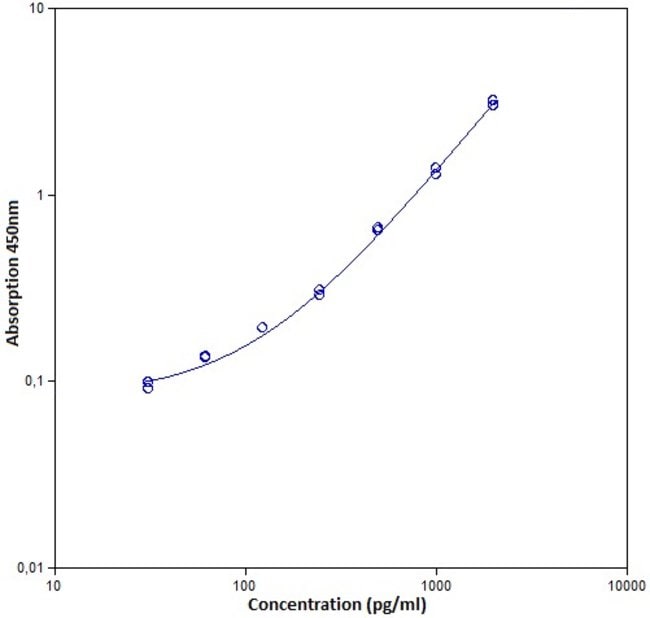
Assay Range 31.25-2000 pg/mL
Assay Sensitivity 7.8 pg/mL
Conjugate HRP
Immunoassay Kit Format Sandwich ELISA Kit
Product Type ELISA
Sample Type Plasma, Serum, Supernatant
Target Species Rat
For Use With (Application) ELISA
For Use With (Equipment) Absorbance Microplate Reader
Gene Alias CED; cytokine; DPD1; LAP; Latency-associated peptide; prepro-transforming growth factor beta-1; regulatory protein; TGF b; TGF b 1; TGF beta; tgf beta 1; tgf beta1; TGF beta-1; TGF beta-1 protein; TGF β; TGF β 1; TGF β1; Tgfb; TGFB1; TGF-B1; Tgfb-1; TGFbeta; TGF-beta 1; TGF-beta 1 protein; TGFbeta1; TGF-beta1; TGF-beta-1; TGFβ1; Transforming growth factor; transforming growth factor b1; transforming growth factor beta; transforming growth factor beta 1; transforming growth factor beta-1; Transforming growth factor beta-1 proprotein; transforming growth factor beta-1 proprotein; transforming growth factor beta-1; transforming growth factor β1; transforming growth factor, beta 1; transforming growth factor, beta 1 (Camurati-Engelmann disease); transforming growth factor, beta-1; transforming growth factor-beta 1; transforming growth factor-beta I; transforming growth factor-beta-1; transforming growth factor-beta-1 precursor; unnamed protein productCED; cytokine; DPD1; LAP; Latency-associated peptide; prepro-transforming growth factor beta-1; regulatory protein; TGF b; TGF b 1; TGF beta; tgf beta 1; tgf beta1; TGF beta-1; TGF beta-1 protein; TGF β; TGF β 1; TGF β1; Tgfb; TGFB1; TGF-B1; Tgfb-1; TGFbeta; TGF-beta 1; TGF-beta 1 protein; TGFbeta1; TGF-beta1; TGF-beta-1; TGFβ1; Transforming growth factor; transforming growth factor b1; transforming growth factor beta; transforming growth factor beta 1; transforming growth factor beta-1; Transforming growth factor beta-1 proprotein; transforming growth factor beta-1 proprotein; transforming growth factor beta-1; transforming growth factor β1; transforming growth factor, beta 1; transforming growth factor, beta 1 (Camurati-Engelmann disease); transforming growth factor, beta-1; transforming growth factor-beta 1; transforming growth factor-beta I; transforming growth factor-beta-1; transforming growth factor-beta-1 precursor; unnamed protein product; Tgfb
Gene ID (Entrez) 59086
Gene Symbol Tgfb1
Interassay CV 6.8%
Intraassay CV 6.8%
Kit Contents Pre-coated 96 well plate, Standard, Sample Diluent, Assay Buffer concentrate, HRP-conjugated Detection Antibody, Wash Buffer, Chromogen, Stop Solution, Adhesive Plate Covers, Standard, Sample Diluent, Assay Buffer concentrate, HRP-conjugated Detection Antibody, Wash Buffer, Chromogen, Stop Solution, Adhesive Plate Covers
Label or Dye Biotin
Protein Aliases TGF-beta-1, LAP
Quantity 96 Tests
Regulatory Status RUO
Sample Volume Plasma 20 μL, Serum 20 μL, Supernatant 20 μL
Storage Requirements 2-8°C
Synonym Camurati-Engelmann disease, DPD1
Target TGF beta-1
Test Time 1 hr 20 min
Total Assay Time 4 hr
Show More Show Less
Do you have information regarding the normal values detectable with your Platinum ELISA Kit?

You can find expected "normal levels" listed in the Platinum ELISA Kit manual under "Expected Values". Please be aware that these normal values were obtained in our laboratories with a limited number of samples. We strongly suggest that each laboratory perform studies in order to establish normal range for their sample populations.

What if it does not look like the supplied reagent volume is sufficient for running the Platinum ELISA?

In case of small reagent volumes, please spin down vial before use to make sure to all contents are collected in the bottom of the tube.

Can I omit the dilution of my Platinum ELISA samples with assay buffer/sample diluent when performing the assay?

We recommend following the instructions for sample dilutions as provided in the manual. We cannot guarantee optimal performance of the assay if internal assay dilutions as instructed were omitted.

Are shorter or longer incubation times possible when using your Platinum ELISA kit?

Incubation times should be followed exactly as stated in the product manual to ensure optimal Platinum ELISA test performance.

Is it necessary to wash the Platinum ELISA plates before usage?

An initial washing step is not necessary but recommended as accuracy may be increased.

Can I always use the same manual for different Platinum ELISA kit lot numbers?

We recommend that you use the manual included with the Platinum ELISA kit.

Is it possible to use the reagents of other Platinum ELISA kits/lots?

The reagents within the Platinum ELISA kits are not interchangeable between different lots of the same kit or between kits against different analytes.

Do I have to run the Platinum ELISA standards and samples in duplicates?

No, but we strongly recommend that you make at least double determinations of each sample and standard point.

Which samples are suitable for Platinum ELISA Kits?

Most ELISAs are suitable for serum, plasma, cell culture supernatants and other body fluids. Detailed information is given in the product manual for each individual kit.

What do Platinum ELISA Kits contain?

All reagents necessary to perform 1 or 10 plate ELISA assays, including optimized capture-antibody pre-coated plates.

I want to collect my tissue culture supernatant daily for a time-course study and run all of my samples at once by ELISA. How should I store my supernatants for use with the eBioscience Platinum ELISA kits?

The supernatants can be harvested and stored -20 degrees C. Avoid freeze/thaw cycles. We recommend that you briefly centrifuge samples after collection to pellet any dead/floating cells remaining in the supernatant. Transfer to new tube for storage.

What concentrations should I use for my recombinant standard when using the eBioscience Platinum ELISA kits?

Each Ready-Set-Go! ELISA Set comes with its own Certificate of Analysis (CofA). The directions on the CofA should be strictly followed to ensure performance of the reagents. The CofA gives specific instructions on how to dilute each component of your lot specific set. The instructions on the CofA should not be deviated from in order to ensure accurate results.

How do I calculate my samples when using the eBioscience Platinum ELISA kits?

The calculation factor is always stated in the manual.

Is the reconstitution volume of the standards the same for different lot numbers when using the eBioscience Platinum ELISA kits?

For some Instant ELISA kits, the reconstitution volume of the standard and blank wells may differ (these components are lot specific). Please use the manual provided in the kit for specific volumes to use.

Do I have to dilute my samples before adding them to the wells when using the eBioscience Platinum ELISA kits?

In general, you can use undiluted samples with the Instant ELISA. Please refer to the product manual to determine if dilution of the sample is required for your kit of interest. The volume of sample required for the individual kits will also be listed in the product manual.

For the eBioscience Platinum ELISA kits, do I have to add the secondary antibody to the wells?

No, the secondary antibody is included as a component of the lyophilized reagents in the wells.

For the eBioscience Platinum ELISA kits, do I have to add recombinant standard to the wells?

No, the recombinant standard is included as a component of the lyophilized reagents in the wells.

Is it possible to store the reagents from the eBioscience Platinum ELISA Kits other than indicated?

Performance of Platinum ELISA cannot be guaranteed if reagents are not stored as indicated.


Product Title
Select an issue

By clicking Submit, you acknowledge that you may be contacted by Fisher Scientific in regards to the feedback you have provided in this form. We will not share your information for any other purposes. All contact information provided shall also be maintained in accordance with our Privacy Policy.