Promotional price valid on web orders only. Your contract pricing may differ. Interested in signing up for a dedicated account number?
Learn More
Learn More
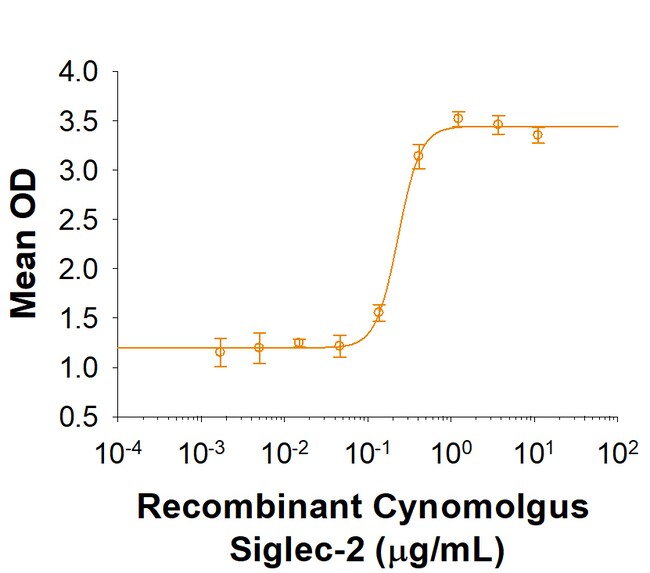
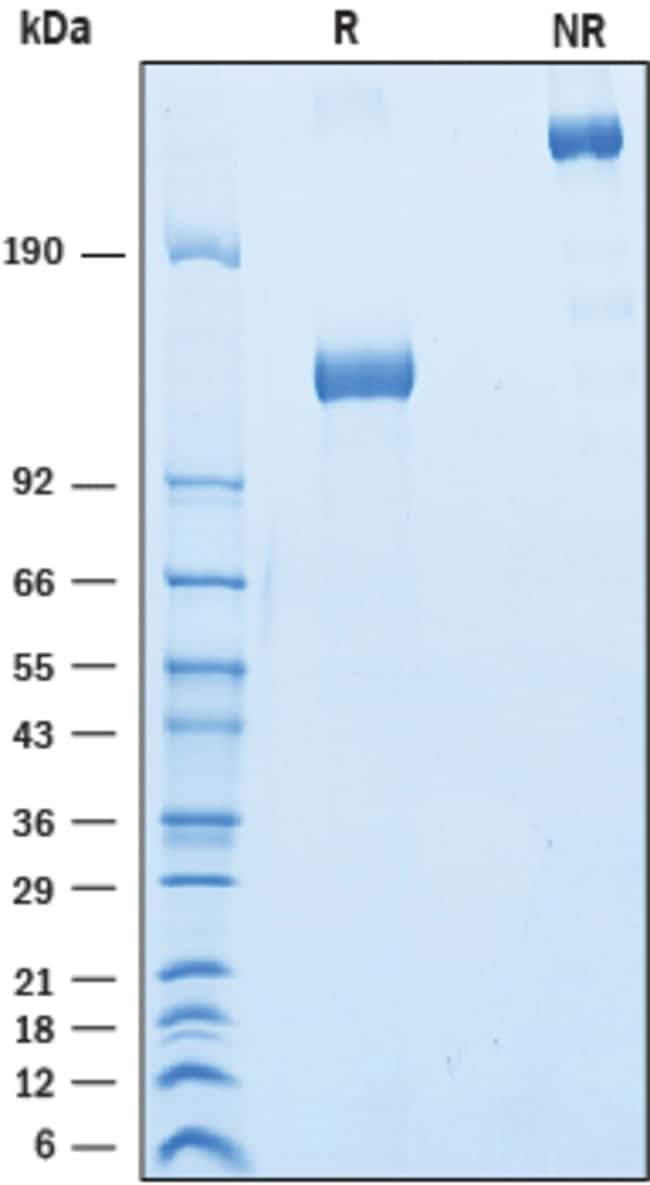
R&D Systems™ Recombinant Cynomolgus Siglec-2/CD22 Fc Chimera Protein
Description
- Siglecs are sialic acid specific I-type lectins that are characterized by an extracellular domain (ECD) with an N-terminal Ig-like V-type domain followed by varying numbers of Ig-like C2-type domains.
- Siglec-2, also known as B cell antigen CD22 or B-lymphocyte cell adhesion molecule (BL-CAM), is a B cell restricted glycoprotein that is expressed in the cytoplasm of progenitor B and pre-B cells and on the surface of mature B cells.
- In humans, two distinct Siglec-2 cDNAs that arise from differential RNA processing of the same gene have been isolated.
- Within the ECD, cynomolgus Siglec-2 shares 84%, 55%, and 56% aa sequence identity with human, mouse, and rat Siglec-2, respectively.
- Siglec-2 is an adhesion molecule that preferentially binds alpha 2,6- linked sialic acid on the same (cis) or adjacent (trans) cells.
- Consistent with a single ligand-binding region, the first two N-terminal Ig-like domains mediated CD22 adhesion with lymphocytes, neutrophils, monocytes, and erythrocytes.
- Besides its role as an adhesion molecule, Siglec-2 is a co-receptor that physically interacts with B cell receptor (BCR) and is rapidly phosphorylated upon BCR ligation.
- It negatively regulates BCR signals by recruiting tyrosine phosphatase SHP-1 to its ITIMs.
- Phosphorylated Siglec-2 can also interact with other intracellular effector proteins such as Syk, PLC gamma, PI3 kinase and Grb-2, suggesting it may play a role in positive signaling.
Specifications
Specifications
| Accession Number | EHH59463 |
| For Use With (Application) | Bioactivity |
| Gene ID (Entrez) | 933 |
| Molecular Weight (g/mol) | 102 kDa |
| Purification Method | >95%, by SDS-PAGE visualized with Silver Staining and quantitative densitometry by Coomassie™ Blue Staining |
| Quantity | 50 μg |
| Source | Human embryonic kidney cell, HEK293-derived cynomolgus monkey Siglec-2/CD22 protein Cynomolgus Monkey Siglec-2/CD22 (Asp20-Arg687) Accession # EHH59463IEGRMDHuman IgG1 (Pro100-Lys330)N-terminus C-terminus |
| Storage Requirements | Use a manual defrost freezer and avoid repeated freeze-thaw cycles. 12 months from date of receipt, -20 to -70°C as supplied. 1 month, 2 to 8°C under sterile conditions after reconstitution. 3 months, ≤ -20°C under sterile conditions after reconstitution. |
| Endotoxin Concentration | <0.10 EU per 1 μg of the protein by the LAL method |
| Conjugate | Unconjugated |
| Show More |
Product Title
By clicking Submit, you acknowledge that you may be contacted by Fisher Scientific in regards to the feedback you have provided in this form. We will not share your information for any other purposes. All contact information provided shall also be maintained in accordance with our Privacy Policy.
Spot an opportunity for improvement?