Promotional price valid on web orders only. Your contract pricing may differ. Interested in signing up for a dedicated account number?
Learn More

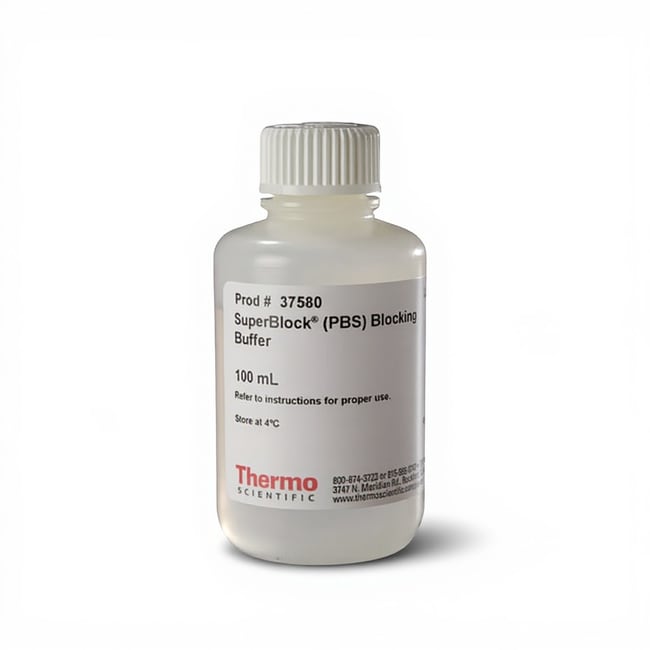
Thermo Scientific™ SuperBlock™ Blocking Buffer

Catalog No. PI37580
Change view
Click to view available options
Quantity:
1 L
100 mL
5 L
5 Pk.
Chemical Name or Material:
SuperBlock (PBS)
SuperBlock (TBS)
SuperBlock (TBS) Dry Blend
SuperBlock T20 (PBS)
SuperBlock T20 (TBS)
8 product options available for selection
Product selection table with 8 available options. Use arrow keys to navigate and Enter or Space to select.
Catalog No. Quantity Chemical Name or Material
PI37580 100 mL SuperBlock (PBS)
PI37515 1 L SuperBlock (PBS)
PI37518 5 L SuperBlock (PBS)
PI37581 100 mL SuperBlock (TBS)
PI37535 1 L SuperBlock (TBS)
PI37545 5 Pk. SuperBlock (TBS) Dry Blend
PI37516 1 L SuperBlock T20 (PBS)
PI37536 1 L SuperBlock T20 (TBS)
Use arrow keys to navigate between rows. Press Enter or Space to select a product option. 8 options available.
8 options
Catalog No. PI37580 Supplier Thermo Scientific™ Supplier No. 37580
Only null left
Add to Cart
Edge
Add to Cart

SuperBlock Blocking Buffer is an optimized solution containing a single purified glycoprotein that provides incredibly fast and effective blocking for ELISA, IHC, and western blot analysis.

SuperBlock Blocking Buffer is an optimized solution containing a single purified glycoprotein that provides incredibly fast and effective blocking for ELISA, IHC, and western blot analysis. Blocking micro-plates, membranes, or tissues with a SuperBlock buffer yields a high signal-to-noise ratio in most detection systems.

Features of SuperBlock Blocking Buffer include:

  • Blocking time—block membranes in 5 to 10 minutes and ELISA plates in 2 minutes
  • Applications—ELISA, western blotting, IHC; biotin-free for use with streptavidin system
  • Stability—store buffer at 4°C for one year; store blocked plates dry for up to 12 months

Blocking micro-plates, membranes, or tissues with SuperBlock buffer yields a high signal-to-noise ratio in most detection systems. The protein-based formulation does not contain any immunoglobulins, albumin, or endogenous biotin, making it compatible in many situations where traditional blocking agents fail. The buffer is especially effective at blocking coated polystyrene microplates (96-well plates) and stabilizing them for drying and storage for later use.

TRUSTED_SUSTAINABILITY

Specifications

Chemical Name or Material SuperBlock (PBS)
Concentration 1X
For Use With (Application) ELISA
Physical Form Liquid
Product Line SuperBlock
Quantity 100 mL
What should I do about the colloidal carbon (black precipitate) in SuperBlock Blocking Buffer solution?

Allow any colloidal carbon, if present, to settle to the bottom of the bottle and pouring off what you need to use. We do not recommend centrifugation or filtering because these procedures may reduce the product's blocking capabilities.

What preservative is used in SuperBlock Blocking Buffer, and what is its source?

Kathon Preservative, a broad spectrum antimicrobial agent, is used at a concentration of 600 ppm.

What is SuperBlock Blocking Buffer's shelf life?

Its shelf life is one year at 4°C.

What incubation time and temperature should I use for effective blocking using the SuperBlock Blocking Buffer ?

Typical procedures use 1 hour at room temperature or overnight at 4°C. However, sufficient blocking in many procedures is possible in 3 x 2 minutes at room temperature.

Is SuperBlock Blocking Buffer RNase-free?

No, SuperBlock Blocking Buffer is not RNase-free.

Does SuperBlock Blocking Buffer work with nylon and nitrocellulose membrane?

Yes, SuperBlock Blocking Buffer works with nylon and nitrocellulose membrane.

Does SuperBlock Blocking Buffer need to be diluted?

No. It is supplied at 1X concentration and should be used “as is.“

Does SuperBlock Blocking Buffer contain albumin, biotin, DNA, detergent or phosphoproteins?

No. Unless it includes “T20“ in the name, for example, SuperBlock T20 (PBS) Blocking Buffer, which contains 0.05% Tween 20.

Can plates be blocked with SuperBlock Blocking Buffer and then stored dry?

After the plates are blocked, remove the blocking buffer and air dry the plates for several hours. Store plates with desiccant in a plastic bag at 4°C. Change desiccant after 24 hours for optimal storage. The plates should be stable for at least 12 months.

How can I reduce background bands in my Western blot?

Optimize the concentration of primary and secondary antibodies. In some cases, increasing the concentration of blocking agent (BSA or non-fat dry milk) or usiing an alternative blocking solution such as Starting Block or SuperBlock may reduce background signal. After incubation with the primary antibody, wash at least 2 times with TBST (include 0.5 M NaCl in one or more of the wash steps). Avoid Nonidet P40 or Triton X-100 in buffers because protein detection is decreased when these detergents are used.

What is the concentration of protein in the SuperBlock (PBS) Blocking Buffer?

This information is proprietary. The protein concentration in the SuperBlock (PBS) Blocking Buffer has been optimized for direct usage without further dilution, however if desired, the blocking buffer may be diluted with phosphate-buffered saline. For best results, our recommendation is to empirically determine the optimal concentration to use.

I used a neuron-specific antibody to label my neurons. How can I reduce non-specific antibody binding?

A blocking step should be performed to reduce fluorescence due to non-specific antibody binding. A common blocking step is the addition of a 2-5% solution of bovine serum albumin (fraction V defatted BSA). Another approach employs the addition of a 5-10% solution of serum from the species in which the secondary antibodies were raised. For example, when using goat anti-mouse IgG secondary antibodies, samples may be effectively blocked with 5-10% normal goat serum. To further reduce background fluorescence, the Image-iT FX Signal Enhancer can be included as a pre-blocking step to decrease non-specific labeling due to charge interactions between the dyes on the conjugates and the cellular constituents.
If you are using a secondary antibody make sure that the species of the antibody is not the same as the species of the sample. For example do not use an anti-mouse secondary antibody on mouse tissue.
Titrate the antibody to the lowest concentration you can use and still get adequate signal.
Try using a fluorescently tagged primary antibody because it should give reduced background but be aware this can reduce signal intensity.

After labeling with my antibody, I am seeing non-specific background binding in my cells or tissue. What could be the cause?

There can be many causes, including insufficient blocking, too high a concentration of the primary or secondary antibody, or degraded primary or secondary antibody. A “no-primary antibody” control can help determine if the secondary antibody is at fault. Otherwise, we recommend trying more stringent blocking or lower concentrations of primary and secondary antibodies.

What concentration of my antibody should I use for cell analysis?

An optimal concentration may be between 1-10 µg/mL for cell and tissue labeling for microscopy, or 0.2-5 µg/mL for flow cytometry. A range of concentrations should be tested to determine what is optimal.

I know I need to block my samples against non-specific protein binding of my antibodies, but which blocker should I use?

For blocking cells or tissues you may use 2-5% bovine serum albumin (fraction V, defatted BSA) or 5-10% normal serum of the species matching the host species of the secondary antibody. Other options include a mixture of BSA and serum or other purified proteins. We offer a ready-made blocking solution, BlockAid Blocking Solution (Cat. No. B10710), which is not species-specific. For cell or tissue samples, avoid the use of non-fat dry milk as a blocking agent as it contains a high level of phosphoproteins, histones, and biotin.


Product Title
Select an issue

By clicking Submit, you acknowledge that you may be contacted by Fisher Scientific in regards to the feedback you have provided in this form. We will not share your information for any other purposes. All contact information provided shall also be maintained in accordance with our Privacy Policy.