Promotional price valid on web orders only. Your contract pricing may differ. Interested in signing up for a dedicated account number?
Learn More

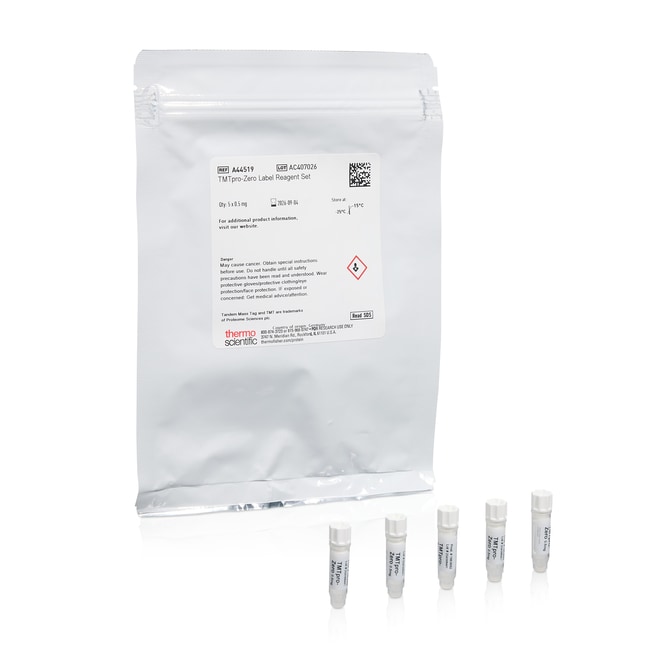
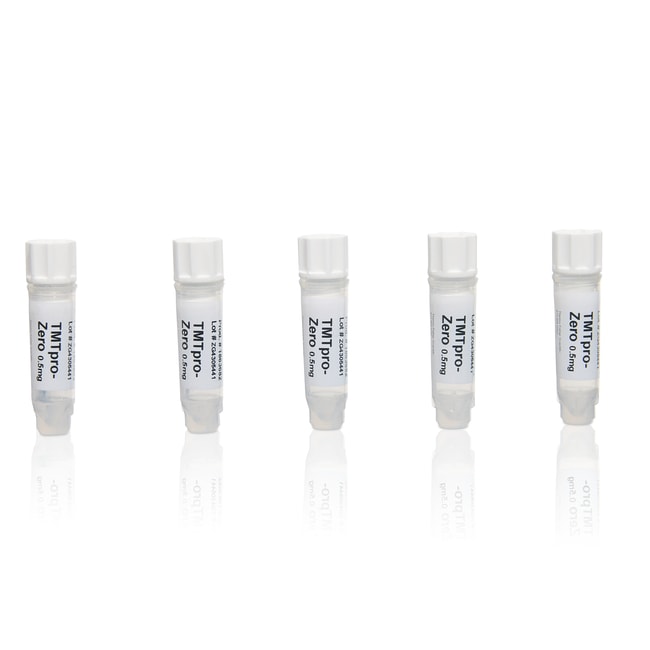
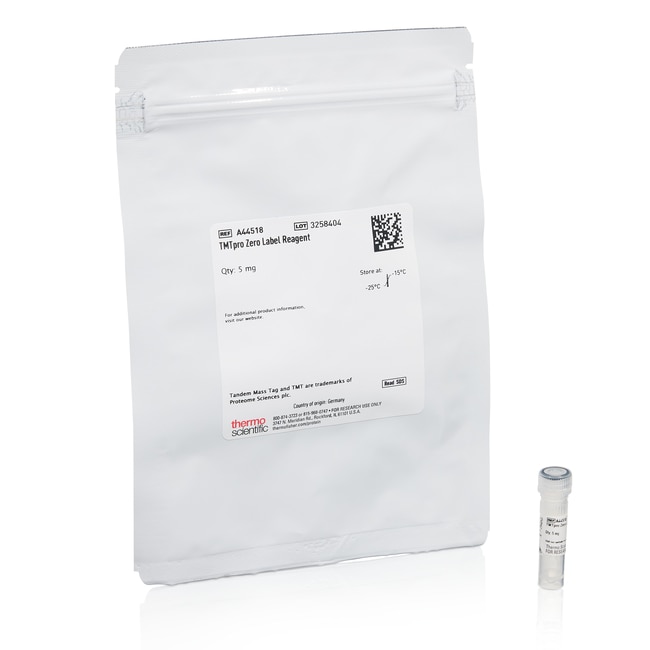
Thermo Scientific™ TMTpro™ Zero Label Reagent

Catalog No. PIA44519
Change view
Click to view available options
Quantity:
1 x 5 mg
5 x 0.5 mg
2 product options available for selection
Product selection table with 2 available options. Use arrow keys to navigate and Enter or Space to select.
Catalog No. Quantity
PIA44519 5 x 0.5 mg
PIA44518 1 x 5 mg
Use arrow keys to navigate between rows. Press Enter or Space to select a product option. 2 options available.
2 options
Catalog No. PIA44519 Supplier Thermo Scientific™ Supplier No. A44519
Only null left
Add to Cart
Edge
Add to Cart

Thermo Scientific TMTpro Zero Label Reagent serves as a 'light' tag for MS-level peptide quantitation for method optimization or use with the TMTpro 16 plex Label Reagent Set.

Thermo Scientific TMTpro Zero Label Reagent serves as a 'light' tag for MS-level peptide quantitation for method optimization or use with the TMTpro 16plex Label Reagent Set.

Features of TMTpro Zero Label Reagent include:
Economical—“light” version may be used for optimization and method development of TMTpro-labeled samples
Efficient—amine-reactive, NHS ester-activated reagents ensure efficient labeling of all peptides regardless of protein sequence or proteolytic enzyme specificity
Compatible—optimized for use with high resolution Thermo Scientific MS/MS platforms, such as the Q Exactive and Orbitrap Fusion Tribrid instrument series, including the Orbitrap Eclipse Tribrid and Orbitrap Exploris 480 mass spectrometers with data analysis fully supported by Proteome Discoverer 2.3

TMTpro label reagents are the next generation of tandem mass tags, designed to increase the level of sample multiplexing without compromising on protein identification and quantitation. The TMTpro tag structure is similar to the TMT tag structure in that the tags remain isobaric and amine reactive, but differs in the longer spacer region and isobutyl proline mass reporter region. After MS/MS fragmentation, each TMTpro tag generates a unique reporter mass (i.e., TMTpro 126-134Da) in the low-mass region of the high-resolution MS/MS spectrum that is used for relative quantitation of protein expression levels. TMTpro Zero Label Reagent is a “light” version of the TMTpro tag that may be used for method development or in conjunction with the set or subset of “heavy” TMTpro reagents.

For high resolution analysis of TMTpro-labeled peptides, the recommended LC column for the Nanospray Flex source is the Acclaim PepMap 100 C18 LC Column (Cat. No. 164942 or 164939). For the EASY-Spray source, the recommended LC column is the EASY-Spray C18 LC Column (Cat. No. ES802 or ES803).

These products are subject to a limited use label license.

TRUSTED_SUSTAINABILITY

Specifications

Description TMTpro™ Zero Label Reagent, 5 x 0.5 mg
For Use With (Equipment) Mass Spectrometer
Product Line TMT
Content And Storage Store at –20°C.
Label or Dye Tandem Mass Tag™ (TMT) Labels
Shipping Condition Dry Ice
Starting Material Peptides
Final Product Type Peptide
Detection Method Mass Spectrometry
Workflow Step Protein Labeling
Quantity 5 x 0.5 mg
Show More Show Less
What is the purpose of the TMTpro Zero Label Reagent?

The TMTpro Zero Label Reagent was designed to be used to optimize methods before multiplexed analysis of samples.

Can the TMT and TMTpro reagents be mixed?

No, the TMT and TMTpro reagents cannot be mixed because the reporter ions are in the same region.

Can TMTpro label reagents dissolved in anhydrous acetonitrile be dried down and stored for later use?

Yes, unused TMTpro label reagent that has been dissolved in anhydrous acetonitrile can be aliquoted into tubes, dried under vacuum at 25-30 degrees C, purged with nitrogen, and stored in a sealed bag with desiccant at -20 degrees C.

At which step should I label my mass spec samples with TMT reagents?

TMT labeling can be performed after reduction, alkylation, digestion, or prior to cleanup, if the sample is buffered at appropriate pH (8-8.5) in a suitable buffer without primary amines (e.g., Tris, glycine). TMT labeling can also be performed after peptide clean-up. Labeling of peptides after clean-up enables measuring and normalizing of the peptide samples for equal mixing.

Do I have to apply correction factors for analyzing data for TMT/TMTpro-labeled samples?

Applying correction factors is required for more accurate relative protein quantitation as the isotopic impurity is variable among the tags, ranging from 5-10%.

How do I bridge the data from different sample sets for TMT-based quantitation?

This is most often done with the utilization of a "pool channel" for each multiplex set. This reference channel typically contains an equimolar mixture of all samples which is labeled with one of the TMT tags that is shared among the sets. The pool channel can be used to then normalize relative protein abundance measurements across multiplexed sets.

In the EasyPep sample preparation workflow, it is mentioned that TMT/TMTpro reagent can be added to peptides before or after the clean-up step. Are there any differences between these two methods, regarding the labeling efficiency or relative quantitation?

The EasyPep kit chemistry is fully compatible with TMT/TMTpro reagents. Most commonly, TMT/TMTpro reagents are used to label peptides immediately after digestion and before peptide cleanup. This enables combining samples for a single cleanup step which reduces variability for more reproducible quantitative measurements. Another option is to label samples after peptide cleanup. This approach provides efficient labeling of the samples but may require the use of a peptide quantification assay to ensure that samples are equally mixed before LC-MS analysis. Both the workflows should provide high labelling efficiencies using our recommended TMT/TMTpro reagent to sample ratios.

What type of mass spectrometer can I use for Tandem Mass Tag (TMT) analysis?

We recommend using high-resolution Orbitrap Tribrid (e.g., Fusion, Lumos, Eclipse), Orbitrap Exploris (e.g., 240, 480), or Q Exactive (e.g,. Plus, HF, HFX) series of instruments.

What is the main purpose of Tandem Mass Tag (TMT) reagents?

Tandem Mass Tag technology is used to individually label different protein samples so they can be combined into a single sample for LC-MS analysis. The major advantages of this workflow are higher sample throughput, less instrument analysis time, high precision of peptide quantitation among replicates, and fewer missing quantified proteins among different samples.

Which downstream applications are compatible with the EasyPep Mini MS Sample Prep Kit?

The EasyPep Mini MS Sample Prep kit is compatible with TMT labeling, peptide fractionation, and phosphopeptide enrichment.

Is TMT quantitation relative or absolute?

TMT quantitation is relative between samples unless a heavy peptide standard is included for comparison.

What is the main purpose of TMT (Tandem Mass Tag) reagents?

TMT technology is used to perform multiplex quantitation of proteins extracted from cells and tissues. Rather than quantify single proteins (for example with an antibody), here, large numbers of proteins can be quantified in a single run.

What is the Pierce TMT11plex Yeast Digest Standard and what is its main purpose?

The Pierce TMT11plex Yeast Digest Standard is a lyophilized yeast peptide mixture of four congenic strains labeled with TMT11plex reagents. It serves as a standard for quality assessment of LC and MS data for samples labeled with Tandem Mass Tag (TMT) reagents.

When should I use quadrupole versus ion trap isolation?

Quadrupole isolation is faster because ions must travel through the quadrupole analyzer regardless of the analysis type chosen. As a result, there is little to no time penalty when using the quadrupole for MS2 isolation. In such a case, quadrupole transmission efficiency will depend on isolation width, m/z, and the cleanliness of the analyzer. Ion trap isolation is best suited for MS3 experiments, including those performed using multinotch isolation for TMT analysis; these types of isolation events are not possible with the quadrupole analyzer.

How effective is the salt removal using Pierce Peptide Desalting Spin Columns?

With Pierce Peptide Desalting Spin Columns, more than 90% of salt or labeling tags such as TMT tags can be removed.

What is the reproducibility of Pierce Peptide Desalting Spin Columns from sample to sample?

With Pierce Peptide Desalting Spin Columns, the reproducibility coefficient of variation (CV) is ± 20%.


WARNING: Cancer - www.P65Warnings.ca.gov

For Research Use Only. Not for use in diagnostic procedures.

Product Title
Select an issue

By clicking Submit, you acknowledge that you may be contacted by Fisher Scientific in regards to the feedback you have provided in this form. We will not share your information for any other purposes. All contact information provided shall also be maintained in accordance with our Privacy Policy.