Learn More
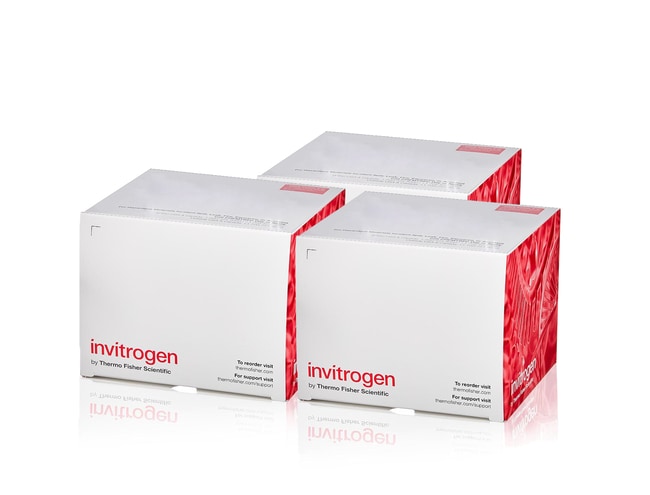


Invitrogen™ Novex™ Tris-Glycine Mini Protein Gel Kits, 4–20%, 1.0 mm, WedgeWell™ format

Description
Invitrogen Novex Tris-Glycine Mini Gels, WedgeWell format, are polyacrylamide gels that provide reproducible separation of a wide range of proteins into well-resolved bands with two times the loading capacity. Novex Tris-Glycine Mini Gels are based on traditional Laemmli protein electrophoresis that allow the use of Laemmli sample and running buffers.
Features of Novex Tris-Glycine gels, WedgeWell format, include:
- Improved shelf life—store gels for up to 7 months at 4°C
- Diversity—use for native and denaturing protein assays
- Wedge-shaped wells—easily load up to two times more sample volume
- Fast run conditions—quickly separate your proteins using constant voltage in less than 60 minutes
Choose the right gel format for your experiments
Novex Tris-Glycine gels, WedgeWell format, come in a variety of fixed concentrations from 6% to 18%, as well as gradients with ranges of 4–12%, 4–20%, 8–16%, and 10–20%. You can select from our many well formats, including 10-, 12-, and 15-well, and different pack sizes.
Run your proteins in native or denatured form
Novex Tris-Glycine gels, WedgeWell format, do not contain SDS and can be used to run your proteins in native or in denatured form. For denatured proteins, we recommend using Novex Tris-Glycine SDS Sample Buffer (LC2676) and Novex Tris-Glycine SDS Running Buffer (LC26755). For native proteins, we recommend using Novex Tris-Glycine Native Sample Buffer (LC2673) and Novex Tris-Glycine Native Running Buffer (LC2672).
Convenient to use
Novex Tris-Glycine gels, WedgeWell format, have innovative wedge-shaped wells that allow up to two times more sample load volume than other 1.0 mm-thick gels. The wedge-shaped wells also have larger openings, making sample loading easier.
For transferring your proteins to a membrane, we recommend using Novex Tris-Glycine Transfer Buffer (LC3675) when preforming traditional wet transfer using the Invitrogen Mini Blot Module (B1000). Transfers can also be performed with rapid semi-dry transfer using the Invitrogen Power Blotter or rapid dry transfer using the iBlot 2 Gel Transfer Device (IB21001).

Specifications
Specifications
| Color | Clear |
| Gel Percentage | 4 to 20% |
| Gel Size | Mini |
| Gel Thickness | 1.0 mm |
| Gel Type | Tris-Glycine Plus |
| Sample Loading Volume | Up to 60 μL |
| Separation of | Protein |
| Separation Range | 20 to 200 kDa |
| Separation Type | Denaturing |
| Wells | 10-well |
| Show More |
Frequently Asked Questions (FAQs)
We do not recommend using gels past their expiration date because over time, the polyacrylamide hydrolyzes to acrylic acid and ammonia and this will affect the resolution of the proteins. Breakdown of polyacrylamide matrix is identified by:
- Ghost bands and doublets, seen first in the high molecular weight proteins
- Smiling of dye front across the gel, with bands in outer lanes becoming very slanted - proteins run slower there due to change in pH and pore size over time.
This is not really recommended, but it is always possible to increase run time by lowering the voltage of the run. In general, the relationships are linear - i.e., decreasing voltage by half will double the run time.
If you are running the gel at constant voltage, you do not need to increase the voltage regardless of the thickness of the gel.
Using constant voltage allows the current and power to decrease during the run, providing a safety margin in case of a break in the system. Having lower power is a safety benefit and will also decrease the chances of experiencing an overheating of the gel. Further, the constant voltage setting does not need adjustment to account for differences in number or thickness of gels being run.
By clicking Submit, you acknowledge that you may be contacted by Fisher Scientific in regards to the feedback you have provided in this form. We will not share your information for any other purposes. All contact information provided shall also be maintained in accordance with our Privacy Policy.