
Protein Molecular Weight Markers

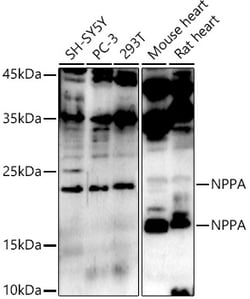
ABclonal Technology NPPA Rabbit pAb

The protein encoded by this gene belongs to the natriuretic peptide family. Natriuretic peptides are implicated in the control of extracellular fluid volume and electrolyte homeostasis. This protein is synthesized as a large precursor (containing a signal peptide), which is processed to release a peptide from the N-terminus with similarity to vasoactive peptide, cardiodilatin, and another peptide from the C-terminus with natriuretic-diuretic activity. Mutations in this gene have been associated with atrial fibrillation familial type 6. This gene is located adjacent to another member of the natriuretic family of peptides on chromosome 1.

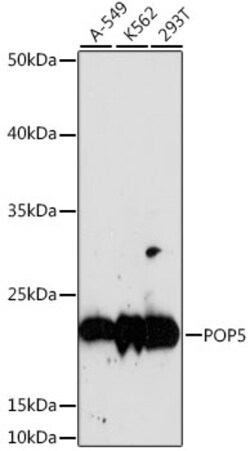
ABclonal Technology POP5 Rabbit pAb
Enables ribonuclease P RNA binding activity. Contributes to ribonuclease P activity. Involved in tRNA 5-leader removal. Located in nucleolus. Part of multimeric ribonuclease P complex and ribonuclease MRP complex.
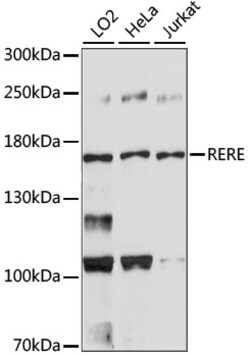
ABclonal Technology RERE Rabbit pAb
This gene encodes a member of the atrophin family of arginine-glutamic acid (RE) dipeptide repeat-containing proteins. The encoded protein co-localizes with a transcription factor in the nucleus, and its overexpression triggers apoptosis. A similar protein in mouse associates with histone deacetylase and is thought to function as a transcriptional co-repressor during embryonic development. Multiple transcript variants encoding different isoforms have been found for this gene.
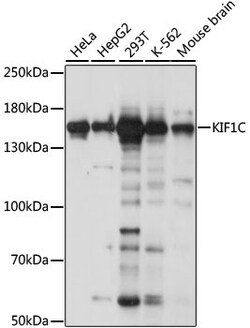
ABclonal Technology KIF1C Rabbit pAb
The protein encoded by this gene is a member of the kinesin-like protein family. The family members are microtubule-dependent molecular motors that transport organelles within cells and move chromosomes during cell division. Mutations in this gene are a cause of spastic ataxia 2, autosomal recessive.
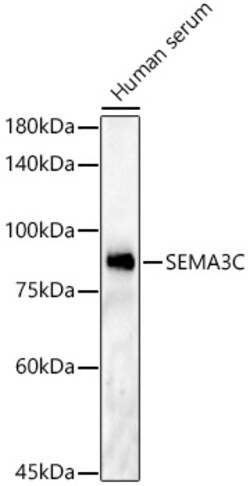
ABclonal Technology SEMA3C Rabbit pAb
This gene encodes a secreted glycoprotein that belongs to the semaphorin class 3 family of neuronal guidance cues. The encoded protein contains an N-terminal sema domain, integrin and immunoglobulin-like domains, and a C-terminal basic domain. Homodimerization and proteolytic cleavage of the C-terminal propeptide are necessary for the function of the encoded protein. It binds a neuropilin co-receptor before forming a heterotrimeric complex with an associated plexin. An increase in the expression of this gene correlates with an increase in cancer cell invasion and adhesion. Naturally occurring mutations in this gene are associated with Hirschsprung disease.
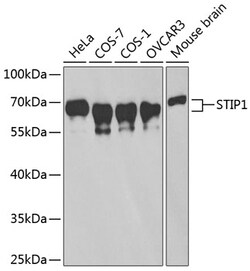
ABclonal Technology STIP1 Rabbit pAb
STIP1 is an adaptor protein that coordinates the functions of HSP70 (see HSPA1A, MIM 140550) and HSP90 (see HSP90AA1, MIM 140571) in protein folding. It is thought to assist in the transfer of proteins from HSP70 to HSP90 by binding both HSP90 and substrate-bound HSP70. STIP1 also stimulates the ATPase activity of HSP70 and inhibits the ATPase activity of HSP90, suggesting that it regulates both the conformations and ATPase cycles of these chaperones (Song and Masison, 2005 [PubMed 16100115]).
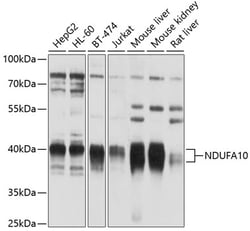
ABclonal Technology NDUFA10 Rabbit pAb
The protein encoded by this gene is a component of 42 kDa complex I, the first enzyme complex in the electron transport chain of mitochondria. This protein has NADH dehydrogenase activity and oxidoreductase activity. It transfers electrons from NADH to the respiratory chain. A mutation in this gene was found in an individual with Leigh syndrome.
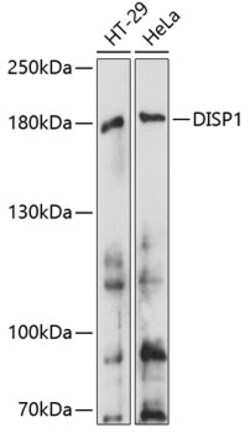
ABclonal Technology DISP1 Rabbit pAb
The pattern of cellular proliferation and differentiation that leads to normal development of embryonic structures often depends upon the localized production of secreted protein signals. Cells surrounding the source of a particular signal respond in a graded manner according to the effective concentration of the signal, and this response produces the pattern of cell types constituting the mature structure. A novel segment-polarity gene known as dispatched has been identified in Drosophila and its protein product is required for normal Hedgehog (Hh) signaling. This gene is one of two human homologs of Drosophila dispatched and, based on sequence identity to its mouse counterpart, the encoded protein may play an essential role in Hh patterning activities in the early embryo.
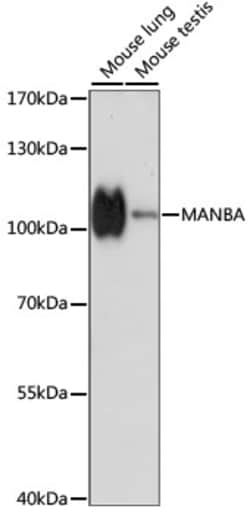
ABclonal Technology MANBA Rabbit pAb
This gene encodes a member of the glycosyl hydrolase 2 family. The encoded protein localizes to the lysosome where it is the final exoglycosidase in the pathway for N-linked glycoprotein oligosaccharide catabolism. Mutations in this gene are associated with beta-mannosidosis, a lysosomal storage disease that has a wide spectrum of neurological involvement.
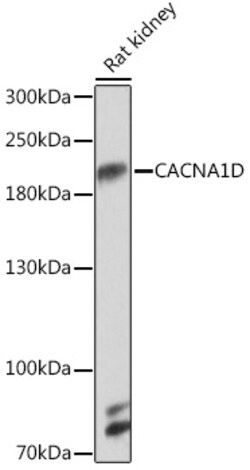
ABclonal Technology CACNA1D Rabbit pAb
Voltage-dependent calcium channels mediate the entry of calcium ions into excitable cells, and are also involved in a variety of calcium-dependent processes, including muscle contraction, hormone or neurotransmitter release, and gene expression. Calcium channels are multisubunit complexes composed of alpha-1, beta, alpha-2/delta, and gamma subunits. The channel activity is directed by the pore-forming alpha-1 subunit, whereas the others act as auxiliary subunits regulating this activity. The distinctive properties of the calcium channel types are related primarily to the expression of a variety of alpha-1 isoforms, namely alpha-1A, B, C, D, E, and S. This gene encodes the alpha-1D subunit. Several transcript variants encoding different isoforms have been found for this gene.
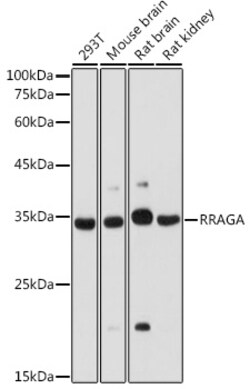
ABclonal Technology RRAGA Rabbit pAb
Enables several functions, including GTP binding activity, protein dimerization activity, and ubiquitin protein ligase binding activity. Involved in several processes, including cellular response to amino acid starvation, negative regulation of autophagy, and positive regulation of TORC1 signaling. Located in lysosome and nucleus. Colocalizes with GATOR1 complex.
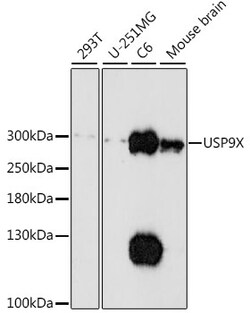
ABclonal Technology USP9X Rabbit pAb
This gene is a member of the peptidase C19 family and encodes a protein that is similar to ubiquitin-specific proteases. Though this gene is located on the X chromosome, it escapes X-inactivation. Mutations in this gene have been associated with Turner syndrome. Alternate transcriptional splice variants, encoding different isoforms, have been characterized.
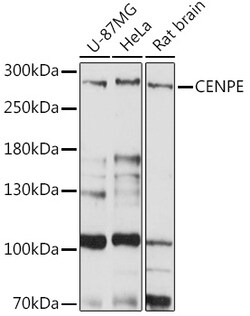
ABclonal Technology CENPE Rabbit pAb
Centrosome-associated protein E (CENPE) is a kinesin-like motor protein that accumulates in the G2 phase of the cell cycle. Unlike other centrosome-associated proteins, it is not present during interphase and first appears at the centromere region of chromosomes during prometaphase. This protein is required for stable spindle microtubule capture at kinetochores which is a necessary step in chromosome alignment during prometaphase. This protein also couples chromosome position to microtubule depolymerizing activity. Alternative splicing results in multiple transcript variants encoding distinct protein isoforms.
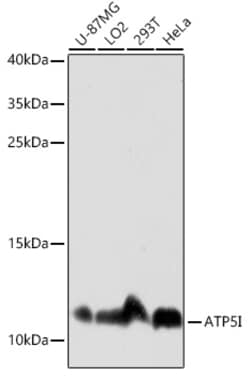
ABclonal Technology ATP5I Rabbit pAb
Mitochondrial ATP synthase catalyzes ATP synthesis, utilizing an electrochemical gradient of protons across the inner membrane during oxidative phosphorylation. It is composed of two linked multi-subunit complexes the soluble catalytic core, F1, and the membrane-spanning component, Fo, which comprises the proton channel. The F1 complex consists of 5 different subunits (alpha, beta, gamma, delta, and epsilon) assembled in a ratio of 3 alpha, 3 beta, and a single representative of the other 3. The Fo seems to have nine subunits (a, b, c, d, e, f, g, F6 and 8). This gene encodes the e subunit of the Fo complex. Alternative splicing results in multiple transcript variants.
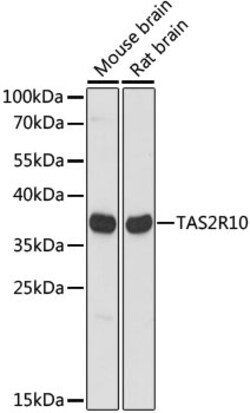
ABclonal Technology TAS2R10 Rabbit pAb
This gene product belongs to the family of candidate taste receptors that are members of the G-protein-coupled receptor superfamily. These proteins are specifically expressed in the taste receptor cells of the tongue and palate epithelia. They are organized in the genome in clusters and are genetically linked to loci that influence bitter perception in mice and humans. In functional expression studies, they respond to bitter tastants. This gene maps to the taste receptor gene cluster on chromosome 12p13.