
Protein Molecular Weight Markers

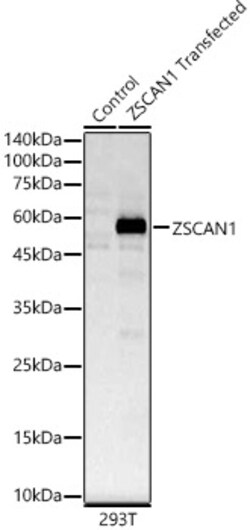
ABclonal Technology ZSCAN1 Rabbit pAb

Enables sequence-specific double-stranded DNA binding activity. Predicted to be involved in regulation of transcription by RNA polymerase II. Predicted to be located in nucleus. Predicted to be part of chromatin.

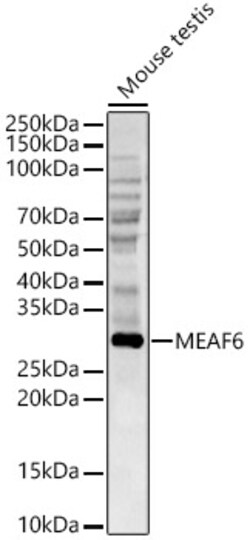
ABclonal Technology MEAF6 Rabbit pAb
This gene encodes a nuclear protein involved in transcriptional activation. The encoded protein may form a component of several different histone acetyltransferase complexes. There is a pseudogene for this gene on chromosome 2. Alternative splicing results in multiple transcript variants.
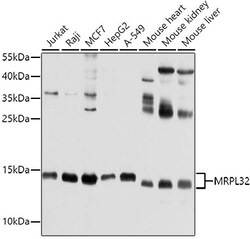
ABclonal Technology MRPL32 Rabbit pAb
Mammalian mitochondrial ribosomal proteins are encoded by nuclear genes and help in protein synthesis within the mitochondrion. Mitochondrial ribosomes (mitoribosomes) consist of a small 28S subunit and a large 39S subunit. They have an estimated 75% protein to rRNA composition compared to prokaryotic ribosomes, where this ratio is reversed. Another difference between mammalian mitoribosomes and prokaryotic ribosomes is that the latter contain a 5S rRNA. Among different species, the proteins comprising the mitoribosome differ greatly in sequence, and sometimes in biochemical properties, which prevents easy recognition by sequence homology. This gene encodes a 39S subunit protein that belongs to the L32 ribosomal protein family. A pseudogene corresponding to this gene is found on chromosome Xp.

New England Biolabs, Inc. Blue Prestained Protein Standard, Broad Range (11-250 kDa) – 150 gel lanes
The Blue Prestained Protein Standard, Broad Range is a mixture of highly pure, recombinant, prestained proteins, covalently coupled with a blue chromophore, that resolves into 11 sharp bands when electrophoresed.

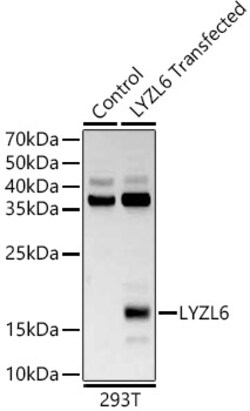
ABclonal Technology LYZL6 Rabbit pAb
This gene encodes a member of the C-type lysozyme/alpha-lactalbumin family. C-type lysozymes are bacteriolytic factors that play a role in host defense, whereas alpha-lactalbumins mediate lactose biosynthesis. The encoded protein contains catalytic residues characteristic of C-type lysozymes and may play a role in male reproduction. Alternatively spliced transcript variants have been observed for this gene.
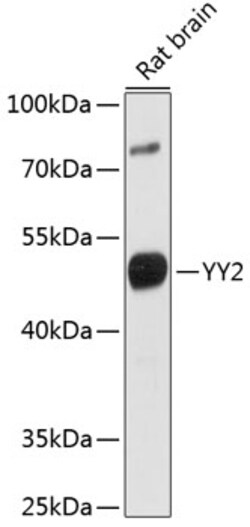
ABclonal Technology YY2 Rabbit pAb
The protein encoded by this gene is a transcription factor that includes several Kruppel-like zinc fingers in its C-terminal region. It possesses both activation and repression domains, and it can therefore have both positive and negative effects on the transcription of target genes. This gene has an intronless coding region, and it appears to have arisen by retrotransposition of the related YY1 transcription factor gene, which is located on chromosome 14.
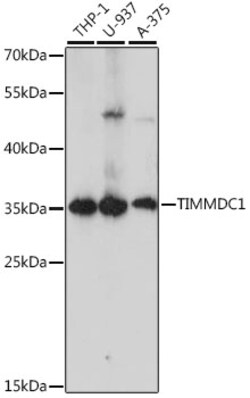
ABclonal Technology TIMMDC1 Rabbit pAb
Located in mitochondrion and nucleoplasm. Implicated in nuclear type mitochondrial complex I deficiency 31.
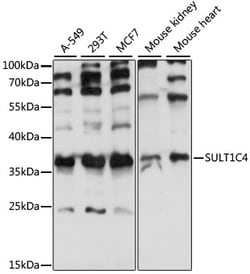
ABclonal Technology SULT1C4 Rabbit pAb
Sulfotransferase enzymes catalyze the sulfate conjugation of many hormones, neurotransmitters, drugs, and xenobiotic compounds. These cytosolic enzymes are different in their tissue distributions and substrate specificities. The gene structure (number and length of exons) is similar among family members. This gene encodes a protein that belongs to the SULT1 subfamily, responsible for transferring a sulfo moiety from PAPS to phenol-containing compounds.
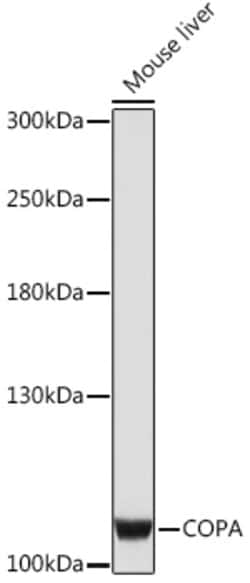
ABclonal Technology COPA Rabbit pAb
In eukaryotic cells, protein transport between the endoplasmic reticulum and Golgi compartments is mediated in part by non-clathrin-coated vesicular coat proteins (COPs). Seven coat proteins have been identified, and they represent subunits of a complex known as coatomer. The subunits are designated alpha-COP, beta-COP, beta-prime-COP, gamma-COP, delta-COP, epsilon-COP, and zeta-COP. The alpha-COP, encoded by COPA, shares high sequence similarity with RET1P, the alpha subunit of the coatomer complex in yeast. Also, the N-terminal 25 amino acids of alpha-COP encode the bioactive peptide, xenin, which stimulates exocrine pancreatic secretion and may act as a gastrointestinal hormone. Alternative splicing results in multiple splice forms encoding distinct isoforms.
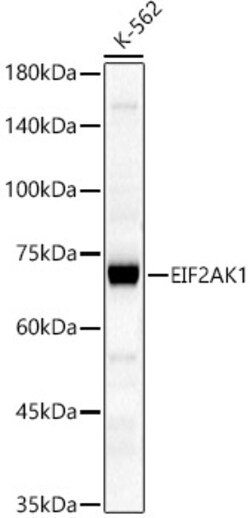
ABclonal Technology EIF2AK1 Rabbit pAb
The protein encoded by this gene acts at the level of translation initiation to downregulate protein synthesis in response to stress. The encoded protein is a kinase that can be inactivated by hemin. Two transcript variants encoding different isoforms have been found for this gene.
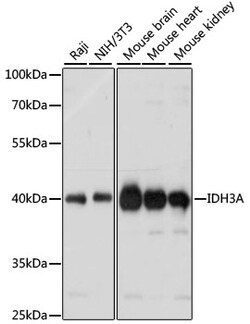
ABclonal Technology IDH3A Rabbit pAb
Isocitrate dehydrogenases catalyze the oxidative decarboxylation of isocitrate to 2-oxoglutarate. These enzymes belong to two distinct subclasses, one of which utilizes NAD(+) as the electron acceptor and the other NADP(+). Five isocitrate dehydrogenases have been reported three NAD(+)-dependent isocitrate dehydrogenases, which localize to the mitochondrial matrix, and two NADP(+)-dependent isocitrate dehydrogenases, one of which is mitochondrial and the other predominantly cytosolic. NAD(+)-dependent isocitrate dehydrogenases catalyze the allosterically regulated rate-limiting step of the tricarboxylic acid cycle. Each isozyme is a heterotetramer that is composed of two alpha subunits, one beta subunit, and one gamma subunit. The protein encoded by this gene is the alpha subunit of one isozyme of NAD(+)-dependent isocitrate dehydrogenase.
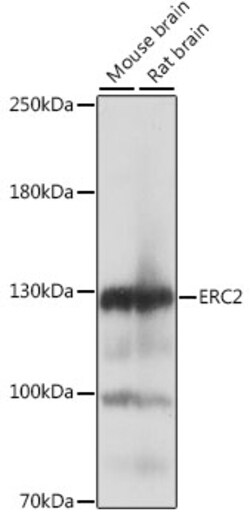
ABclonal Technology ERC2 Rabbit pAb
This gene encodes a protein that belongs to the Rab3-interacting molecule (RIM)-binding protein family. Members of this protein family form part of the cytomatrix at the active zone (CAZ) complex and function as regulators of neurotransmitter release. Alternative splicing results in multiple transcript variants.
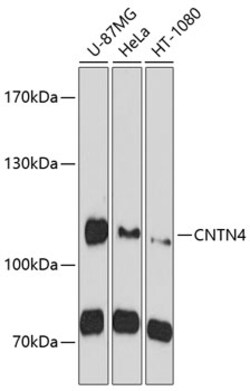
ABclonal Technology CNTN4 Rabbit pAb
This gene encodes a member of the contactin family of immunoglobulins. Contactins are axon-associated cell adhesion molecules that function in neuronal network formation and plasticity. The encoded protein is a glycosylphosphatidylinositol-anchored neuronal membrane protein that may play a role in the formation of axon connections in the developing nervous system. Deletion or mutation of this gene may play a role in 3p deletion syndrome and autism spectrum disorders. Alternative splicing results in multiple transcript variants.
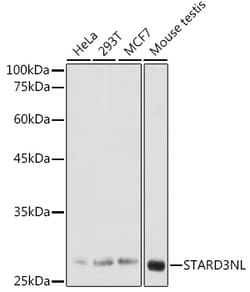
ABclonal Technology STARD3NL Rabbit pAb
This gene encodes a late-endosomal protein that contains a conserved MENTAL (MLN64 N-terminal) domain. The encoded protein binds cholesterol molecules and may play a role in endosomal cholesterol transport through interactions with metastatic lymph node protein 64 (MLN64).

ABclonal Technology BEST1 Rabbit pAb
This gene encodes a member of the bestrophin gene family. This small gene family is characterized by proteins with a highly conserved N-terminus with four to six transmembrane domains. Bestrophins may form chloride ion channels or may regulate voltage-gated L-type calcium-ion channels. Bestrophins are generally believed to form calcium-activated chloride-ion channels in epithelial cells but they have also been shown to be highly permeable to bicarbonate ion transport in retinal tissue. Mutations in this gene are responsible for juvenile-onset vitelliform macular dystrophy (VMD2), also known as Best macular dystrophy, in addition to adult-onset vitelliform macular dystrophy (AVMD) and other retinopathies. Alternative splicing results in multiple variants encoding distinct isoforms.