
Protein Molecular Weight Markers

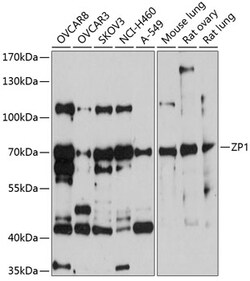
ABclonal Technology ZP1 Rabbit pAb

The zona pellucida is an extracellular matrix that surrounds the oocyte and early embryo. It is composed primarily of three or four glycoproteins with various functions during fertilization and preimplantation development. The protein encoded by this gene ensures the structural integrity of the zona pellucida. Mutations in this gene are a cause of oocyte maturation defect and infertility.

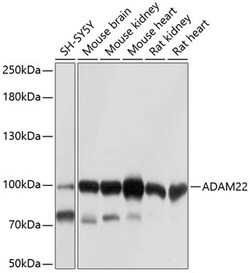
ABclonal Technology ADAM22 Rabbit pAb
This gene encodes a member of the ADAM (a disintegrin and metalloprotease domain) family. Members of this family are membrane-anchored proteins structurally related to snake venom disintegrins, and have been implicated in a variety of biological processes involving cell-cell and cell-matrix interactions, including fertilization, muscle development, and neurogenesis. Unlike other members of the ADAM protein family, the protein encoded by this gene lacks metalloprotease activity since it has no zinc-binding motif. This gene is highly expressed in the brain and may function as an integrin ligand in the brain. In mice, it has been shown to be essential for correct myelination in the peripheral nervous system. Alternative splicing results in several transcript variants.
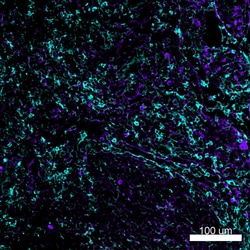
Biolegend Purified anti-mouse Podoplanin
Purified anti-mouse Podoplanin [8.1.1]; Isotype: Syrian Hamster IgG; Reactivity: Mouse; Apps: FC, IHC-F, SB; Size: 500 μg
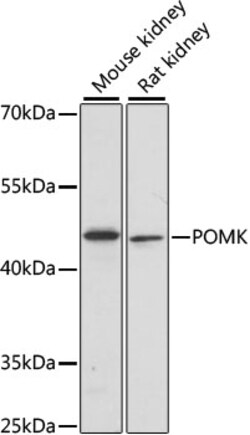
ABclonal Technology POMK Rabbit pAb
This gene encodes a protein that may be involved in the presentation of the laminin-binding O-linked carbohydrate chain of alpha-dystroglycan (a-DG), which forms transmembrane linkages between the extracellular matrix and the exoskeleton. Some pathogens use this O-linked carbohydrate unit for host entry. Loss of function compound heterozygous mutations in this gene were found in a human patient affected by the Walker-Warburg syndrome (WWS) phenotype. Mice lacking this gene contain misplaced neurons (heterotopia) in some regions of the brain, possibly from defects in neuronal migration. Alternative splicing of this gene results in multiple transcript variants.
![ABclonal Technology [KO Validated] GIT1 Rabbit pAb](https://assets.fishersci.com/TFS-Assets/CCG/product-images/5000106086.jpg-250.jpg)
ABclonal Technology [KO Validated] GIT1 Rabbit pAb
Enables gamma-tubulin binding activity. Involved in positive regulation of microtubule nucleation and regulation of cytokinesis. Located in several cellular components, including focal adhesion, microtubule cytoskeleton, and mitochondrion. Implicated in attention deficit hyperactivity disorder. Biomarker of Huntingtons disease.
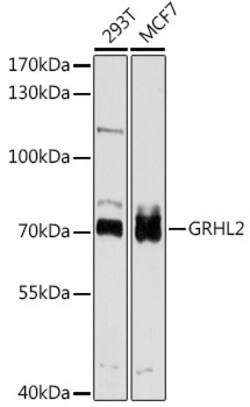
ABclonal Technology GRHL2 Rabbit pAb
The protein encoded by this gene is a transcription factor that can act as a homodimer or as a heterodimer with either GRHL1 or GRHL3. Defects in this gene are a cause of non-syndromic sensorineural deafness autosomal dominant type 28 (DFNA28).
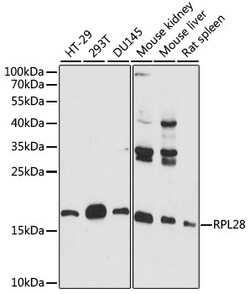
ABclonal Technology RPL28 Rabbit pAb
Ribosomes, the organelles that catalyze protein synthesis, consist of a small 40S subunit and a large 60S subunit. Together these subunits are composed of 4 RNA species and approximately 80 structurally distinct proteins. This gene encodes a ribosomal protein that is a component of the 60S subunit. The protein belongs to the L28E family of ribosomal proteins. It is located in the cytoplasm. Variable expression of this gene in colorectal cancers compared to adjacent normal tissues has been observed, although no correlation between the level of expression and the severity of the disease has been found. As is typical for genes encoding ribosomal proteins, there are multiple processed pseudogenes of this gene dispersed through the genome. Alternative splicing results in multiple transcript variants encoding distinct isoforms.
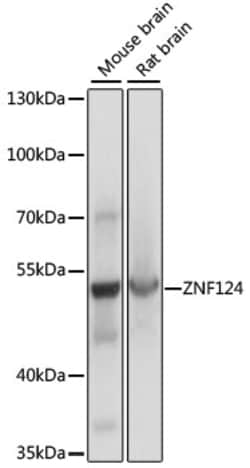
ABclonal Technology ZNF124 Rabbit pAb
This gene encodes a protein with an amino-terminal KRAB-A box and multiple repeated Kruppel-type (C2H2) zinc finger motifs at its carboxy terminus. The encoded protein may function as a transcription factor. Expression of this gene is increased after vascular endothelial growth factor (VEGF) stimulation in human leukemia cell lines and results in inhibition of apoptotic cell death induced by irradiation or exposure to etoposide. Alternative splicing results in multiple transcript variants encoding distinct proteins.
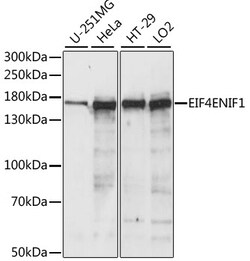
ABclonal Technology EIF4ENIF1 Rabbit pAb
The protein encoded by this gene is a nucleocytoplasmic shuttle protein for the translation initiation factor eIF4E. This shuttle protein interacts with the importin alpha-beta complex to mediate nuclear import of eIF4E. It is predominantly cytoplasmic, its own nuclear import is regulated by a nuclear localization signal and nuclear export signals. Multiple transcript variants encoding different isoforms have been found for this gene.
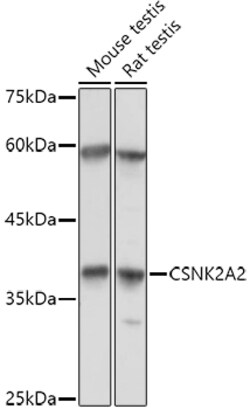
ABclonal Technology CSNK2A2 Rabbit pAb
This gene encodes the alpha, or alpha 2, catalytic subunit of the protein kinase enzyme, casein kinase 2 (CK2). Casein kinase 2 is a serine/threonine protein kinase that phosphorylates acidic proteins such as casein. It is involved in various cellular processes, including cell cycle control, apoptosis, and circadian rhythms. This heterotetrameric kinase includes two catalytic subunits, either alpha or alpha, and two regulatory beta subunits. The closely related gene paralog encoding the alpha, or alpha 1 subunit (CSNK2A1, Gene ID 1457) is found on chromosome 20. An intronic variant in this gene (alpha 2) may be associated with leukocyte telomere length in a South Asian population. A related transcribed pseudogene is found on chromosome 11.
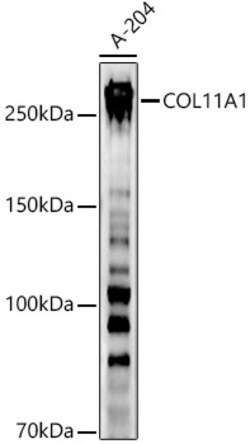
ABclonal Technology COL11A1 Rabbit pAb
This gene encodes one of the two alpha chains of type XI collagen, a minor fibrillar collagen. Type XI collagen is a heterotrimer but the third alpha chain is a post-translationally modified alpha 1 type II chain. Mutations in this gene are associated with type II Stickler syndrome and with Marshall syndrome. A single-nucleotide polymorphism in this gene is also associated with susceptibility to lumbar disc herniation. Multiple transcript variants have been identified for this gene.

Biotium CF640R-Dextran 10, 000 MW, Anionic and Fixable
CF dye labeled dextrans could be used as a fluorescent fluid-phase markers to study cell permeability, endocytosis, or mechanisms of biomolecular delivery. The dextran conjugates are available in a variety of molecular weights, and contain a formaldehyde-fixable free-amine group. CF dyes are Biotium's line of next-generation fluorescent dyes with advantages in brightness, photostability, and conjugate specificity compared to other fluorescent dyes. Far-red fluorescent CF640R dye has excitation/emission at 642/662 nm.
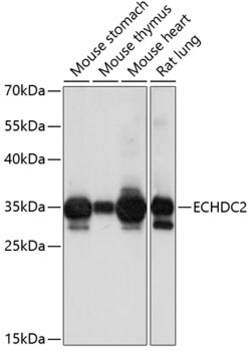
ABclonal Technology ECHDC2 Rabbit pAb
Predicted to enable enoyl-CoA hydratase activity. Predicted to be involved in fatty acid beta-oxidation. Predicted to be active in mitochondrion.
![ABclonal Technology [KO Validated] IMPDH2 Rabbit mAb](https://assets.fishersci.com/TFS-Assets/CCG/product-images/5000135453.jpg-250.jpg)
ABclonal Technology [KO Validated] IMPDH2 Rabbit mAb
This gene encodes the rate-limiting enzyme in the de novo guanine nucleotide biosynthesis. It is thus involved in maintaining cellular guanine deoxy- and ribonucleotide pools needed for DNA and RNA synthesis. The encoded protein catalyzes the NAD-dependent oxidation of inosine-5-monophosphate into xanthine-5-monophosphate, which is then converted into guanosine-5-monophosphate. This gene is up-regulated in some neoplasms, suggesting it may play a role in malignant transformation.
![ABclonal Technology [KO Validated] GRK2 Rabbit pAb](https://assets.fishersci.com/TFS-Assets/CCG/product-images/5000111165.jpg-250.jpg)
ABclonal Technology [KO Validated] GRK2 Rabbit pAb
This gene encodes a member of the G protein-coupled receptor kinase family of proteins. The encoded protein phosphorylates the beta-adrenergic receptor as well as a wide range of other substrates including non-GPCR cell surface receptors, and cytoskeletal, mitochondrial, and transcription factor proteins. Data from rodent models supports a role for this gene in embryonic development, heart function and metabolism. Elevated expression of this gene has been observed in human patients with heart failure and Alzheimers disease.