
Protein Molecular Weight Markers

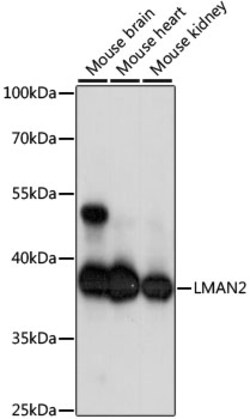
ABclonal Technology LMAN2 Rabbit pAb

This gene encodes a type I transmembrane lectin that shuttles between the endoplasmic reticulum, the Golgi apparatus and the plasma membrane. The encoded protein binds high mannose type glycoproteins and may facilitate their sorting, trafficking and quality control.

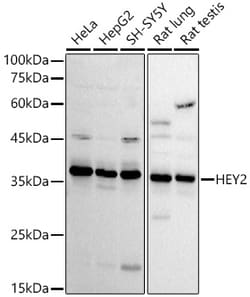
ABclonal Technology HEY2 Rabbit pAb
This gene encodes a member of the hairy and enhancer of split-related (HESR) family of basic helix-loop-helix (bHLH)-type transcription factors. The encoded protein forms homo- or hetero-dimers that localize to the nucleus and interact with a histone deacetylase complex to repress transcription. Expression of this gene is induced by the Notch signal transduction pathway. Two similar and redundant genes in mouse are required for embryonic cardiovascular development, and are also implicated in neurogenesis and somitogenesis. Alternatively spliced transcript variants have been found, but their biological validity has not been determined.
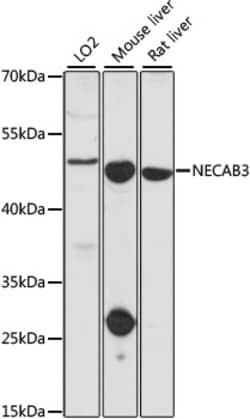
ABclonal Technology NECAB3 Rabbit pAb
The protein encoded by this gene interacts with the amino-terminal domain of the neuron-specific X11-like protein (X11L), inhibits the association of X11L with amyloid precursor protein through a non-competitive mechanism, and abolishes the suppression of beta-amyloid production by X11L. This protein, together with X11L, may play an important role in the regulatory system of amyloid precursor protein metabolism and beta-amyloid generation. The protein is phosphorylated by NIMA-related expressed kinase 2, and localizes to the Golgi apparatus. Multiple transcript variants encoding different isoforms have been found for this gene.

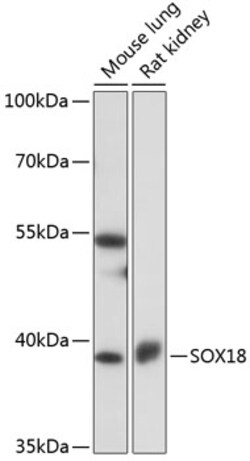
ABclonal Technology SOX18 Rabbit pAb
This gene encodes a member of the SOX (SRY-related HMG-box) family of transcription factors involved in the regulation of embryonic development and in the determination of the cell fate. The encoded protein may act as a transcriptional regulator after forming a protein complex with other proteins. This protein plays a role in hair, blood vessel, and lymphatic vessel development. Mutations in this gene have been associated with recessive and dominant forms of hypotrichosis-lymphedema-telangiectasia.
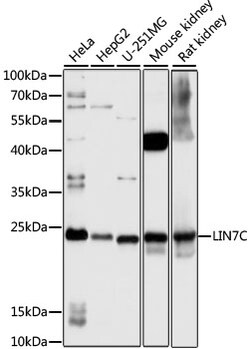
ABclonal Technology LIN7C Rabbit pAb
Enables L27 domain binding activity and cytoskeletal protein binding activity. Involved in morphogenesis of an epithelial sheet. Located in cell-cell junction, cytoplasm, and plasma membrane. Part of MPP7-DLG1-LIN7 complex.
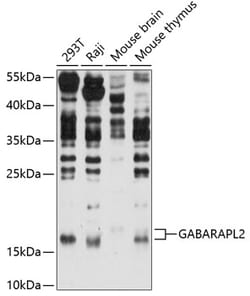
ABclonal Technology GABARAPL2 Rabbit pAb
Enables ubiquitin protein ligase binding activity. Involved in negative regulation of proteasomal protein catabolic process and protein localization to endoplasmic reticulum. Located in Golgi membrane and autophagosome membrane.
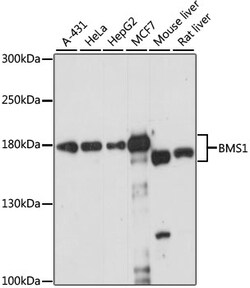
ABclonal Technology BMS1 Rabbit pAb
This gene likely encodes a ribosome assembly protein. A similar protein in yeast functions in 35S-rRNA processing, which includes a series of cleavage steps critical for formation of 40S ribosomes. Related pseudogenes exist on chromosomes 2, 9, 10, 15, 16, and 22.
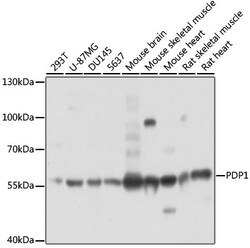
ABclonal Technology PDP1 Rabbit pAb
Pyruvate dehydrogenase (E1) is part of the pyruvate dehydrogenase complex (E1, E2, E3), with E1 activity regulated by phosphorylation and dephosphorylation. Pyruvate dehydrogenase kinases inactivate E1 by phosphorylating serine residues, while pyruvate dehydrogenase phosphatases activate E1 by dephosphorylation. The phosphatase is a heterodimer with catalytic and regulatory subunits. The catalytic subunit encoded by this gene is predominantly expressed in skeletal muscle and belongs to the protein phosphatase 2C (PP2C) superfamily. Located in the mitochondrial matrix, this enzyme, along with pyruvate dehydrogenase and kinases, regulates pyruvate metabolism. Mutations in this gene lead to pyruvate dehydrogenase phosphatase deficiency. Multiple alternatively spliced isoforms have been identified.
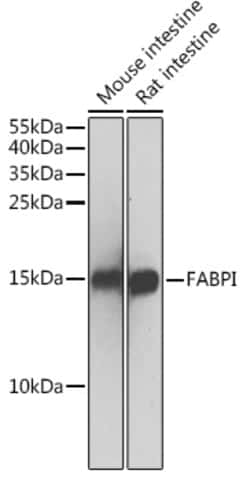
ABclonal Technology FABPI Rabbit pAb
The protein encoded by this gene is an intracellular fatty acid-binding protein that participates in the uptake, intracellular metabolism, and transport of long-chain fatty acids. The encoded protein is also involved in the modulation of cell growth and proliferation. This protein binds saturated long-chain fatty acids with high affinity, and may act as a lipid sensor to maintain energy homeostasis.
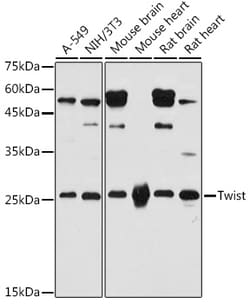
ABclonal Technology Twist Rabbit pAb
This gene encodes a basic helix-loop-helix (bHLH) transcription factor that plays an important role in embryonic development. The encoded protein forms both homodimers and heterodimers that bind to DNA E box sequences and regulate the transcription of genes involved in cranial suture closure during skull development. This protein may also regulate neural tube closure, limb development and brown fat metabolism. This gene is hypermethylated and overexpressed in multiple human cancers, and the encoded protein promotes tumor cell invasion and metastasis, as well as metastatic recurrence. Mutations in this gene cause Saethre-Chotzen syndrome in human patients, which is characterized by craniosynostosis, ptosis and hypertelorism.
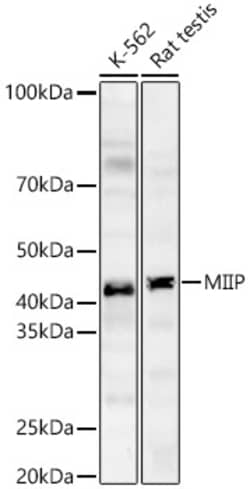
ABclonal Technology MIIP Rabbit pAb
This gene encodes a protein that interacts with the oncogene protein insulin-like growth factor binding protein 2 and may function as an inhibitor of cell migration and invasion. This protein also interacts with the cell division protein 20 and may be involved in regulating mitotic progression. This protein may function as a tumor suppressor by inhibiting the growth or certain cancers.
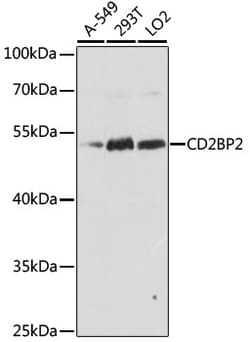
ABclonal Technology CD2BP2 Rabbit pAb
This gene encodes a bi-functional protein. In the cytoplasm, the encoded protein binds the cytoplasmic tail of human surface antigen CD2 via its C-terminal GYF domain, and regulate CD2-triggered T lymphocyte activation. In the nucleus, this protein is a component of the U5 small nuclear ribonucleoprotein complex and is involved in RNA splicing. A pseudogene has been identified on chromosome 7. Alternative splicing results in multiple transcript variants but their biological validity has not been determined.

Rockland Immunochemicals OspA Control Protein 100 µg
Outer-Surface Protein A (OspA) a lipoprotein from Borrelia burgdorferi encoded on its Plasmid lp54 is a major component of the spirochete's extracellular matrix. OspA probably serves as a lipid-anchor. The spirochetes migrate from the tick midgut during feeding to its salivary glands and are thus transmitted to the mammal host. This transition may be facilitated by changes in expression of some B. burgdorferi genes. Upon transmission of the spirochete from the Ixodes tick to mammalian host the transcript level of OspA can change. B. burgdorferi can attach to diverse tissues within the vertebrate host and the tick vector suggesting that physiological factors other than pH and temperature may play roles in modulating B. burgdorferi gene expression.