
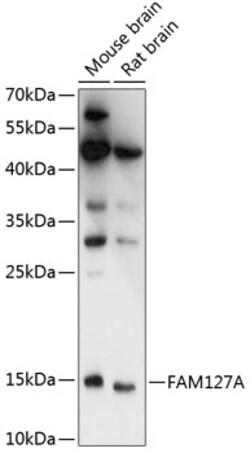
Protein Molecular Weight Markers

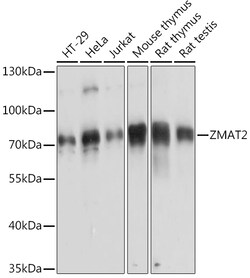
ABclonal Technology ZMAT2 Rabbit pAb

Predicted to enable DNA binding activity and zinc ion binding activity. Involved in mRNA splicing, via spliceosome. Located in nucleus. Part of U2-type precatalytic spliceosome.

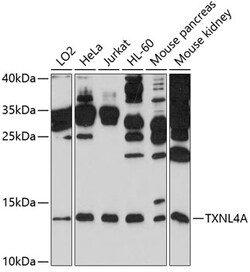
ABclonal Technology TXNL4A Rabbit pAb
The protein encoded by this gene is a member of the U5 small ribonucleoprotein particle (snRNP), and is involved in pre-mRNA splicing. This protein contains a thioredoxin-like fold and it is expected to interact with multiple proteins. Protein-protein interactions have been observed with the polyglutamine tract-binding protein 1 (PQBP1). Mutations in both the coding region and promoter region of this gene have been associated with Burn-McKeown syndrome, which is a rare disorder characterized by craniofacial dysmorphisms, cardiac defects, hearing loss, and bilateral choanal atresia. A pseudogene of this gene is found on chromosome 2. Alternative splicing results in multiple transcript variants.
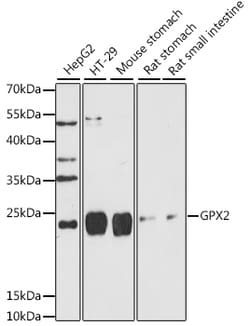
ABclonal Technology GPX2 Rabbit pAb
The protein encoded by this gene is a member of the glutathione peroxidase family, which reduces organic hydroperoxides and hydrogen peroxide (H2O2) using glutathione, protecting cells from oxidative damage. This isozyme is mainly expressed in the gastrointestinal tract and liver (in humans), localized in the cytoplasm, and prefers hydrogen peroxide as its substrate. Overexpression is linked to increased differentiation and proliferation in colorectal cancer. It is also a selenoprotein, with selenocysteine (Sec) at its active site, encoded by the UGA codon. The 3 UTR of selenoprotein mRNAs contains a stem-loop structure called the SECIS element, essential for interpreting UGA as Sec, not a stop codon. Alternative splicing variants of this gene have been identified.
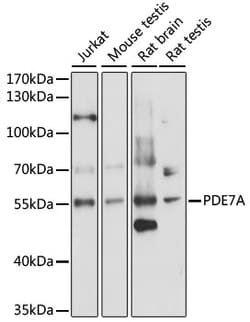
ABclonal Technology PDE7A Rabbit pAb
The protein encoded by this gene belongs to the cyclic nucleotide phosphodiesterase (PDE) family, and PDE7 subfamily. This PDE hydrolyzes the second messenger, cAMP, which is a regulator and mediator of a number of cellular responses to extracellular signals. Thus, by regulating the cellular concentration of cAMP, this protein plays a key role in many important physiological processes. Alternatively spliced transcript variants encoding different isoforms have been described for this gene.
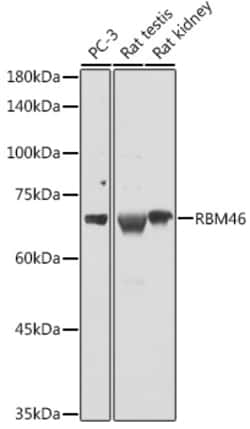
ABclonal Technology RBM46 Rabbit pAb
Predicted to enable mRNA binding activity. Predicted to act upstream of or within mRNA stabilization and trophectodermal cell differentiation. Predicted to be active in nucleus.
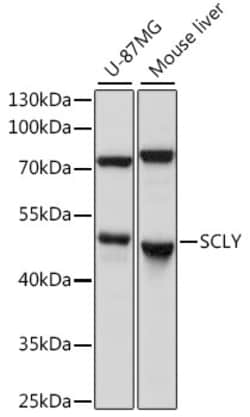
ABclonal Technology SCLY Rabbit pAb
Selenocysteine lyase (SCLY, EC 4.4.1.16) catalyzes the pyridoxal 5-prime phosphate-dependent conversion of L-selenocysteine to L-alanine and elemental selenium (Mihara et al., 2000 [PubMed 10692412]).
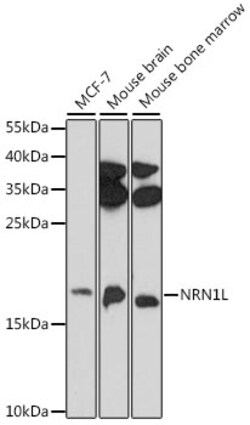
ABclonal Technology NRN1L Rabbit pAb
The protein encoded by this gene is extracellular and enhances both neurite growth and neuronal survival. The encoded protein is found both as a GPI anchored membrane-bound form and as a secreted form. This activity-related ligand functions as a homodimer or heterodimer.

American Radiolabeled Chemicals Inc PROT MOL MARKER 14C 1UC
Protein molecular weight markers-14C 1uCi in 0.01M sodium phosphate (pH 7.2), 0.01 mCi/ml, S.A. 10-100 ug/mg, Mixture of Myosin-methyl-14C methylated, Phosphorylase B-methyl-14C methylated, BSA-methyl-14C methylated, Ovalbumin-methyl-14C methylated, Carbon
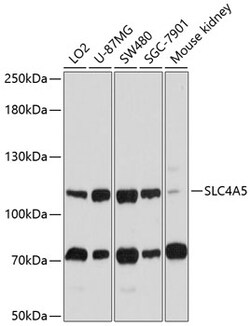
ABclonal Technology SLC4A5 Rabbit pAb
This gene encodes a member of the sodium bicarbonate cotransporter (NBC) family, part of the bicarbonate transporter superfamily. Sodium bicarbonate cotransporters are involved in intracellular pH regulation and electroneural or electrogenic sodium bicarbonate transport. This protein is thought to be an integral membrane protein. Multiple transcript variants encoding different isoforms have been found for this gene, but the biological validity of some variants has not been determined.
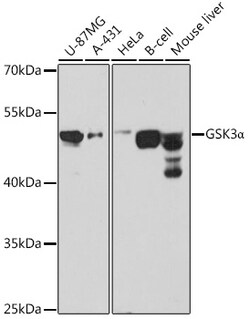
ABclonal Technology GSK3α Rabbit pAb
This gene encodes a multifunctional Ser/Thr protein kinase that is implicated in the control of several regulatory proteins including glycogen synthase, and transcription factors, such as JUN. It also plays a role in the WNT and PI3K signaling pathways, as well as regulates the production of beta-amyloid peptides associated with Alzheimers disease.
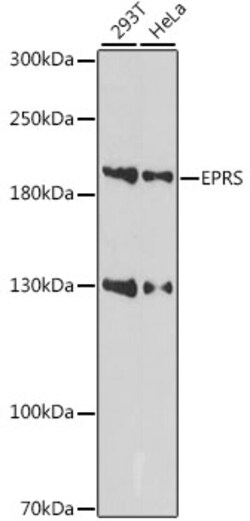
ABclonal Technology EPRS Rabbit pAb
Aminoacyl-tRNA synthetases are a class of enzymes that charge tRNAs with their cognate amino acids. The protein encoded by this gene is a multifunctional aminoacyl-tRNA synthetase that catalyzes the aminoacylation of glutamic acid and proline tRNA species. Alternative splicing has been observed for this gene, but the full-length nature and biological validity of the variant have not been determined.
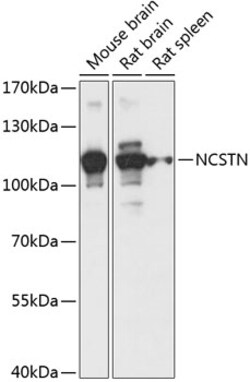
ABclonal Technology NCSTN Rabbit pAb
This gene encodes a type I transmembrane glycoprotein that is an integral component of the multimeric gamma-secretase complex. The encoded protein cleaves integral membrane proteins, including Notch receptors and beta-amyloid precursor protein, and may be a stabilizing cofactor required for gamma-secretase complex assembly. The cleavage of beta-amyloid precursor protein yields amyloid beta peptide, the main component of the neuritic plaque and the hallmark lesion in the brains of patients with Alzheimers disease, however, the nature of the encoded proteins role in Alzheimers disease is not known for certain. Mutations in this gene are associated with familial acne inversa. A pseudogene of this gene is present on chromosome 21. Alternatively spliced transcript variants of this gene have been described, but the full-length nature of some of these variants has not been determined.
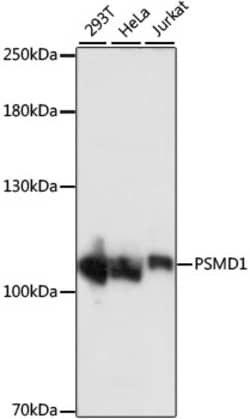
ABclonal Technology PSMD1 Rabbit pAb
The 26S proteasome is a multicatalytic proteinase complex composed of a 20S core and a 19S regulator. The 20S core has 4 rings made of 28 subunits, including 7 alpha and 7 beta subunits in each ring. The 19S regulator consists of a base with 6 ATPase subunits and 2 non-ATPase subunits, and a lid with up to 10 non-ATPase subunits. Proteasomes, found throughout eukaryotic cells, cleave peptides in an ATP/ubiquitin-dependent process in a non-lysosomal pathway. A modified form, the immunoproteasome, processes class I MHC peptides. This gene encodes the largest non-ATPase subunit of the 19S regulator lid, responsible for substrate recognition and binding. Evidence suggests interactions with viral proteins, including coronaviruses. Alternative splicing produces multiple transcript variants.
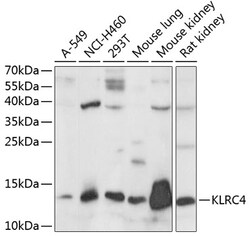
ABclonal Technology KLRC4 Rabbit pAb
Natural killer (NK) cells are lymphocytes that can mediate lysis of certain tumor cells and virus-infected cells without previous activation. They can also regulate specific humoral and cell-mediated immunity. NK cells preferentially express several calcium-dependent (C-type) lectins, which have been implicated in the regulation of NK cell function. This gene is a member of the NKG2 group of genes that are expressed primarily in natural killer (NK) cells. These family members encode transmembrane proteins that are characterized by a type II membrane orientation (have an extracellular C-terminus) and the presence of a C-type lectin domain. This family member is located within the NK complex, a region that contains several C-type lectin genes preferentially expressed in NK cells. Read-through transcription exists between this gene and the downstream KLRK1 (killer cell lectin-like receptor subfamily K, member 1) family member.