
Primary Antibody Matched Pairs


AdipoGen RBP4 rat rec
Protein. Rat RBP4 aa 19-201 is fused at the N-terminus to a FLAG -tag. Source HEK 293 cells. Endotoxin content <0.1EU/µg purified protein LAL test Lonza. Liquid. 0.2µm-filtered solution in PBS, pH 7.2. Purity >90% SDS-PAGE. Retinol binding protein 4 RBP4 RBP is a 21kDa secreted protein, a member of the lipocalin family and is known as the primary transporter of retinol vitamin A to tissues. A recent report revealed RBP4 as an adipokine linking glucose transporter 4 GLUT4 suppression in adipose tissue to insulin. Elevated human and mouse serum RBP4 levels are associated with insulin resistance and its severity, obesity, and certain components of metabolic syndrome. Furthermore, human serum RBP4 levels are closely related to renal function.

ABclonal Technology CD96 Rabbit mAb

CD96 (cluster of differentiation 96) belongs to the IgG (immunoglobulin) superfamily receptors It is expressed in the spinal cord kidney trachea digestive tissues prostate placenta bone of adults and fetal brain and liver This gene is located on human chromosome 3q13 The protein encoded by this gene belongs to the immunoglobulin superfamily It is a type I membrane protein The protein may play a role in the adhesive interactions of activated T and NK cells during the late phase of the immune response It may also function in antigen presentation Alternative splicing occurs at this locus and two transcript variants encoding distinct isoforms have been identified
AdipoGen IL-1alpha (mouse) Matched Pair Detection Set (1 Set)
Matched Pair Detection Set. Detects mouse IL-1alpha. Does not detect human IL-1alpha or mouse IL-1beta. Colorimetric assay. Sample Type: Cell Culture Supernatant. Range: 15.6 to 2000pg/ml. Sensitivity: 10pg/ml. IL-1alpha lacks a signal peptide and is secreted by an unconventional, endoplasmic reticulum-Golgi-independent mechanism. IL-1alpha was reported to be more widely and constitutively expressed and has intracellular functions, but also acts locally in a membrane-bound form by activating IL-1R1. Additionally, passive release of IL-1alpha upon cell death can trigger a sterile inflammatory response to dying cells. Recently it has been observed that all activators of the inflammasome NLRP3/NALP3 induce the simultaneous secretion of IL-1alpha and IL-1beta. Although most activators fully rely on the inflammasome for IL-1alpha secretion, some induce the processing and secretion of IL-1alpha in an inflammasome-independent manner.

Biotium PLAP (Placental Alkaline Phosphatase)(ALPP/238), CF740 conjugate, 0.1mg/mL
PLAP is a tissue specific, trophoblast-derived, 70 kDa, glycosyl-phosphatidylinositol (GPI)-anchored, dimeric, Zn2 metallo glycoprotein that catalyzes the hydrolysis of phosphomonoesters into an inorganic phosphate and an alcohol. It is present in the placenta and serum of pregnant women and in high frequency in gynecological and testicular cancers and in lower frequency in other tumors. The three tissue-specific AP's in humans, PLAP, germ cell AP (GCAP) and intestinal AP, are 90-98% homologous. Non-tissue specific AP is found in kidney, liver and bone. This MAb binds equally well to all common allelic variants (S, F, FS and I) of PLAP as to AP from normal human testis. This MAb can be used both as coating as well as tracer antibody in the same ELISA to detect PLAP in serum of S, F, FS and I phenotypes.Primary antibodies are available purified, or with a selection of fluorescent CF Dyes and other labels. CF Dyes offer exceptional brightness and photostability. Note: Conju

Human VSIG4 ELISA Pair Set 15PP (Sino Biological)
Each vial contains 100 ng of recombinant VSIG4. Reconstitute with 1 mL detection antibody dilution buffer. After reconstitution, store at -20℃ to -80℃ in a manual defrost freezer. A seven-point standard curve using 2-fold serial dilutions in sample dilution buffer, and a high standard of 2 ng/mL is recommended.
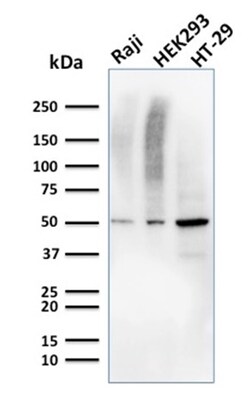
Biotium MMP3 (Marker of Metastasis and Rheumatoid Arthritis)(MMP3/2655), CF568 conjugate, 0.1mg/mL
The matrix metalloproteinases (MMP) are a family of peptidase enzymes responsible for the degradation of extracellular matrix components, including collagen, gelatin, fibronectin, laminin and proteoglycan. Transcription of MMP genes is differentially activated by phorbol ester, lipopolysaccharide (LPS) or staphylococcal enterotoxin B (SEB). MMP catalysis requires both calcium and zinc. MMP-3, MMP-10 and MMP-11 (also designated stromelysin-1, 2 and 3, respectively) activate procollagenase. MMP-3 activation of procollagenase can occur via two pathways. Direct activation by MMP-3 is slow and activation by MMP-3 in conjunction with tissue or plasma proteinases is rapid. MMP-10 is expressed in small intestine, and at lower levels in lung and heart. MMP-11 is specifically expressed in stromal cells of breast carcinomas and contributes to epithelial cell malignancies. Primary antibodies are available purified, or with a selection of fluorescent CF Dyes and other labels. CF Dyes of
Biotium RAD51 (Prognostic and Response to Chemotherapy Marker)(RAD51/2765), Biotin conjugate, 0.1mg/mL
RAD51 is one of the key factors of DNA repair by homologous recombination and has been shown to have anti-apoptotic activity in tumor cells. RAD51 protein interacts with a variety of tumor suppressor proteins including p53, BRCA1 and BRCA2. Elevated expression of RAD51 enhances radio-resistance of human tumor cells. Overexpression of RAD51 protein in tumor cells renders them resistant against cytotoxic drugs like Cisplatin. RAD51 interacts with BRCA1 and BRCA2 to influence subcellular localization and cellular response to DNA damage. BRCA2 inactivation may be a key event leading to genomic instability and tumorigenesis from deregulation of RAD51. High-level expression of RAD51 has been observed in a variety of human malignancies. RAD51 overexpression correlates with histological grading of the tumor in invasive ductal mammary carcinoma. Primary antibodies are available purified, or with a selection of fluorescent CF Dyes and other labels. CF Dyes offer exceptional brightnes
Biotium RAD51 (Prognostic and Response to Chemotherapy Marker)(RAD51/2753), CF740 conjugate, 0.1mg/mL
RAD51 is one of the key factors of DNA repair by homologous recombination and has been shown to have anti-apoptotic activity in tumor cells. RAD51 protein interacts with a variety of tumor suppressor proteins including p53, BRCA1 and BRCA2. Elevated expression of RAD51 enhances radio-resistance of human tumor cells. Overexpression of RAD51 protein in tumor cells renders them resistant against cytotoxic drugs like Cisplatin. RAD51 interacts with BRCA1 and BRCA2 to influence subcellular localization and cellular response to DNA damage. BRCA2 inactivation may be a key event leading to genomic instability and tumorigenesis from deregulation of RAD51. High-level expression of RAD51 has been observed in a variety of human malignancies. RAD51 overexpression correlates with histological grading of the tumor in invasive ductal mammary carcinoma. Primary antibodies are available purified, or with a selection of fluorescent CF Dyes and other labels. CF Dyes offer exceptional brightnes
Biotium CD56 / NCAM1 / NKH1 (Neuronal Cell Marker) (NCAM1/1496), CF740 conjugate, 0.1mg/mL
This MAb reacts with an extracellular domain (close to transmembrane) of CD56/NCAM. Three isoforms of neural cell adhesion molecule (NCAM) are produced by differential splicing of the RNA transcript from a single gene. The 135 kDa isoform is the basic molecule, which is glycosylated or sialylated to produce the mature species. Anti-CD56 recognizes two proteins of the neural cell adhesion molecule, the basic molecule expressed on most neuroectodermally derived tissues and neoplasms (e.g. retinoblastoma, medulloblastomas, astrocytomas, neuroblastomas, and small cell carcinomas). It is also expressed on some mesodermally derived tumors (rhabdomyosarcoma). Anti-CD56 plays an important role in the diagnosis of nodal and nasal NK/T-cell lymphomas.Primary antibodies are available purified, or with a selection of fluorescent CF Dyes and other labels. CF Dyes offer exceptional brightness and photostability. Note: Conjugates of blue fluorescent dyes like CF405S and CF405M are not
Biotium CD56 / NCAM1 / NKH1 (Neuronal Cell Marker) (NCAM1/1496), CF405S conjugate, 0.1mg/mL
This MAb reacts with an extracellular domain (close to transmembrane) of CD56/NCAM. Three isoforms of neural cell adhesion molecule (NCAM) are produced by differential splicing of the RNA transcript from a single gene. The 135 kDa isoform is the basic molecule, which is glycosylated or sialylated to produce the mature species. Anti-CD56 recognizes two proteins of the neural cell adhesion molecule, the basic molecule expressed on most neuroectodermally derived tissues and neoplasms (e.g. retinoblastoma, medulloblastomas, astrocytomas, neuroblastomas, and small cell carcinomas). It is also expressed on some mesodermally derived tumors (rhabdomyosarcoma). Anti-CD56 plays an important role in the diagnosis of nodal and nasal NK/T-cell lymphomas.Primary antibodies are available purified, or with a selection of fluorescent CF Dyes and other labels. CF Dyes offer exceptional brightness and photostability. Note: Conjugates of blue fluorescent dyes like CF405S and CF405M are not
Biotium CD56 / NCAM1 / NKH1 (Neuronal Cell Marker) (NCAM1/1496), CF647 conjugate, 0.1mg/mL
This MAb reacts with an extracellular domain (close to transmembrane) of CD56/NCAM. Three isoforms of neural cell adhesion molecule (NCAM) are produced by differential splicing of the RNA transcript from a single gene. The 135 kDa isoform is the basic molecule, which is glycosylated or sialylated to produce the mature species. Anti-CD56 recognizes two proteins of the neural cell adhesion molecule, the basic molecule expressed on most neuroectodermally derived tissues and neoplasms (e.g. retinoblastoma, medulloblastomas, astrocytomas, neuroblastomas, and small cell carcinomas). It is also expressed on some mesodermally derived tumors (rhabdomyosarcoma). Anti-CD56 plays an important role in the diagnosis of nodal and nasal NK/T-cell lymphomas.Primary antibodies are available purified, or with a selection of fluorescent CF Dyes and other labels. CF Dyes offer exceptional brightness and photostability. Note: Conjugates of blue fluorescent dyes like CF405S and CF405M are not

Human SELE ELISA Pair Set 15PP (Sino Biological)
Each vial contains 135 ng of recombinant Human E-Selectin / CD62e / SELE. Reconstitute with 1 mL dilution buffer. After reconstitution, store at -20℃ to -80℃ in a manual defrost freezer. A seven-point standard curve using 2-fold serial dilutions in dilution buffer, and a high standard of 6000 pg/mL is recommended.
Biotium S100A9(47-8D3), Biotin conjugate, 0.1mg/mL
This MAb stains the cytoplasm of macrophages and histiocytes in hematopoietic organs, Kupffer's cells of the liver and Langerhan's cells of the skin. It also stains the mantle zone B-lymphocytes of the lymph node and spleen, spermatogonia, and chief cells of the stomach. S100A9 is expressed by macrophages in acutely inflamed tissues and in chronic inflammation. It is detected in peripheral blood leukocytes, in neutrophils and granulocytes. It is present at sites of vascular inflammation. S100A9 is also expressed in epithelial cells constitutively or induced during dermatoses. S100A9 is a Calcium-binding protein. It has antimicrobial activity towards bacteria and fungi. It is important for resistance to invasion by pathogenic bacteria. It up-regulates transcription of genes that are under the control of NF-kappa-B. S100A9 plays a role in the development of endotoxic shock in response to bacterial lipopolysaccharide (LPS). It promotes tubulin polymerization when unphosphorylate
Biotium UGT1A9 (UDP glucuronosyltransferase 1 family, polypeptide A9)(UGT1A9/1229), CF488A conjugate, 0.1mg/mL
This antibody recognizes a protein of about 60 kDa, which is identified as human UGT1A9. It does not cross-react with the other UGT1A isoforms including UGT1A7, UGT1A8, and UGT1A10 and shows a high degree of specificity. UGT1A9 is a UDP-glucuronosyltransferase, an enzyme of the glucuronidation pathway that transforms small lipophilic molecules, such as steroids, bilirubin, hormones, and drugs, into water-soluble, excretable metabolites. This MAb binds to human hepatocytes and the majority of human hepatocellular carcinomas (HCC s). In frozen sections, it stains hepatic cells and may be used as a marker of the liver. This MAb also binds to cell preparations of hepatocellular carcinoma biopsies or cell lines.Primary antibodies are available purified, or with a selection of fluorescent CF Dyes and other labels. CF Dyes offer exceptional brightness and photostability. Note: Conjugates of blue fluorescent dyes like CF405S and CF405M are not recommended for detecting low abund
Biotium UGT1A9 (UDP glucuronosyltransferase 1 family, polypeptide A9)(UGT1A9/1229), 0.2mg/mL
This antibody recognizes a protein of about 60 kDa, which is identified as human UGT1A9. It does not cross-react with the other UGT1A isoforms including UGT1A7, UGT1A8, and UGT1A10 and shows a high degree of specificity. UGT1A9 is a UDP-glucuronosyltransferase, an enzyme of the glucuronidation pathway that transforms small lipophilic molecules, such as steroids, bilirubin, hormones, and drugs, into water-soluble, excretable metabolites. This MAb binds to human hepatocytes and the majority of human hepatocellular carcinomas (HCC s). In frozen sections, it stains hepatic cells and may be used as a marker of the liver. This MAb also binds to cell preparations of hepatocellular carcinoma biopsies or cell lines.Primary antibodies are available purified, or with a selection of fluorescent CF Dyes and other labels. CF Dyes offer exceptional brightness and photostability. Note: Conjugates of blue fluorescent dyes like CF405S and CF405M are not recommended for detecting low abund