
Donkey Secondary Antibodies

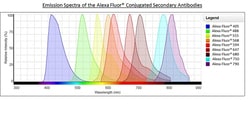
Abcam Donkey Anti-Rabbit IgG H&L (Alexa Fluor 405) preadsorbed
Donkey Anti-Rabbit IgG H&L (Alexa Fluor 405) preadsorbed
The product is subject to the following: Abcam Restricted Use Statement


Biotium Prohibitin (Mitochondrial Marker)(PHB/3231), CF647 conjugate, 0.1mg/mL
Recognizes a protein of 30 kDa which is identified as Prohibitin, an evolutionarily conserved protein with homologues found in yeast to man. It is located in the inner membrane of mitochondria. Although prohibitin mRNA and protein expression occurs throughout the cell cycle, maximum levels are detected during the G1/S phase transition and minimum levels are seen in S phase and the G2/mitosis boundary. Prohibitin is located exclusively in the mitochondria with the highest concentration on the inner membrane. Prohibitin is an ideal mitochondrial marker. It shows antiproliferative activity and has been proposed to play a role in normal cell cycle regulation, replicative senescence, cellular immortalization, and tumor suppression. Primary antibodies are available purified, or with a selection of fluorescent CF Dyes and other labels. CF Dyes offer exceptional brightness and photostability. Note: Conjugates of blue fluorescent dyes like CF405S and CF405M are not recommended fo
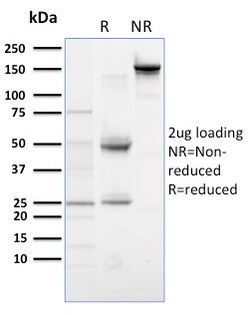
Biotium PLK1 (Marker of Mitosis)(AZ44), CF647 conjugate, 0.1mg/mL
Plk (for polo-like kinase) encodes a serine/threonine kinase that is closely related to polo and CDC5, genes that are required for passage through mitosis in Drosophila and Saccharomyces, respectively. Polo and Cdc5 both code for proteins that are involved in regulating the function of the mitotic spindle. Plk protein accumulates in the cell during the S and G2 phases of the cell cycle; Plk protein content and catalytic activity peak at the onset of mitosis, followed by a rapid reduction after mitosis. Plk expression is detectable in mitotically active tissues such as colon and placenta, as well as in tumors of various origins. It has also been suggested that Plk may serve as a marker of cell proliferation. Required for recovery after DNA damage checkpoint and entry into mitosis. Required for kinetochore localization of BUB1B. Phosphorylates SGOL1. Required for spindle pole localization of isoform 3 of SGOL1 and plays a role in regulating its centriole cohesion function. Phos
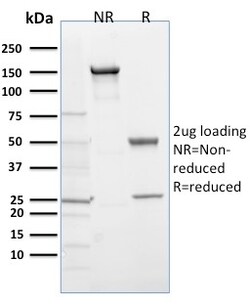
Biotium EGLN1 / PHD2(366G/76/3), CF647 conjugate, 0.1mg/mL
This antibody recognises human prolyl hydroxylase 2 (PHD2), a 46 kDa enzyme expressed abundantly in all tissues with the highest expression in testis. Hypoxia inducible factor-1 (HIF-1) is a transcriptional complex, consisting of an alpha and beta subunit, which plays a key role in coordinating the cellular response to hypoxia. During normal oxygen conditions, the alpha subunit of HIF-1 is rapidly degraded, however when hypoxia occurs this degradation is suppressed and HIF-1 activates the transcription of various genes important for survival and adaptation to hypoxia. Prolyl hydroxylase 2 catalyses the hydroxylation of specific prolyl residues within the HIF-1 alpha subunit, thereby targeting this subunit for degradation. Primary antibodies are available purified, or with a selection of fluorescent CF Dyes and other labels. CF Dyes offer exceptional brightness and photostability. Note: Conjugates of blue fluorescent dyes like CF405S and CF405M are not recommended for det

Biotium Endoglin / CD105 (Angiogenesis Marker)(ENG/3269), CF647 conjugate, 0.1mg/mL
CD105/Endoglin is a Type I membrane glycoprotein located on cell surfaces and is part of the TGF-beta receptor complex. This protein has been found on endothelial cells, activated macrophages, fibroblasts, and smooth-muscle cells. Endoglin has a role in the development of the cardiovascular system and in vascular remodeling. Its expression is regulated during heart development. CD105 is highly expressed in endothelial cells during tumor angiogenesis and inflammation, with weak or negative expression in vascular endothelium of normal tissues. Angiogenesis is a promising prognostic marker in a variety of tumors. Endoglin is a more specific and sensitive marker for tumor angiogenesis than CD31 or CD34, as it labels only newly-formed blood vessels and may serve as a prognostic marker for prostate adenocarcinoma, and cancers of the lung, stomach, breast, and brain.Primary antibodies are available purified, or with a selection of fluorescent CF Dyes and other labels. CF Dyes offer
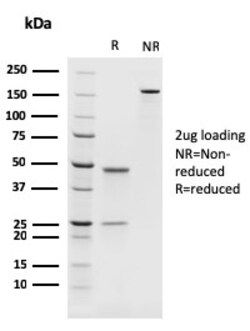
Biotium PAX8 (Renal Cell Marker)(rPAX8/1492), CF647 conjugate, 0.1mg/mL
Recognizes a protein of 62 kDa, identified as PAX8. It is a member of the paired box (PAX) family of transcription factors. This nuclear protein is involved in thyroid follicular cell development and expression of thyroid-specific genes. Mutations in this gene have been associated with thyroid dysgenesis, thyroid follicular carcinomas, and atypical thyroid adenomas. PAX-8 is expressed in the thyroid (and associated carcinomas), non-ciliated mucosal cells of the fallopian tubes, and simple ovarian inclusion cysts, but not normal ovarian surface epithelial cells. PAX-8 is expressed in a high percentage of ovarian serous, endometrioid, and clear cell carcinomas, but only rarely in primary ovarian mucinous adenocarcinomas. PAX-8 expression is reported in renal tubules as well as renal cell carcinoma, nephroblastoma, and seminoma. PAX-8 antibody may be used as an additional immunohistochemical marker for renal epithelial tumors. Primary antibodies are available purified, or with a
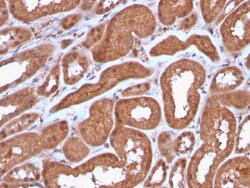
Biotium MTAP (Tumor Suppressor Marker)(MTAP/3137R), CF647 conjugate, 0.1mg/mL
Recognizes a protein of 31 kDa, which is identified as MTAP (5'-deoxy-5'-methylthioadenosine phosphorylase). It catalyzes the reversible phosphorolysis of methylthioadenosine, which is important in polyamine metabolism and for the salvage of adenine and methionine. The gene encoding MTAP is linked to the tumor suppressor gene, p16INK4A. Deficient levels of MTAP can occur in cancers primarily through co-deletion of the MTAP gene and the p16INK4A gene. Cells expressing MTAP and possessing adenine salvage pathway activity may be less susceptible to malignancy due to growth-inhibitory actions of agents (e. g. antifolates), whose mechanism of action, in part, involves this de novo purine pathway. Primary antibodies are available purified, or with a selection of fluorescent CF Dyes and other labels. CF Dyes offer exceptional brightness and photostability. Note: Conjugates of blue fluorescent dyes like CF405S and CF405M are not recommended for detecting low abundance targets, b
Biotium CD44v6 (Marker of Tumor Metastasis) (CD44v6/1246), CF647 conjugate, 0.1mg/mL
This antibody recognizes an epitope encoded by exon v6 on the variant portion of human CD44. The CD44 molecule belongs to a family of cellular adhesion molecules found on a wide range of normal and malignant cells in epithelial, mesothelial and hemopoiesis tissues. CD44 is a single gene with 20 exons, of which 10 are normally expressed to encode the basic CD44 (H-CAM) molecule. The additional 10 exons (v1 to v10) are only expressed by alternative splicing of the nuclear RNA. The expression of specific cell adhesion molecule CD44 splice variants has been reported to be associated with metastasis in certain human malignancies.Primary antibodies are available purified, or with a selection of fluorescent CF Dyes and other labels. CF Dyes offer exceptional brightness and photostability. Note: Conjugates of blue fluorescent dyes like CF405S and CF405M are not recommended for detecting low abundance targets, because blue dyes have lower fluorescence and can give higher non-spec
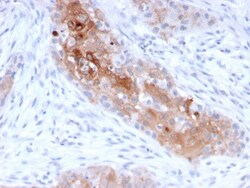
Biotium Desmoglein-1 (DSG1)(32-2B), CF647 conjugate, 0.1mg/mL
Recognizes a protein of ~150 kDa, identified as Desmoglein-1 (DSG1). Desmoglein-1 is a member of the desmosomal cadherin family. Desmosomes are intercellular adhering junctions that represent cell surface attachment sites for intermediate filament. Desmocollins and desmogleins are the main desmosomal transmembrane proteins. Desmogleins consist of Dsg1, Dsg2, Dsg3, and Dsg4 isoforms. Within the desmosome, the extracellular domain of desmoglein is essential for calcium dependent heterophilic binding to the desmocollins, whereas the intracellular domain is essential for binding to the desmosomal plaque protein, plakoglobin. Desmoglein 1 is synthesized exclusively in the suprabasal layers. Intact and functionally active desmoglein 1 is essential to epidermal integrity. Primary antibodies are available purified, or with a selection of fluorescent CF Dyes and other labels. CF Dyes offer exceptional brightness and photostability. Note: Conjugates of blue fluorescent dyes like CF
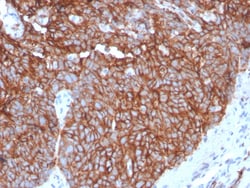
Biotium GLUT-1 (Tumor Progression and Mesothelioma Marker)(GLUT1/3132R), CF647 conjugate, 0.1mg/mL
Recognizes a protein of 55 kDa, which is identified as GLUT-1. Glucose transporters are integral membrane glycoproteins involved in transporting glucose into most cells. There are many types of glucose transport carrier proteins, designated as Glut-1 to Glut-12. Glut-1 is a major glucose transporter in the mammalian blood-brain barrier. It is expressed in high density on the membranes of human erythrocytes and the brain capillaries that comprise the blood-brain barrier. Glut-1 is expressed at variable levels in many human tissues. Overexpression of Glut-1 has been linked to tumor progression or poor survival of patients with carcinomas of the colon, breast, cervical, lung, bladder and mesothelioma. Glut-1 is a sensitive and specific marker for the differentiation of malignant mesothelioma (positive) from reactive mesothelium (negative). Primary antibodies are available purified, or with a selection of fluorescent CF Dyes and other labels. CF Dyes offer exceptional brightnes
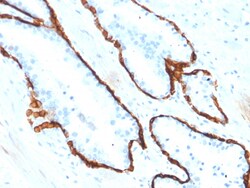
Biotium Cytokeratin 15 (Esophageal Squamous Cell Carcinoma Marker)(KRT15/2554), CF568 conjugate, 0.1mg/mL
Keratin 15 is a type I keratin which is expressed only in basal keratinocytes in stratified epithelia and does not appear to have a natural type II expression partner. Keratin 15 is down regulated in activated keratinocytes. Cytokeratin 15 is a specific marker of stem cells of the hair-follicle bulge and may be a useful marker for diagnosis between basal cell carcinoma (BCC) and trichoepithelioma. Trichoblastoma are benign neoplasms of follicular differentiation frequently found in nevus sebaceous. Many morphologic features are shared with nodular basal cell carcinoma, sometimes rendering a diagnosis difficult. Trichoblastoma and BCC show variable expression of Cytokeratin 15 and Cytokeratin 19, and absence of hair keratins. Primary antibodies are available purified, or with a selection of fluorescent CF Dyes and other labels. CF Dyes offer exceptional brightness and photostability. Note: Conjugates of blue fluorescent dyes like CF405S and CF405M are not recommended for
Immunoreagents Inc DONKEY A-GOAT IGG DYLIGHT 650
Secondary Antibody; Donkey anti-goat IgG (H&L), Affinity Pure, DyLight 650 Conjugate, Host: Donkey, Format: Lyo, Label: DyL650, Applications: WB, ELISA, IHC/ICC, IF, IP, FC, FACS
Immunoreagents Inc DONKEY A-GOAT IGG DYLIGHT 550
Seconday Antibody; Donkey anti-goat IgG (H&L), Affinity Pure, min x w/Hu, Mu, Rb or Rt lgG/SP, DyLight 550 Conjugate, Host: Donkey, Format: Lyo, Label: DyL550, Applications: WB, ELISA, IHC/ICC, IF, IP, FC, FACS
Immunoreagents Inc DONKEY A-GOAT IGG HRP 1MG
Secondary Antibody; Donkey anti-goat IgG (H&L), Affinity Pure, HRP Conjugate, Host: Donkey, Format: Lyo, Label: HRP, Applications: WB, ELISA, IHC/ICC
Immunoreagents Inc DONKEY A-GOAT IGG DYLIGHT 633
Secondary Antibody; Donkey anti-goat IgG (H&L), Affinity Pure, DyLight 633 Conjugate, Host: Donkey, Format: Lyo, Label: DyL633, Applications: WB, ELISA, IHC/ICC, IF, IP, FC, FACS