
Protein Labeling Reagents

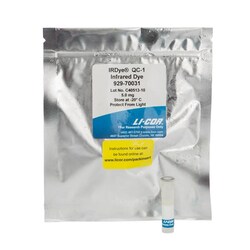
LICORbio IRDye QC-1 NHS Ester (5.0 mg)
IRDye QC-1 is the first non-fluorescent (dark) quencher compatible with a wide range of visible and near-infrared fluorophores (~500-800 nm). It has the widest available quenching range, so you do not need to carefully match the donor's fluorescence spectrum with the acceptor's absorbance. IRDye QC-1 NHS ester can be used for FRET (fluorescence resonance energy transfer) applications such as protease assays. Recently, it has been paired with IRDye 800CW in optoacoustic studies.


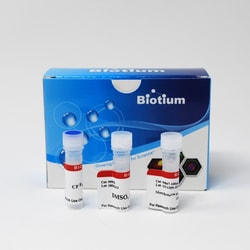
Biotium MemBrite™ Fix 488/515 Cell Surface Staining Kit, 100 Reactions
MemBrite™ Fix Cell Surface Staining Kits are designed for covalently staining the surface of live cells to conveniently visualize cell boundaries in immunofluorescence experiments. MemBrite™ Fix are new covalent cell surface stains that react irreversibly with cell surface proteins for staining that can withstand formaldehyde or alcohol fixation, and detergent permeabilization. Unlike lectins such as WGA, which bind specific targets that may vary between cell types, MemBrite™ Fix dyes react widely with cell surface proteins. MemBrite™ Fix staining is rapid and non-toxic to cells, and because MemBrite™ Fix dyes are highly water soluble, they stain cells much more evenly than traditional lipophilic membrane dyes like DiO, DiI, PKH, Vybrant, or CellMask™. This trial size kit has reagents sufficient for 100 labeling reactions. The kit contains 1 vial of MemBrite™ Fix 488/515 that is sufficient for 20 uL of 1000X dye after DMSO reconstitution.

Biotium CF488A, Succinimidyl Ester
CF Dye Succinimidyl Esters (SE, also known as NHS esters) are amine-reactive fluorescent dyes. SE dyes are commonly used to label antibodies and other proteins on free amine groups, such as lysine residues. CF dyes are Biotium's line of next-generation fluorescent dyes with advantages in brightness, photostability, and conjugate specificity compared to other fluorescent dyes. Green fluorescent CF488A dye has excitation/emission at 490/515 nm.
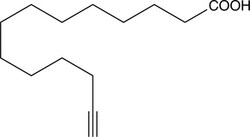
Cayman Chemical Myristic Acid Alkyne, Purity: ≥98%, CAS: 82909-47-5, 1 mg
A form of the 14-carbon myristic acid with an ω-terminal alkyne group; can be used in linking reactions utilizing click chemistry

Sigma Aldrich Fine Chemicals Biosciences Sodium azide
Sodium azide | 65.01 | 26628-22-8 | MFCD00003536 | 100g

Biotium ViaFluor 647, 50 uL
ViaFluor Live Cell Microtubule Stains are cell-permeable taxol probes for imaging the microtubule cytoskeleton in live cells. Available with blue, green, or far-red fluorescence.
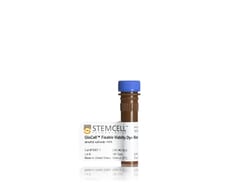
STEMCELL Technologies GloCell™ Fixable Viability Dye Red 780, Size: 500 Tests
GloCell™ Fixable Viability Dye Red 780 is a fluorescent cell viability dye for staining live/dead mammalian cells in applications such as flow cytometry. The dye irreversibly binds intracellular and cell surface amine groups and can be utilized prior to fixation, permeabilization, or cryopreservation. Cells with compromised plasma membranes become permeable to the GloCell™ dye, resulting in a greater fluorescence compared to live cells in a cell viability assay.GloCell™ Fixable Viability Dye Red 780 is excited by the red laser at 633 nm and it has a fluorescence emission maximum of 780 nm that can be detected using the 780/60 band pass filter used to detect APC-Cy7.
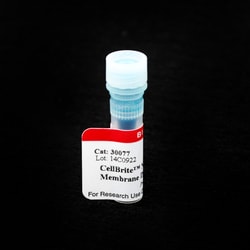
Biotium CellBrite™ NIR750 Cytoplasmic Membrane Dye, 2 mM in DMSO
CellBrite™ NIR Cytoplasmic Membrane Dyes are novel near-infrared carbocyanine dyes for labeling the cytoplasmic membranes of living cells. Due to their long emission wavelengths, near-infrared cell membrane stains can be used to label cells for near-infrared small animal imaging studies for non-invasive imaging of cell migration and cell homing. The dyes have long 18-carbon hydrophobic tails and an additional water-soluble group. These unique chemical structure elements make the dyes easy to dissolve while providing highly stable cytoplasmic membrane staining, unlike traditional carbocyanine dyes like DiI, DiO, and DiR, which are often difficult to dissolve or prone to precipitation during cell staining. CellBrite™ NIR750 has an excitation/emission of 748/780 nm.

Medchemexpress LLC FAM azide, 6-isomer | 1386385-76-7 | MFCD29912889 | 99.8% | 10 MG

FAM azide, 6-isomer is a fluorescein-derived azide labeling reagent used for fluorescent tagging and bioconjugation via click chemistry. It offers a bright fluorescein signal and an azide functional group for efficient conjugation to alkyne-containing molecules.
- Fluorescent fluorescein-based dye with azide functional group.
- Compatible with copper-catalyzed azide-alkyne cycloaddition (CuAAC).
- Compatible with strain-promoted azide-alkyne cycloaddition (SPAAC) with DBCO/BCN reagents.
- Supplied as a solid; solution variants in DMSO are also available from some suppliers.
- Molecular weight 458.42 and CAS 1386385-76-7; high purity for labeling applications.
- Available in small pack sizes suitable for research-scale labeling.
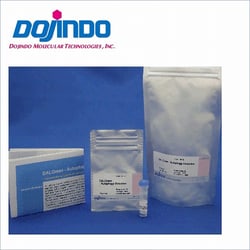
Dojindo Molecular Technologies Inc DAPGreen–Autophagy Detection(5 nmol)
DAPGreen is used to detect autophagy in live cells. Autophagy is an intracellular degradation system, where dysfunctional proteins and organelles are degraded. In this process, aggregated dysfunctional proteins are surrounded by the double membrane to form an autophagosome. The small fluorescent molecule DAPGreen is used to detect autophagosomes and autolysosomes. The mechanism has been suggested to be that the dye is incorporated into the autophagosome during double-membrane formation via structural features and then emits fluorescence under hydrophobic conditions (λex: 450 nm, λem: 535 nm). DALGreen is cell-permeable, has no requirement of transfection method, and enables live-cell imaging with fluorescence microscopy, plate reader, and flow cytometry. For monitoring only autolysosomes, we recommend DALGreen [D675], as it allows the detection of phagosome-lysosome fusion. Dojindo offers various reagents for autophagy research. (https://www.dojindo.com/autophagy-research/#jmp-b)
Biotium ViaFluor 405 Live Cell Microtubule Stain, Trial Size
ViaFluor™ 405 is a blue fluorescent taxol probe with excitation/emission at 408/452 nm that allows fluorescent staining of microtubules in living cells for detection in the DAPI channel. Supplied at 1000X in DMSO, with a vial of 100 mM verapamil, which can enhance staining in some cell types.
Dojindo Molecular Technologies Inc PlasMem Bright Green dye (100 ul) offers plasma membrane staining for 24 hrs+ with clear visualization, high retentivity, low toxicity, water-soluble, no washing, applicable to live and fixed cells.
The plasma membrane consists of a lipid bilayer separating the intracellular environment from the extracellular space. Thus, the PM plays a central role in many cell behaviors such as cell migration, cell stretching, and signaling cascades. Additionally, PM dysfunction is an important biomarker because it is related to cell status and is linked to many diseases. PlasMem Bright dyes have higher retentivity on the plasma membrane. Furthermore, PlasMem Bright dyes are more water-soluble compared with other commercially available dyes and can be diluted with the culture medium. The PlasMem Bright dyes offer two different color options (green and red) and provide ready-to-use DMSO solutions. A working solution can be prepared easily via a single dilution step using growth medium or HBSS. Dojindo offers various reagents for cell membrane research. (https://www.dojindo.com/track-the-dynamics-of-plasma-membrane/)