
Bioluminescence Assays and Reagents


BD D- Luciferin Sodium Salt
Specific for firefly luciferase in the illustrated reactions

Thermo Scientific™ pCMV-Gaussia Luc Vector for Luciferase Assays
Drive Gaussia luciferase expression as a reporter for gene regulation studies using vectors with a multiple cloning site (MCS) or control promoter (CMV or TK).
Thermo Scientific™ pCMV-Red Firefly Luc Vector for Luciferase Assays
Drive red-shifted firefly luciferase expression as a reporter for gene regulation studies using vectors with a multiple cloning site (MCS) or control promoter (CMV or TK).

Thermo Scientific™ pMCS-Cypridina Luc Vector for Luciferase Assays
Drive Cypridina luciferase expression as a reporter for gene regulation studies using vectors with a multiple cloning site (MCS) or control promoter (CMV or TK).

Thermo Scientific™ pMCS-Green Renilla Luc Vector for Luciferase Assays
Drive Green Renilla luciferase expression as a reporter for gene regulation studies using vectors with a multiple cloning site (MCS) or control promoter (CMV or TK).

Promega Nano-Glo™ Luciferase Assay System
The Nano-Glo™ Luciferase Assay System provides a simple, single-addition reagent that generates a glow-type signal in the presence of NanoLuc luciferase with a half-life of approximately 120 minutes in commonly used tissue culture media.


Promega Nano-Glo™ Dual-Luciferase™ Reporter Assay System
The Nano-Glo™ Dual-Luciferase Reporter (NanoDLR) Assay System is a homogeneous reagent system that allows you to sequentially detect the activities of firefly (Photinus pyralis) luciferase and NanoLuc luciferase (Nluc) from a single sample.

Promega QuantiLum™ Recombinant Luciferase
QuantiLum Recombinant Luciferase is a luciferase expressed from a cloned gene from the North American firefly (Photinus pyralis).

Promega ONE-Glo™ EX Luciferase Assay System
ONE-Glo™ EX Luciferase Assay System provides both the high sensitivity and long-lived luminescence required to batch-process multiple 96-, 384- or 1,536-well plates. The approximately 2-hour signal half-life provides greater flexibility in assay design.

Promega Bio-Glo™ Luciferase Assay System
The Bio-Glo™ Luciferase Assay System provides a highly sensitive, robust, homogeneous reagent, the Bio-Glo™ Assay reagent with a new luciferase substrate, for the detection of firefly luciferase reporter gene expression in the ADCC Reporter Bioassay.
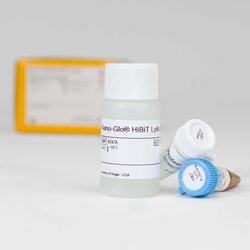
Promega Nano-Glo HiBiT Lytic Detection System, 10ml
Accurately quantify Any HiBiT Tagged Protein Expressed in Cells in an antibody free, plate based method.
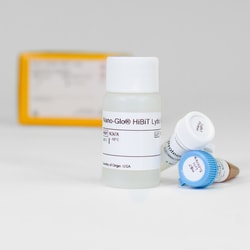
Promega Nano-Glo HiBiT Lytic Detection System, 100ml
Accurately quantify Any HiBiT Tagged Protein Expressed in Cells in an antibody free, plate based method.

Promega Transfection Carrier DNA
A plasmid DNA used to reduce the amount of an expression vector or reporter vector in mammalian cell transfection without reducing the overall amount of DNA.
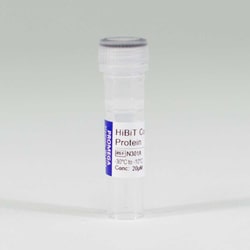
Promega HiBiT Control Protein, 100μL
A 20μm control protein. Use as a positive control with the Nano-Glo HiBiT Detection and Blotting Systems.
Promega Nano-Glo™ Dual-Luciferase™ Reporter Assay/pNL1.1.PGK Bundle
The Nano-Glo™ Dual-Luciferase Reporter (NanoDLR) Assay System is a homogeneous reagent system that allows you to sequentially detect the activities of firefly (Photinus pyralis) luciferase and NanoLuc luciferase (Nluc) from a single sample.