Substrates



ACROBiosystems Monoclonal Anti-Flag Tag Antibody Europium chelate (for TR-FRET) is expressed from Mouse HEK293, 5000 tests
Monoclonal Anti-Flag Tag Antibody Europium chelate (for TR-FRET) is expressed from Mouse HEK293


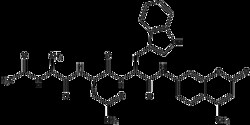
AdipoGen Ac-Ala-Asn-Trp-AMC [Ac-ANW-AMC], 2 mg
Ac-Ala-Asn-Trp-AMC [Ac-ANW-AMC] (2 mg), AdipoGen Life Sciences. Chemical. Formula: C30H32N6O7. MW: 588.6. Synthetic. Ac-ANW-AMC is a fluorogenic peptide substrate for measuring chymotrypsin-like activity of the immunoproteasome. Hydrolysis of this substrate by the beta5i-subunit of the immunoproteasome is monitored by observing fluorescence at an Excitation wavelength of 345nm and Emission at 445nm. This substrate is specific to the immunoproteasome and is not hydrolyzed efficiently by the constitutive proteasome.

Medchemexpress LLC L-glutamic acid gamma-(7-amido-4-methylcoumarin) | 98516-76-8 | MFCD00051217 | >98.0% | 304.30 g·mol⁻¹ | C15H16N2O5 | 100 MG

H-Glu(AMC)-OH is a fluorescent amino acid derivative used as a peptide substrate to measure aminopeptidase A activity. The compound contains a 7-amino-4-methylcoumarin (AMC) fluorophore linked to glutamic acid; enzymatic cleavage releases the fluorescent AMC reporter for sensitive detection. Supplied as a solid for research use, it is suitable for kinetic and end-point enzymology assays.

Medchemexpress LLC Z-Gly-Pro-Arg-AMC hydrochloride | 201928-42-9 | 99.2% | 656.13 | 1 MG
Z-Gly-Pro-Arg-AMC hydrochloride is a fluorescent substrate for trypsin and cathepsin K. This compound can be utilized to determine the activity of both trypsin and cathepsin K enzymes.
- Fluorescent trypsin and cathepsin K substrate
- Used to determine trypsin and cathepsin K activity

Medchemexpress LLC Arg-Arg-AMC acetate | 487.56 | 1 MG
Arg-Arg-AMC acetate is the acetate salt form of Arg-Arg-AMC. It functions as a fluorescent substrate for cathepsin B and is utilized in cathepsin B activity assays.
- Fluorescent substrate for cathepsin B
- Used in cathepsin B activity assays
- Acetate salt form


AURORA BIOLABS LLC Aurora Biolabs TR-FRET Assay Kit, PARP2 Target, Trapping Activity, 40 Rxn
The TR-FRET PARP2 Trapping Assay Kit is designed to quantify PARP2 poly-ADP-ribosylation activity and monitor PARP2 trapping on DNA substrates. The assay utilizes a Terbium-labeled anti-Tag2 antibody donor and a fluorophore-labeled DNA acceptor to measure binding via fluorescence resonance energy transfer. Auto-PARylation of PARP2 in the presence of NAD+ causes dissociation from DNA, reducing the FRET signal, while PARP2 trapping maintains a high signal.
- Quantitative assessment of trapping status on DNA
- Uses TR-FRET technology with 620 nm and 665 nm emission detection
- Includes 40 reactions per kit
- Requires HTRF® certified microplate reader
- Kit components include assay buffer, recombinant human protein, NAD+, fluorescence-labeled DNA substrate, and detection antibody

AURORA BIOLABS LLC Aurora Biolabs, TR-FRET, Cereblon-4C Binding Assay, 384 Reactions
The TR-FRET Cereblon-4C Binding Assay Kit is designed to measure binding affinity between Cereblon (CRBN) and its ligands. Utilizing the CRBN/DDB1/CUL4A/RBX1 complex, this assay employs TR-FRET technology with a terbium-labeled anti-Tag1 antibody and a fluorescently labeled thalidomide ligand. Quantitative measurement of the binding interaction is achieved through an HTRF signal, calculated from the ratio of emission intensities at 665 nm and 620 nm. The kit is intended for research use only.
- Measures binding affinity between the substrate-recognition component and ligands
- Detects inhibition of binding interactions when test compounds compete with thalidomide
- Quantifies results via HTRF signal ratio calculation
- Components include a protein complex, terbium-labeled antibody, and fluorophore-labeled ligand
Medchemexpress LLC Gly-Pro-AMC hydrobromide | 115035-46-6 | 98.68% | 410.26 | 25 MG
Gly-Pro-AMC hydrobromide is a fluorescent dye that serves as a specific fluorescent substrate for detecting Dipeptidyl peptidase IV (DPP-IV) activity. It is intended for research use only.
- Fluorescent dye
- Specific fluorescent substrate for detecting Dipeptidyl peptidase IV (DPP-IV) activity
- Fluorescence detection conditions: excitation wavelength 350 nm, fluorescence emission spectrum detection 450 nm