Promotional price valid on web orders only. Your contract pricing may differ. Interested in signing up for a dedicated account number?
Learn More

Invitrogen™ ADORA1 Polyclonal Antibody
GREENER_CHOICE

Catalog No. PA3041
Change view
Click to view available options
Quantity:
100 μL
1 product options available for selection
Product selection table with 1 available options. Use arrow keys to navigate and Enter or Space to select.
Catalog No. Quantity
PA3041 100 μL
Use arrow keys to navigate between rows. Press Enter or Space to select a product option. 1 options available.
1 options
Catalog No. PA3041 Supplier Invitrogen™ Supplier No. PA3041
Add to Cart
Add to Cart

Rabbit Polyclonal Antibody

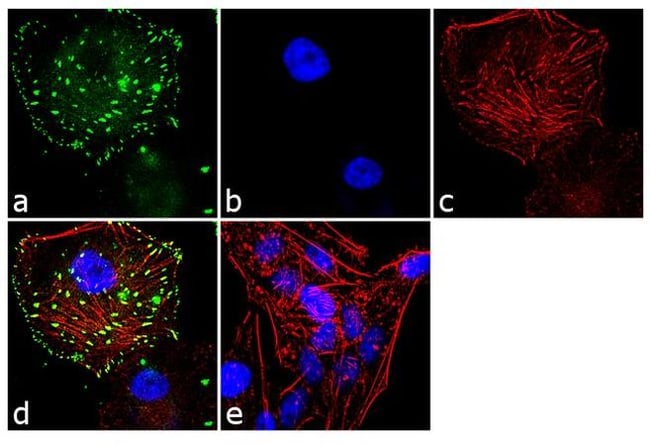
PA3-041 detects Adenosine Receptor A1 from human and mouse samples. Reactivity is stronger in mouse, and is only recommended for use in overexpressed or recombinant human samples. PA3-041 has been successfully used in Western blot applications. By Western blot PA3-041 detects a ~34-37 kDa band representing Adenosine Receptor A1 from mouse brain. The PA3-041 immunogen is a mix of synthetic peptides corresponding to the C-terminal portion of human and mouse Adenosine Receptor A1 residues. The immunizing sequences are: C(309) Q P A P P I D E D L P E E R P D D(326) for human, and C(309) Q P K P P I E E D I P E E K A D D(326) for mouse.

Adenosine receptors (ARs) are members of the 7-transmembrane domain G-protein-coupled receptor superfamily. Structural, biochemical and pharmacological analyses of the AR genes and protein has led to the discovery of four distinct AR subtypes (A1, A2a, A2b, A3). Activation of ARs mediates several receptor subtype-specific physiological processes that include cardiac rate, smooth muscle tone, platelet aggregation, inflammation, cell growth and death, and neurotransmission. The A1AR is a glycoprotein that can activate Gi and Go proteins in vitro. In intact cells, agonist occupation of the A1AR has been shown to cause pertussis toxin-sensitive inhibition of adenylyl cyclase activity and, in some systems, a stimulation of phospholipase C resulting in mobilization of intracellular calcium stores. Activation of potassium channels by A1AR has been intensively studied in relation to its dramatic effects on the cardiovascular system. A1AR protein is highly expressed in brain (especially cerebellum, hippocampus, thalamus, and cortex) and spinal cord and in part, modulates neurotransmitter release. In white adipocytes A1AR inhibits lipolysis and stimulates glucose uptake. Other tissues also express A1AR including kidney and testis.
TRUSTED_SUSTAINABILITY

Specifications

Antigen ADORA1
Applications Western Blot, Immunocytochemistry
Classification Polyclonal
Concentration Conc. Not Determined
Conjugate Unconjugated
Formulation Whole serum with 0.05% sodium azide
Gene ADORA1
Gene Accession No. P30542, Q60612
Gene Alias A1AR; A1-AR; A1R; AA1R; adenosine A1 receptor; adenosine A1 receptor variant 1; adenosine A1 receptor variant 2; adenosine receptor A1; ADO-A1 receptor; ADORA1; AI848715; AR; BB176431; RDC7; Ri
Gene Symbols ADORA1
Host Species Rabbit
Immunogen Synthetic peptides corresponding to the C-terminal portion of human and mouse Adenosine Receptor A1.
Quantity 100 μL
Regulatory Status RUO
Primary or Secondary Primary
Gene ID (Entrez) 11539, 134
Target Species Human, Mouse
Content And Storage -20°C, Avoid Freeze/Thaw Cycles
Product Type Antibody
Form Liquid
Isotype IgG
Show More Show Less
Product Title
Select an issue

By clicking Submit, you acknowledge that you may be contacted by Fisher Scientific in regards to the feedback you have provided in this form. We will not share your information for any other purposes. All contact information provided shall also be maintained in accordance with our Privacy Policy.