Promotional price valid on web orders only. Your contract pricing may differ. Interested in signing up for a dedicated account number?
Learn More
Learn More
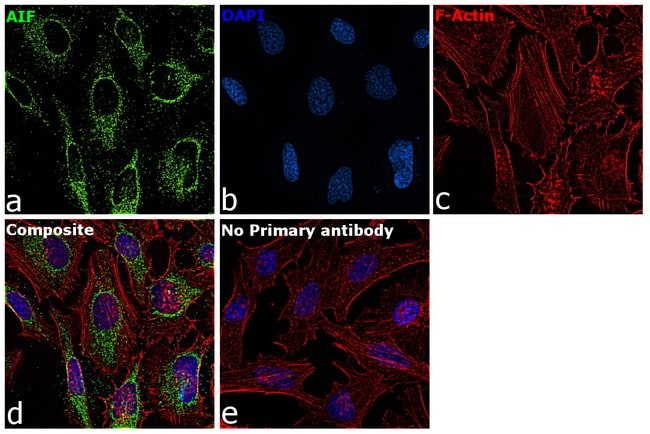

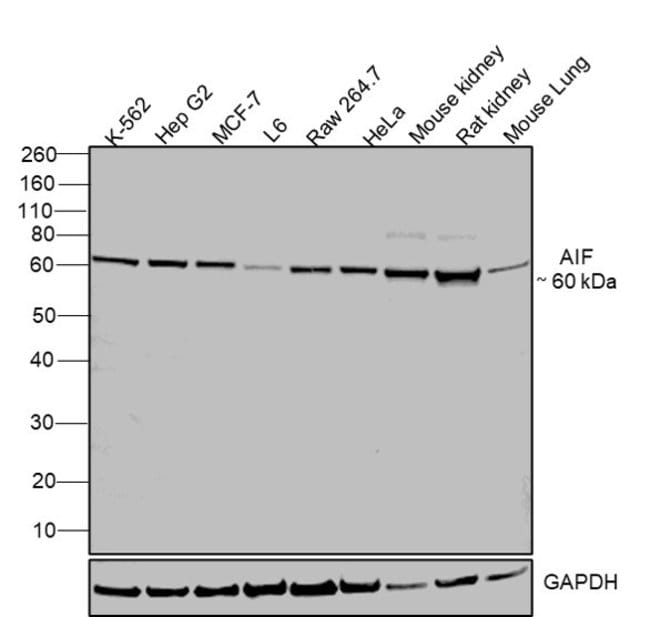
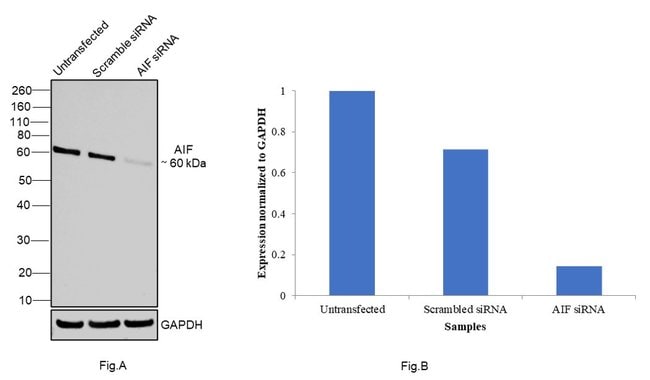
Invitrogen™ AIF Polyclonal Antibody

Description
It is not recommended to aliquot this antibody.
Apoptosis Inducing Factor (AIF) causes chromatin condensation and DNA fragmentation. AIF was recently identified, and cloned. Apoptosis is characterized by several morphological nuclear changes including chromatin condensation and nuclear fragmentation. These changes are triggered by the activation of members of caspase family, caspase activated DNase, and several novel proteins. Like the critical molecules, cytochrome c and caspase-9, in apoptosis, AIF localizes in mitochondria. AIF translocates to the nucleus when apoptosis is induced and induces mitochondria to release the apoptogenic proteins cytochrome c and caspase-9. AIF induces chromatin condensation and large scale DNA fragmentation, which are the hallmarks of apoptosis, of the isolated nucleus and the nucleus in live cells by microinjection and apoptosis stimuli. AIF is highly conserved between human and mouse and widely expressed. Mutations in the AIF gene cause combined oxidative phosphorylation deficiency 6, which results in a severe mitochondrial encephalomyopathy. Alternative splicing results in multiple transcript variants of AIF and a related pseudogene has been identified on chromosome 10.

Specifications
Specifications
| Antigen | AIF |
| Applications | Immunoprecipitation, Western Blot, Immunocytochemistry, Western Blot |
| Classification | Polyclonal |
| Concentration | 33 μg/mL |
| Conjugate | Unconjugated |
| Formulation | 0.01M HEPES with 100μg/mL BSA, 50% glycerol, 0.15M NaCl and no preservative; pH 7.5 |
| Gene | AIFM1 |
| Gene Accession No. | O95831, Q9JM53, Q9Z0X1 |
| Gene Alias | AG1; AGR1; Aif; AIFM1; AIFsh2; apoptosis inducing factor mitochondria associated 1; apoptosis inducing factor, mitochondria associated 1; apoptosis-inducing factor 1, mitochondrial; apoptosis-inducing factor, mitochondrion-associated 1; apoptosis-inducing factor, mitochondrion-associated, 1; CMT2D; CMTX4; COWCK; COXPD6; DFNX5; ER protein 18; ER protein 19; ERP18; ERP19; hAG-1; harlequin; Hq; hTLP19; MGC111425; mitochondrial apoptosis-inducing factor 1; NADMR; NAMSD; pcd8; PDCD8; PDIA16; programmed cell death 8 (apoptosis-inducing factor); programmed cell death protein 8; RP3-438D16.2; striatal apoptosis-inducing factor; testicular secretory protein Li 4; TLP19; UNQ713/PRO1376 |
| Gene Symbols | AIFM1 |
| Show More |
Product Title
By clicking Submit, you acknowledge that you may be contacted by Fisher Scientific in regards to the feedback you have provided in this form. We will not share your information for any other purposes. All contact information provided shall also be maintained in accordance with our Privacy Policy.
Spot an opportunity for improvement?