Learn More
Description
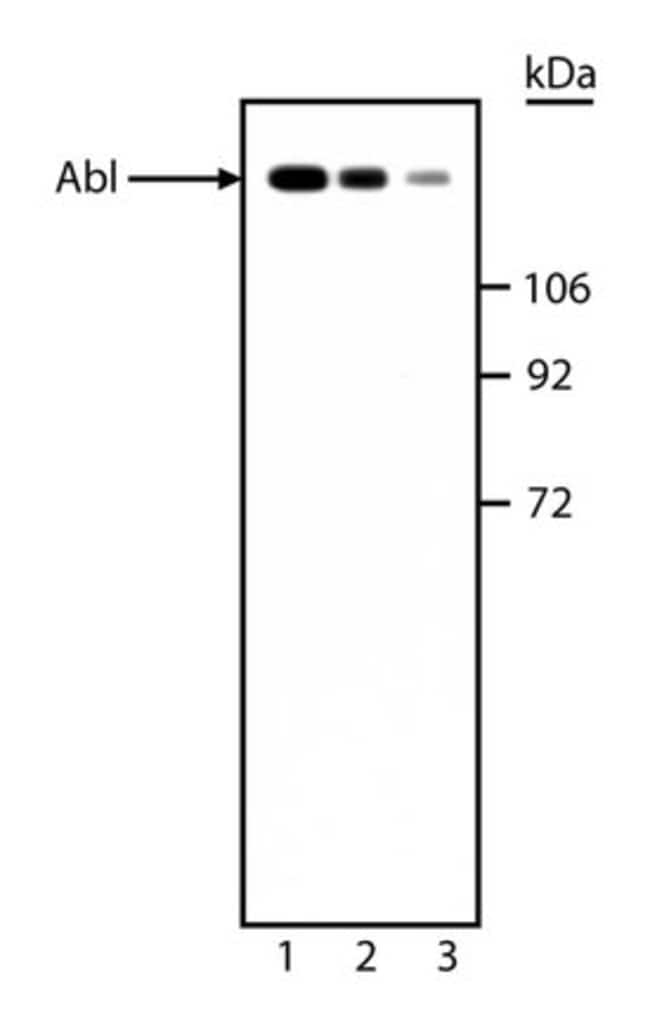
The proto-oncogene c-abl was first isolated from the mouse genome as a gene with similarity to the v-abl oncogene of Abelson murine leukemia virus. The c-abl gene encodes a protein tyrosine kinase that is localized in the cytoplasm and nucleus. The c-abl protein shares several common features with other cytoplasmic tyrosine kinases, including the src-homology domains 2 (SH2) and 3 (SH3). The SH2 domain is believed to bind specifically to tyrosine residues of other proteins. The function of the SH3 domain is still unclear. Unique to the c-abl tyrosine kinase is a large C-terminal segment which seems to be essential for its biological function, since mice homozygous for a C-terminal deletion of c-abl have multiple defects at birth. The C-terminal fragment of c-abl contains a DNA-binding domain, and the DNA-binding affinity of this domain seems to be regulated by phosphorylation of critical serine/threonine residues. The c-abl proto-oncogene can be activated in a variety of ways. For example, in Philadelphia chromosome (Ph1)-positive leukemias the c-abl proto-oncogene on chromosome 9 becomes fused to the bcr gene on chromosome 22, and bcr-abl fusion proteins are produced. Ph1-positive cells express either the a-typical 210 kDa bcr-abl fusion protein or a smaller 185 kDa bcr-abl fusion protein. The bcr sequences activate the c-abl tyrosine kinase by deregulating its expression, and actin filament-binding function associated with c-abl is also activated. Expression of bcr-abl fusion proteins in vitro leads to transformation of pre-B lymphoid cells supporting their role as an oncogene. The phosphorylated form of c-abl is observed at ∽145 kDa on SDS/PAGE. The 8E9 clone has been reported to react with an epitope in the tyrosine kinase domain of murine abl proteins [Wang et al .].

Specifications
Specifications
| Antigen | ABL |
| Applications | Western Blot |
| Classification | Monoclonal |
| Clone | 8.00E+09 |
| Concentration | 0.5mg/mL |
| Conjugate | Unconjugated |
| Formulation | Aqueous buffered solution containing ≤0.09% sodium azide. |
| Host Species | Mouse |
| Immunogen | Recombinant Mouse Abl Gag Fusion Protein |
| Purification Method | Affinity Purified |
| Show More |
For Research Use Only.
By clicking Submit, you acknowledge that you may be contacted by Fisher Scientific in regards to the feedback you have provided in this form. We will not share your information for any other purposes. All contact information provided shall also be maintained in accordance with our Privacy Policy.