Learn More
Description
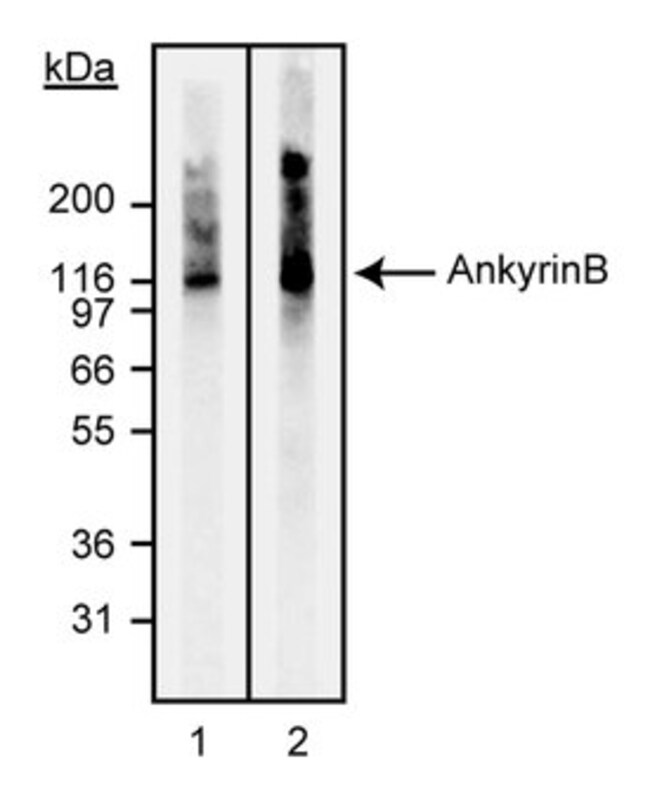
Ankyrins are a family of proteins which were first discovered in erythrocytes and shown to bind to spectrin, a primary component of the cytoskeletal architecture. They have since been shown to be expressed at very high levels in the vertebrate brain and are also found in other cell types. Ankyrins function by acting as adaptors to link integral membrane proteins, including cell adhesion and ion channel molecules to the cytoskeleton. The structure of ankyrin consists of three domains, two highly conserved N-terminal and one C-terminal variable domain. The conserved regions contain a membrane-binding domain of ∽89-95 kDa and a spectrin-binding domain of ∽62 kDa, while the variable region has pre-mRNA alternative splice sites. Two ankyrins have been extensively characterized: ankryin R is the product of the ANK1 gene and is primarily expressed in the brain, although alternatively spliced forms are found in erythrocytes; ankyrin B is the product of the ANK2 gene, located on a different chromosome from ANK1, and is primarly expressed in neonatal and adult brain but is also found in heart, lymphocytes and platelets. Studies done on ankyrinB (-/-) knockout mice, which die by postnatal day 21, have demonstrated a link between the L1 cell adhesion molecule and ankyrin B in premyelinated axons. Isoforms of ankyrin B have been reported to be detectable ranging from approximately 440, 220, 150 and 110 kDa in western blot analysis, depending on the tissue-type of origin.
This antibody is routinely tested by western blot analysis. Other applications were tested at BD Biosciences Pharmingen during antibody development only or reported in the literature.

Specifications
Specifications
| Antigen | Ankyrin B |
| Applications | Western Blot |
| Classification | Monoclonal |
| Clone | 2.2 |
| Concentration | 0.5mg/mL |
| Conjugate | Unconjugated |
| Formulation | Aqueous buffered solution containing ≤0.09% sodium azide. |
| Host Species | Mouse |
| Immunogen | Human Ankyrin B Spectrin Binding Domain Peptide |
| Purification Method | Affinity Purified |
| Show More |
By clicking Submit, you acknowledge that you may be contacted by Fisher Scientific in regards to the feedback you have provided in this form. We will not share your information for any other purposes. All contact information provided shall also be maintained in accordance with our Privacy Policy.