Learn More

Description
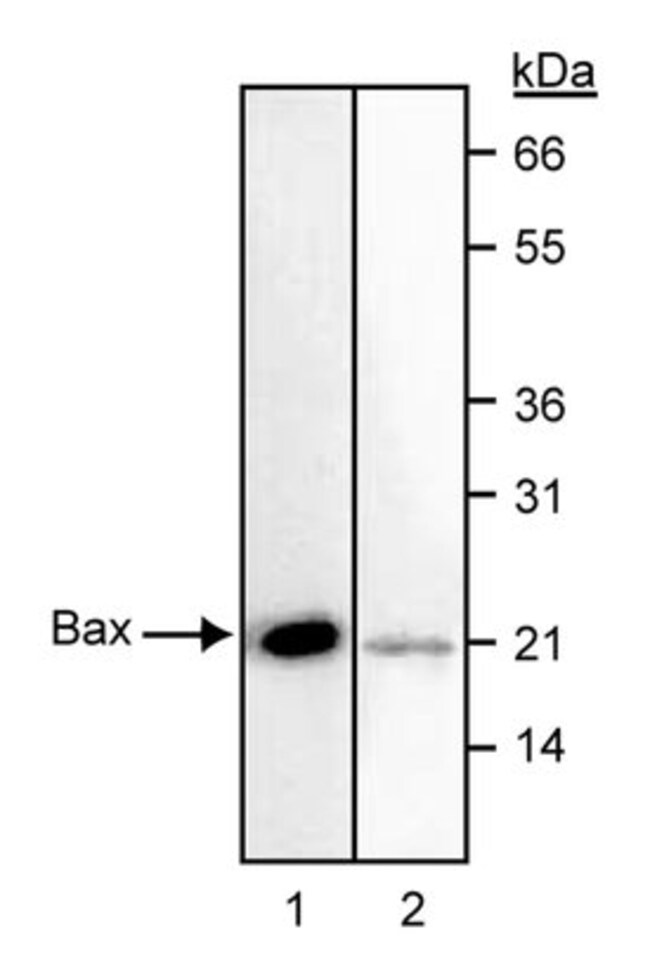
The Bcl-2 family members are involved in mediating programmed cell death or apoptosis, and share two highly conserved functional regions, Bcl-2 homology 1 and 2 (BH1 and BH2). Several of the family members including Bcl-2 act as inhibitors of apoptosis, whereas others such as Bax promote cell death. It is thought that protein-protein interactions between Bcl-2 family members play an important role in their function. For example, Bax may form homodimers or heterodimers with either Bcl-2 and Bcl-XL (long). Bax homodimers is thought to promote cell death, whereas Bax heterodimerization with either Bcl-2 and Bcl-XL appears to block cell death. When Bax is present in excess, it can counteract the ability of Bcl-2 to inhibit cell death. Bax expression has been identified in a variety of tissues, including lung, stomach, kidney, thymus, lymph nodes, bone marrow, spleen, heart, exocrine pancreas, and brain. Liver, kidney, and the exocrine pancreas have been found to contain little or no Bcl-2. The Bax gene potentially encodes three different proteins Bax-α (21 kDa), Bax-β (24 kDa) and Bax-γ (5 kDa). Bax-α is the most common transcript.

Specifications
Specifications
| Antigen | Bax |
| Applications | Western Blot |
| Classification | Monoclonal |
| Clone | 6A7 |
| Concentration | 0.5mg/mL |
| Conjugate | Unconjugated |
| Formulation | Aqueous buffered solution containing ≤0.09% sodium azide. |
| Host Species | Mouse |
| Immunogen | N-terminal peptide sequence |
| Purification Method | Affinity Purified |
| Show More |
For Research Use Only.
By clicking Submit, you acknowledge that you may be contacted by Fisher Scientific in regards to the feedback you have provided in this form. We will not share your information for any other purposes. All contact information provided shall also be maintained in accordance with our Privacy Policy.