Learn More

Description
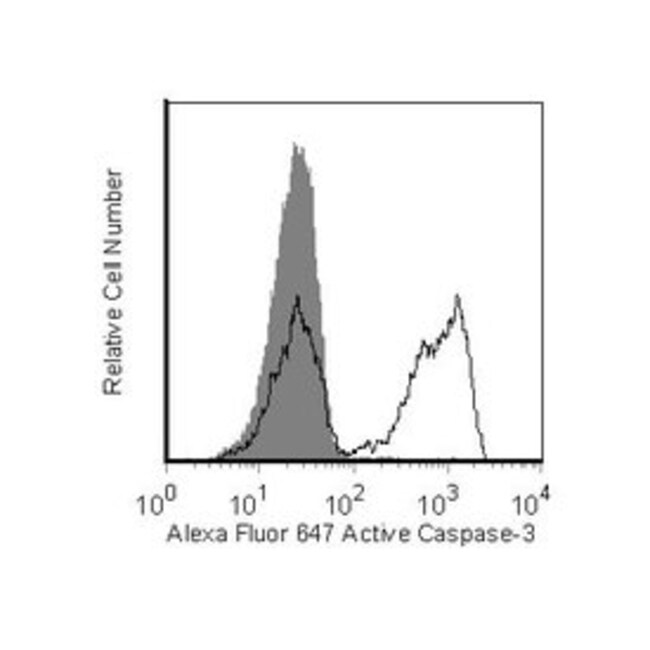
The caspase family of cysteine proteases plays a key role in apoptosis and inflammation. Caspase-3 is a key protease that is activated during the early stages of apoptosis and, like other members of the caspase family, is synthesized as an inactive pro-enzyme that is processed in cells undergoing apoptosis by self-proteolysis and/or cleavage by another protease. The processed forms of caspases consist of large (17-22 kDa) and small (10-12 kDa) subunits which associate to form an active enzyme. Active caspase-3, a marker for cells undergoing apoptosis, consists of a heterodimer of 17 and 12 kDa subunits which is derived from the 32 kDa pro-enzyme. Active caspase-3 proteolytically cleaves and activates other caspases, as well as relevant targets in the cytoplasm, e.g., D4-GDI and Bcl-2, and in the nucleus (e.g. PARP). This antibody has been reported to specifically recognize the active form of caspase-3 in human and mouse cells. It has not been reported to recognize the pro-enzyme form of caspase-3.

Specifications
Specifications
| Antigen | Caspase-3 |
| Applications | Flow Cytometry |
| Classification | Monoclonal |
| Clone | C92-605 |
| Conjugate | Alexa Fluor 647 |
| Description | CPP32; Yama; Apopain |
| Formulation | Aqueous buffered solution containing BSA and ≤0.09% sodium azide. |
| Host Species | Rabbit |
| Immunogen | Human Active Caspase-3 Fragment |
| Purification Method | Affinity Purified |
| Show More |
Safety and Handling
By clicking Submit, you acknowledge that you may be contacted by Fisher Scientific in regards to the feedback you have provided in this form. We will not share your information for any other purposes. All contact information provided shall also be maintained in accordance with our Privacy Policy.