Learn More
Description
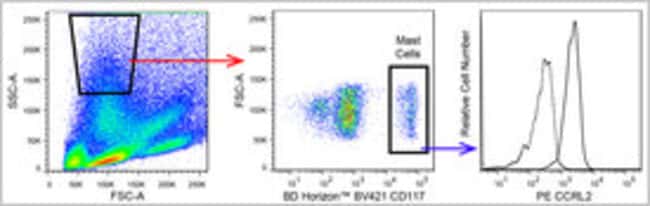
The BZ2E3 monoclonal antibody specifically binds to CCRL2 (C-C chemokine receptor-like 2) which is also known as Lipopolysaccharide-inducible C-C chemokine receptor (L-CCR/Lccr). CCRL2 is a chemokine receptor-like, 7-transmembrane protein that can bind CCL19 or the nonchemokine chemoattractant, chemerin/RARRES2. CCRL2 is expressed by a variety of cell types including mast cells, macrophages and some endothelial cells. CCRL2 appears to play various roles in regulating chemokine activities, e.g., by binding and internalizing excess local levels of the CCL19 /MIP-3β chemokine. Alternatively, endothelial cell-expressed CCRL2 can bind and present the chemerin/RARRES2 chemoattractant to lymphoid cells that express the functional signaling receptor, CMKLR1, and promote their adhesion.

Specifications
Specifications
| Antigen | CCRL2 |
| Applications | Flow Cytometry |
| Classification | Monoclonal |
| Clone | BZ2E3 |
| Concentration | 0.2mg/mL |
| Conjugate | PE |
| Description | C-C chemokine receptor-like 2; L-CCR; Lccr; Cmkbr1l2; Ackr5 |
| Formulation | Aqueous buffered solution containing ≤0.09% sodium azide. |
| Host Species | Rat |
| Immunogen | Mouse CCRL2 Peptide |
| Show More |
By clicking Submit, you acknowledge that you may be contacted by Fisher Scientific in regards to the feedback you have provided in this form. We will not share your information for any other purposes. All contact information provided shall also be maintained in accordance with our Privacy Policy.