Learn More
Description
Platelet-derived growth factor (PDGF) is a potent mitogen for cells of mesenchymal origin and exerts its effects by binding to the PDGF receptor (PDGFR), a transmembrane protein tyrosine kinase. PDGFR is composed of PDGFRα (CD140a) and/or PDGFRβ (CD140b) polypeptides. Both PDGF and PDGFR consist of subunits that form homo- or heterodimers with varying specificities: PDGF-AA binds only to αα PDGFR, PDGF-AB binds to both αα and αβ PDGFR, and PDGF-BB binds to all three PDGFRs . Ligand binding induces dimerization and activation of the receptor. Upon activation, CD140b is phosphorylated at multiple tyrosine sites and, in turn, an intracellular phosphorylation cascade is initiated. PDGFR localizes primarily to membrane invagin ations termed caveolae, compartments that are enriched in several of its downstream effectors, including phosphatidylinositol 3'-kinase, Src, and phospholipase C-γ(PLC-γ).
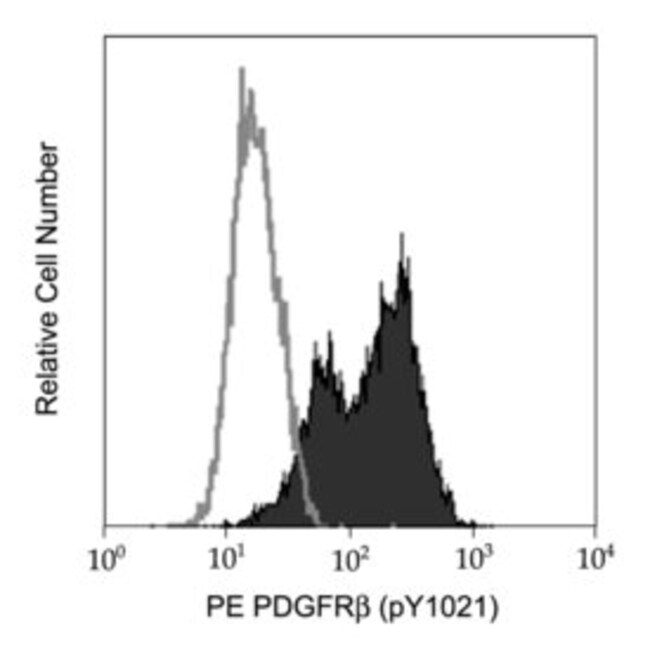
The J105-412 monoclonal antibody recognizes the phosphorylated tyrosine 1021 (pY1021 ) in the C-terminal noncatalytic region of CD140b, which interacts primarily with PLC-γ. The orthologous phosphorylation site in mouse PDGFRβ is Y1020.

Specifications
Specifications
| Antigen | CD140b (pY1021) |
| Applications | Flow Cytometry |
| Classification | Monoclonal |
| Clone | J105-412 |
| Conjugate | PE |
| Description | PDGF Receptor β |
| Formulation | Aqueous buffered solution containing BSA and ≤0.09% sodium azide. |
| Host Species | Mouse |
| Immunogen | Phosphorylated Human PDGFRβ Peptide |
| Purification Method | Affinity Purified |
| Show More |
By clicking Submit, you acknowledge that you may be contacted by Fisher Scientific in regards to the feedback you have provided in this form. We will not share your information for any other purposes. All contact information provided shall also be maintained in accordance with our Privacy Policy.