Learn More
Description
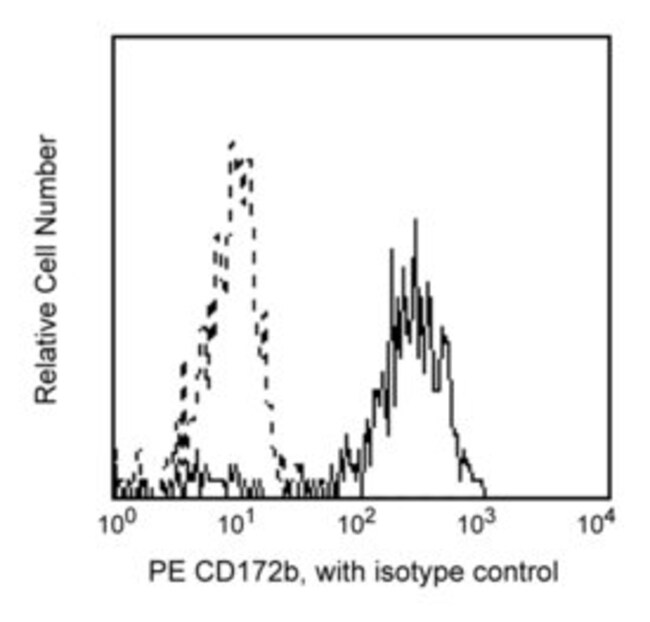
Reacts with a 50 kDa, type I transmembrane glycoprotein known as signal regulatory protein β (SIRPβ). The SIRPs are members of the immunoglobulin superfamily. SIRPβ does not possess a cytoplasmic domain but instead the transmembrane domain contains a positively-charged residue that interacts with one other transmembrane protein (DAP-12 or KARAP). DAP-12 has two immunoreceptor tyrosine-based activation motifs (ITAM) within its cytoplasmic domain that are thought to link SIRPβ to activating machinery. SIRPβ is expressed on peripheral blood monocytes and granulocytes, but is not expressed on CD34+ cells. SIRPα and SIRPβ have complementary roles in signal regulation and may work together in tuning the response to a stimulus

Specifications
Specifications
| Antigen | CD172b |
| Applications | Flow Cytometry |
| Classification | Monoclonal |
| Clone | B4B6 |
| Conjugate | PE |
| Description | SIRPB1; SIRP-BETA-1; SIRPβ1; SIRPbeta; SIRP beta |
| Formulation | Aqueous buffered solution containing BSA and ≤0.09% sodium azide. |
| Host Species | Mouse |
| Immunogen | Human SIRPβ1 extracellular domain Recombinant Protein |
| Purification Method | Affinity Purified |
| Show More |
For Research Use Only.
By clicking Submit, you acknowledge that you may be contacted by Fisher Scientific in regards to the feedback you have provided in this form. We will not share your information for any other purposes. All contact information provided shall also be maintained in accordance with our Privacy Policy.