Learn More
Description
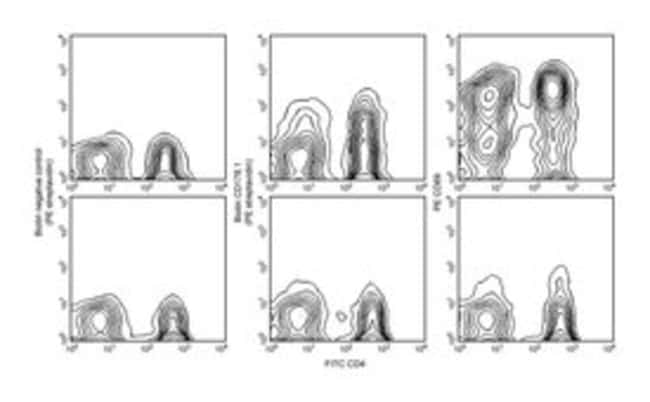
The Kay-10 antibody reacts with CD178.1, the Fas Ligand alloantigen (mFasL.1, CD95 Ligand) expressed on activated T lymphocytes of selected strains of mice (eg, C57BL/6, C3H, MRL, NOD, NZB, NZW, and SJL). It does not react with similarly activated T blasts from BALB/c, DBA/1, or DBA/2 mice. It also reacts with Cos cells transfected with mFasL cDNA derived from C57BL/6 and C3H mice, but not with mFasL cDNA from BALB/c or DBA/2 mice. In addition, Kay-10 mAb efficiently blocks cytotoxic activity of a C3H T-cell line, but not a BALB/c T-cell line. Phenotypic and genotypic characterizations of mouse Fas Ligand reveal the existence of two alloantigens: mFasL.1, which is recognized by mAbs Kay-10, MFL3 (Cat. no. 555291), and MFL4 (Cat. no. 555022), and mFasL.2 (recognized by mAbs MFL3 and MFL4). Functional studies suggest that mFasL.2 has higher specific activity than mFasL.1. In the mouse, FasL is expressed on activated T cell lines and in spleen, testis, and eye. FasL mRNA has been demonstrated at various levels in bone marrow, thymus, spleen, lymph node, lung, small intestine, testis, and uterus. Moreover, T-cell activators, but not B-cell activators, enhanced the expression of mRNA was restricted to the T-cell lineage among a panel of cell lines from lymphoid tissues. Fas Ligand is not functional in mice homozygous for the gld(generalized lymphoproliferative disease) mutation; these mice cannot limit the expansion of activated lymphocytes and develop autoimmune disease. Fas Ligand is a member of the TNF/NGF family which binds to CD95 (Fas), inducing apoptotic cell death. This Fas/Fas Ligand interaction is believed to participate in T-cell development, the regulation of immune responses, and cell-mediated cytotoxic mechanisms. There is mounting evidence that Fas Ligand is also pro-inflammatory, mediating neutrophil extravasation and chemotaxis. Fas Ligand is released from the surface of transfectant cells by metalloproteinases, and the soluble Fas Ligand may block the activities of the membrane-bound molecule.

Specifications
Specifications
| Antigen | CD178.1 |
| Applications | Flow Cytometry |
| Classification | Monoclonal |
| Clone | KAY-10 |
| Concentration | 0.5mg/mL |
| Conjugate | Biotin |
| Description | mFasL.1, CD95 Ligand |
| Formulation | Aqueous buffered solution containing ≤0.09% sodium azide. |
| Host Species | Mouse |
| Immunogen | Transfected cell line |
| Show More |
For Research Use Only.
By clicking Submit, you acknowledge that you may be contacted by Fisher Scientific in regards to the feedback you have provided in this form. We will not share your information for any other purposes. All contact information provided shall also be maintained in accordance with our Privacy Policy.