Learn More
Description
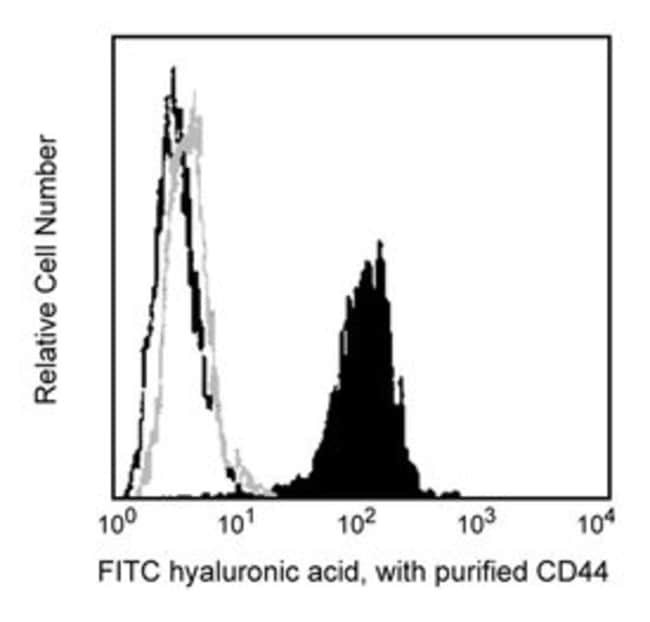
The KM114 antibody reacts with an epitope on both alloantigens and all isoforms of the CD44 glycoprotein (Pgp-1, Ly-24). The KM114 hybridoma was produced at the same time as the published clone KM201, and the mAb recognizes a different epitope from that recognized by mAb IM7. The standard form of CD44, lacking variable exons and referred to as CD44H or CD44S, is widely expressed on hematopoietic and non-hematopoietic cells. CD44 isoforms encoded by variable exons are expressed on epithelial cells, but only at low levels on most leukocytes. Mice with the Ly-24.1 alloantigen (e.g., BALB/c, CBA/J, DBA/1, DBA/2) have relatively large subsets of CD44H+ T lymphocytes, while Ly-24.2 strains (e.g., A, AKR, CBA/N, C3H/He, C57BL, C57BR, C57L, C58, NZB, SJL, SWR, 129) have lower expression of CD44H on T cells. CD44 is a cell adhesion receptor, and its ligand, hyaluronate, is a common component of extracellular matrices. Differential glycosylation of CD44 influences its binding to hyaluronate. Additional ligands include the cell-surface form of CD74 and the cytokine osteopontin (Eta-1).10 Bone marrow- and thymus-derived progenitor cells capable of repopulating the thymus express CD44. In the periphery, the level of CD44 expression increases upon activation of B lymphocytes, CD4+ T cells, and CD8+ T cells; and memory cells can be recognized by their CD44[hi] phenotype. KM114 antibody can be used in ELISA to detect soluble CD44, and it is effective for in vitro blocking of hyaluronate recognition by CD44. It has been reported that KM114 mAb cross-reacts with CD44 of the Chinese hamster, Cricetulus griseus, but not human CD44.

Specifications
Specifications
| Antigen | CD44 |
| Applications | Flow Cytometry |
| Classification | Monoclonal |
| Clone | KM114 |
| Concentration | 0.5mg/mL |
| Conjugate | Unconjugated |
| Description | Pgp-1, H-CAM, Ly-24 |
| Formulation | Aqueous buffered solution containing ≤0.09% sodium azide. |
| Host Species | Rat |
| Immunogen | (C57BL/6 x DBA/2)F1 mouse bone marrow-derived stromal cell clone BMS2 |
| Show More |
By clicking Submit, you acknowledge that you may be contacted by Fisher Scientific in regards to the feedback you have provided in this form. We will not share your information for any other purposes. All contact information provided shall also be maintained in accordance with our Privacy Policy.