Learn More
Description
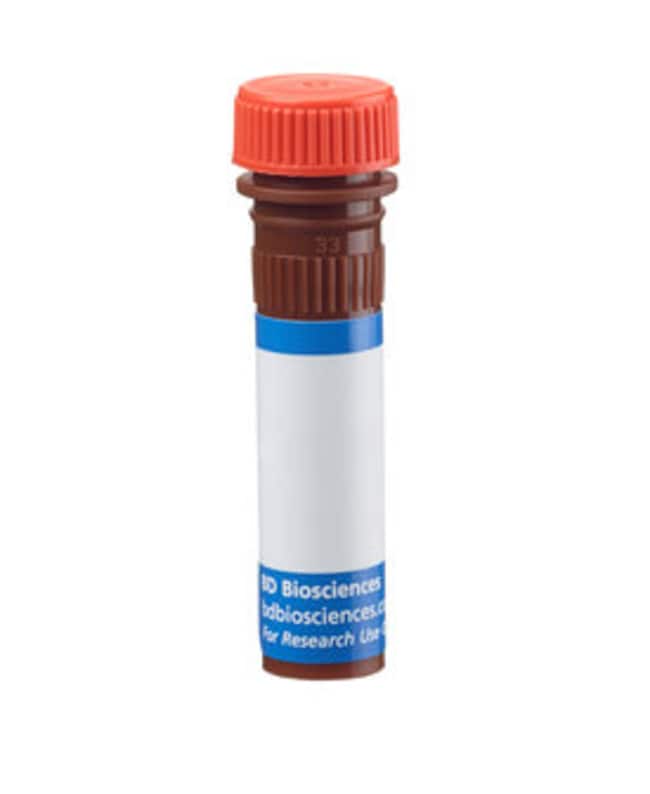
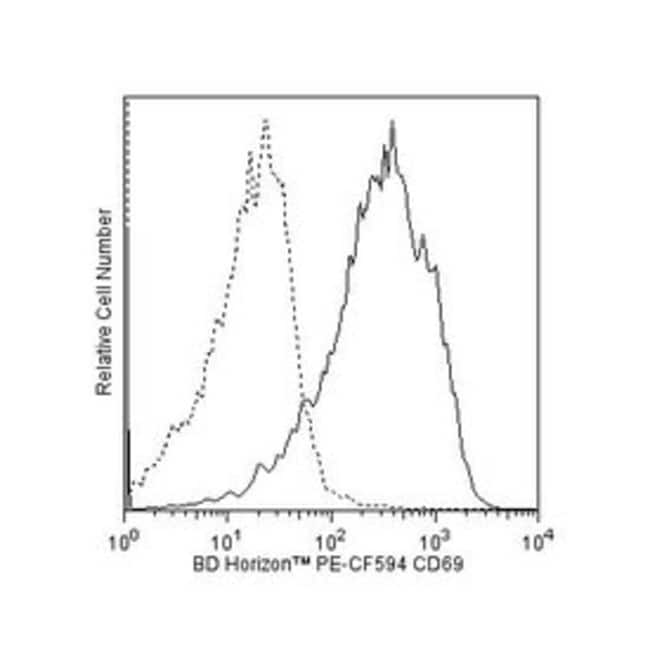
The H1.2F3 monoclonal antibody specifically binds to CD69 (Very Early Activation antigen), an 85 kDa disulfide-linked homodimer of differentially glycosylated subunits. CD69 is a C-type lectin, most closely related to the NKR-P1 and Ly-49 NK cell-activation molecules. Its expression is rapidly induced upon activation of lymphocytes (T, B, NK, and NK-T cells), neutrophils, and macrophages. CD69 is expressed also on thymocytes that are undergoing positive selection; its role in that process is unclear. H1.2F3 mAb augments PMA-induced T-cell stimulation and IFN- γ-induced macrophage stimulation. IL-2-activated NK cells express CD69, and H1.2F3 mAb induces redirected lysis of FcR-bearing target cells by NK cells.
This antibody is conjugated to BD Horizon™ PE-CF594, which has been developed exclusively by BD Biosciences as a better alternative to PE-Texas Red™. PE-CF594 excites and emits at similar wavelengths to PE-Texas Red™ yet exhibits improved brightness and spectral characteristics. Due to PE having maximal absorption peaks at 496nm and 564nm, PE-CF594 can be excited by the blue (488-nm), green (532-nm) and yellow-green (561-nm) lasers and can be detected with the same filter set as PE-Texas Red™ (eg 610/20-nm filter).

Specifications
Specifications
| Antigen | CD69 |
| Applications | Flow Cytometry |
| Classification | Monoclonal |
| Clone | H1.2F3 |
| Concentration | 0.2mg/mL |
| Conjugate | PE-CF594 |
| Description | VEA; Very Early Activation Antigen; AIM; Activation Induced Molecule |
| Formulation | Aqueous buffered solution containing BSA, protein stabilizer, and ≤0.09% sodium azide. |
| Host Species | Hamster |
| Immunogen | Mouse Dendritic Epidermal T Cell Line Y245 |
| Show More |
By clicking Submit, you acknowledge that you may be contacted by Fisher Scientific in regards to the feedback you have provided in this form. We will not share your information for any other purposes. All contact information provided shall also be maintained in accordance with our Privacy Policy.