Learn More
Description
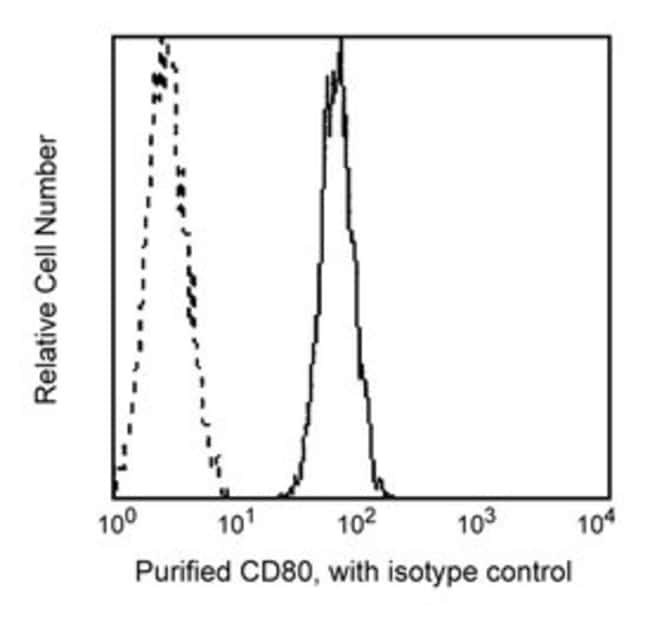
Reacts with a 60kDa transmembrane glycoprotein which was clustered as CD80 in the Fifth International Workshop on Human Differentiation Antigens. There have been several recent studies reporting discrepancies in the expression and function of CD80 when the BB1 clone is used compared to other anti-CD80 monoclonals (e.g., L307.4). Caution should therefore be used in the interpretation of data generated using BB1, as reports indicate that BB1 may recognize, in addition to CD80, CD74 and even possibly another as yet undefined molecule. CD80, a member of the Ig supergene family, is expressed on activated B cells, macrophages, and dendritic cells. It is the ligand for two molecules expressed on T cells: CD28 and CD152 (CTLA-4). CD80 is also expressed in activated CD4+ and CD8+ T cells, appearing late after activation, suggesting that activated T cells may be capable of autocrine costimulation via the CD28 activation pathway. The binding of CD28 molecule by CD28 mAb or by CD80 antigen results in T-cell activation and a signal for IL-2 production.
Host Species: Mouse
Clone: BB1
Isotype: IgM, κ
Species Reactivity: Human
Flow Cytometry

Specifications
Specifications
| Antigen | CD80 |
| Applications | Flow Cytometry |
| Classification | Monoclonal |
| Clone | BB1 |
| Concentration | 0.5mg/mL |
| Conjugate | Unconjugated |
| Description | B7-1 |
| Formulation | Aqueous buffered solution containing ≤0.09% sodium azide. |
| Host Species | Mouse |
| Purification Method | Affinity Purified |
| Show More |
For Research Use Only.
By clicking Submit, you acknowledge that you may be contacted by Fisher Scientific in regards to the feedback you have provided in this form. We will not share your information for any other purposes. All contact information provided shall also be maintained in accordance with our Privacy Policy.