Learn More
Description
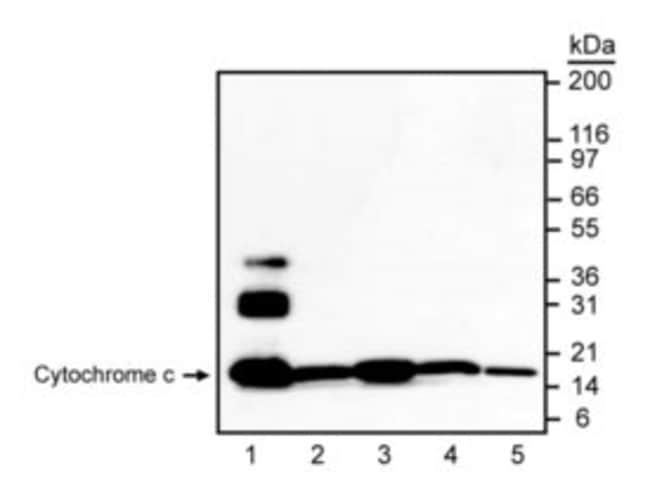
A cytochrome is an electron-transporting protein that contains a heme prosthetic group. Cytochromes have been known to be essential components of the mitochondrial respiratory chain since 1925. The iron atom of the heme group in cytochromes alternates between a reduced ferrous (+2) state and an oxidized ferric (+3) state during electron transport in oxidative phosphorylation. Cytochromes are classified into four groups (a, b, c and d) according to spectrochemical characteristics, and there are five cytochromes between coenzyme QH2 and O2 in the electron transport chain. Cytochrome c is a water-soluble protein that either promotes cell survival or death, depending upon its intracellular location. In healthy cells, it is a peripheral membrane protein of the mitochondria that transports electrons from the coenzyme QH2 cytochrome c reductase complex to the cytochrome c oxidase complex. When proapoptotic stimuli induce breakdown of the mitochondria, cytochrome c is released to the cytosol where it functions in the activation of caspases that trigger apoptosis. The 6H2.B4 monoclonal antibody has been reported to recognize the native and not the denatured form of rat, mouse, and human cytochrome c. Furthermore, studies utilizing competitive ELISA indicate that mAb 6H2.B4 binds to a region around residue 62 of rat cytochrome c. The 6H2.B4 monoclonal antibody is not useful for western blot analysis. For the western blot application, clone 7H8.2C12 (Mfr.no. 556433) would be recommended. Suggested positive controls for detecting cytochrome c include P388D mouse lymphoma cells (ATCC CCL 46),
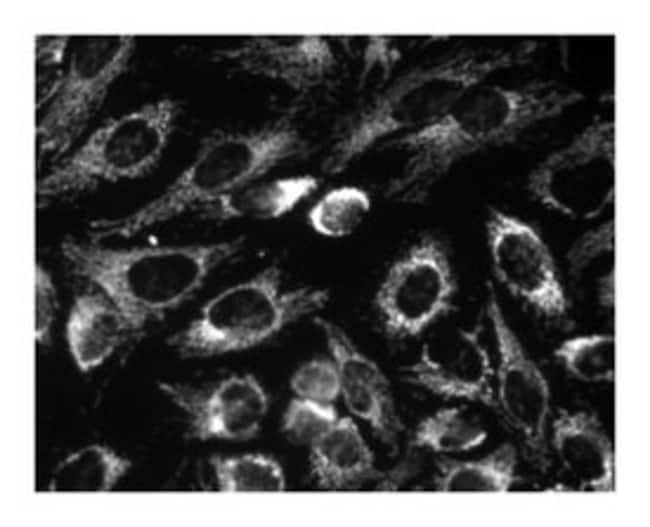
HeLa human carcinoma cells (ATCC CCL2), Jurkat T leukemia cells (ATCC TIB152) and NIH 3T3 mouse fibroblast cells (ATCC CRL 1658). This antibody is routinely tested by immunoprecipitation and immunofluorescent imaging. Other applications were tested at BD Biosciences Pharmingen during antibody development only or reported in the literature.
Host Species: Mouse
Clone: 6H2.B4
Isotype: IgG1 κ
Species Reactivity: Human
Immunogen: Rat cytochrome c
Immunoprecipitation

Specifications
Specifications
| Antigen | Cytochrome c |
| Applications | Immunoprecipitation |
| Classification | Monoclonal |
| Clone | 6H2.B4 |
| Concentration | 0.5mg/mL |
| Conjugate | Unconjugated |
| Formulation | Aqueous buffered solution containing ≤0.09% sodium azide. |
| Host Species | Mouse |
| Immunogen | Rat cytochrome c |
| Purification Method | Affinity Purified |
| Show More |
For Research Use Only.
By clicking Submit, you acknowledge that you may be contacted by Fisher Scientific in regards to the feedback you have provided in this form. We will not share your information for any other purposes. All contact information provided shall also be maintained in accordance with our Privacy Policy.