Learn More
Description
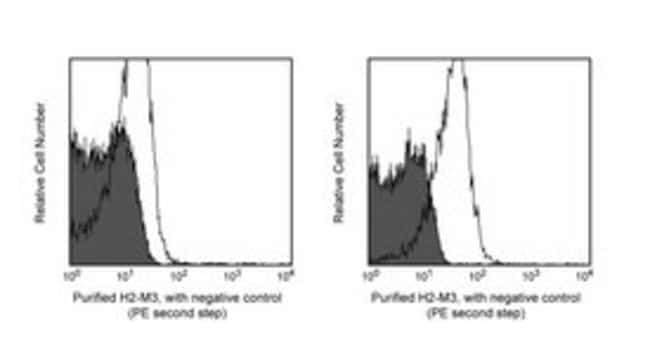
The hamster anti-mouse H2-M3 antibody (clone 130) reacts with the H2-M3 major histocompatibility complex (MHC) non-classical class Ib antigen. H2-M3 (M3) associates with β2-microglobulin and is capable of being expressed by most leukocytes. However, due to a lack of endogenous antigens, M3 has been reported to be undetectable on most cells. Its expression is induced by high-affinity N-formylated peptides from mitochondria, Listeria monocytogenes, and Mycobacterium tuberculosis. The induced expression of M3 is most efficient on antigen
presenting cells. M3 presents antigen to cytotoxic T lymphocytes and may play a key role in protective immunity against the intracellular bacteria L. monocytogenes and M. tuberculosis. Furthermore, M3 is capable of presenting mitochondrial antigens for intrathymic positive selection of T-cell receptors which recognize those peptides.
Host Species: Hamster
Clone: 130
Isotype: IgG1 κ
Species Reactivity: Mouse
Immunogen: Purified soluble complex of recombinant truncated M3 and β2-microglobulin
Flow Cytometry, Immunoprecipitation

Specifications
Specifications
| Antigen | H2-M3 |
| Applications | Flow Cytometry |
| Classification | Monoclonal |
| Clone | 130 |
| Concentration | 0.5mg/mL |
| Conjugate | Unconjugated |
| Formulation | Aqueous buffered solution containing ≤0.09% sodium azide. |
| Host Species | Hamster |
| Immunogen | Purified soluble complex of recombinant truncated M3 and β2-microglobulin |
| Purification Method | Affinity Purified |
| Show More |
For Research Use Only.
By clicking Submit, you acknowledge that you may be contacted by Fisher Scientific in regards to the feedback you have provided in this form. We will not share your information for any other purposes. All contact information provided shall also be maintained in accordance with our Privacy Policy.