Learn More

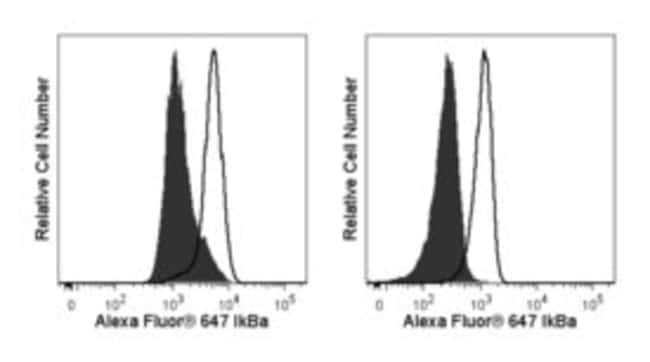
Description
NF-κB is a transcription factor that is a member of the mammalian NF-κB/Rel family of proteins. Members of this family are involved in the regulation of cell proliferation, immune function, as well as development.In resting cells, IκBα binds to and maintains NF-κB in the cytoplasm by blocking the nuclear localization sequences of NF-κB. In the cellular response to an extracellular signal, IκBα is phosphorylated and subsequently degraded via the ubiquination-proteasome pathway, allowing NF-κB to translocate to the nucleus. Once in the nucleus, NF-κB can induce the transcription of IκBα thereby renewing the cycle so that IκBα can form a complex with NF-κB and maintain it in its cytoplasmic location. IκBα -/- mice show an increased level of NF-κB activity and have been shown to die soon after birth.
The 25/IkBa/MAD-3 monoclonal antibody recognizes human IκBα regardless of phosphorylation status and does not cross-react with mouse IκBα .

Specifications
Specifications
| Antigen | IkBa |
| Applications | Flow Cytometry |
| Classification | Monoclonal |
| Clone | 25/IkBa/MAD-3 |
| Conjugate | Alexa Fluor 647 |
| Description | MAD-3; I-kappa-B-alpha; IkB-alpha; NFKBIA; NF-kappa-B inhibitor alpha |
| Formulation | Aqueous buffered solution containing BSA and ≤0.09% sodium azide. |
| Host Species | Mouse |
| Immunogen | Human IκBα aa. 145-302 Recombinant Protein |
| Purification Method | Affinity Purified |
| Show More |
By clicking Submit, you acknowledge that you may be contacted by Fisher Scientific in regards to the feedback you have provided in this form. We will not share your information for any other purposes. All contact information provided shall also be maintained in accordance with our Privacy Policy.