Learn More
Description
Lck is a member of the Src family of cytoplasmic protein-tyrosine kinases (PTKs) that is normally expressed exclusively in lymphoid cells, primarily T lymphocytes and NK cells. Members of this family have several common features: 1) unique N-terminal domains, 2) attachment to cellular membranes through a myristylated N-terminus, and 3) homologous SH2, SH3, and catalytic domains. The unique N-terminal domain of Lck interacts with the cytoplasmic tails of the CD4 and CD8 cell-surface glycoproteins of T lymphocytes, which recognize antigen presenting cells via their surface MHC class II and class I molecules, respectively. The catalytic activity of Lck is regulated by both kinases and phosphatases that control the phosphorylation states of two tyrosine residues that have opposing effects. Repression of Lck's catalytic activity occurs via phosphorylation at tyrosine 505 (Y505), located near the carboxy terminus. Phosphorylation of this tyrosine site is mediated by the Csk family of PTKs, and its dephosphorylation is mediated by the protein tyrosine phosphatase, CD45. When Lck is phosphorylated at this site, it assumes a folded tertiary structure which is enzymatically inactive. When CD45 dephosphorylates it at Y505, Lck is able to autophosphorylate its Y394, which leads to conformational changes in the catalytic domain that induce kinase activity. However, it has been observed that the inhibitory effect of the phosphorylated Y505 can be overcome by direct engagement of Lck's SH3 domain and that both Y394 and Y505 are phosphorylated together in cells activated by hydrogen peroxide. Activated Lck phosphorylates the ITAMs (Immunoreceptor-based Tyrosine Activation Motifs) of the T cell receptor (TCR) and thus is critical for activation and development of T lymphocytes. The interactions of Lck, Csk, CD45, CD4 or CD8, and TCR are only a small part of a complex immunoregulatory cascade that involves additional substrates for Csk and CD45, other enzymes, adhesion molecules, adaptor proteins, and specialized membrane
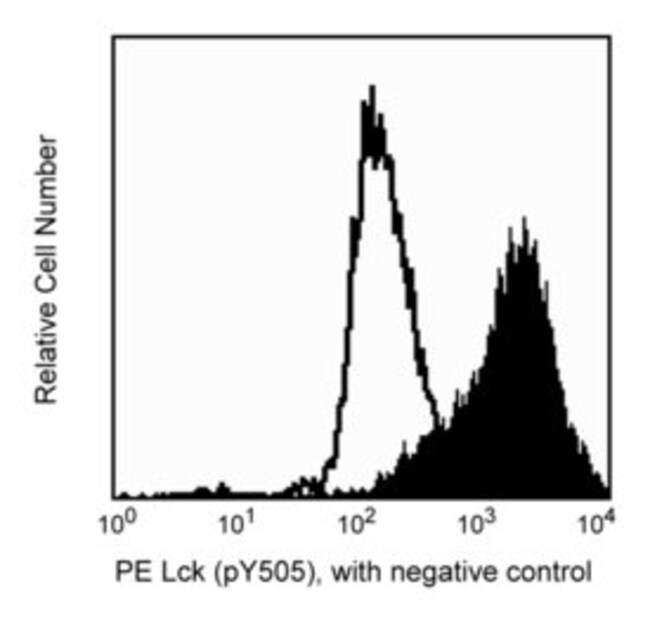
microdomains. The 4/LCK-Y505 monoclonal antibody recognizes the phosphorylated Y505 of the catalytic domain of Lck.The Alexa Fluor™ 488- conjugated format has been evaluated by flow using a human model system. However, the unconjugated form of this antibody (Mfr. No. 612390) has been shown to react with human, mouse, and rat in western blot. A phosphorylated peptide corresponding to residues around Tyrosine-505 from human Lck was used as the immunogen.
Flow Cytometry, Intracellular Staining

Specifications
Specifications
| Antigen | Lck (pY505) |
| Applications | Flow Cytometry |
| Classification | Monoclonal |
| Clone | 4/LCK-Y505 |
| Conjugate | PE |
| Formulation | Aqueous buffered solution containing BSA and ≤0.09% sodium azide. |
| Host Species | Mouse |
| Immunogen | Phosphorylated Human Lck Peptide |
| Purification Method | Affinity Purified |
| Quantity | 50 Tests |
| Show More |
By clicking Submit, you acknowledge that you may be contacted by Fisher Scientific in regards to the feedback you have provided in this form. We will not share your information for any other purposes. All contact information provided shall also be maintained in accordance with our Privacy Policy.