Promotional price valid on web orders only. Your contract pricing may differ. Interested in signing up for a dedicated account number?
Learn More
Learn More
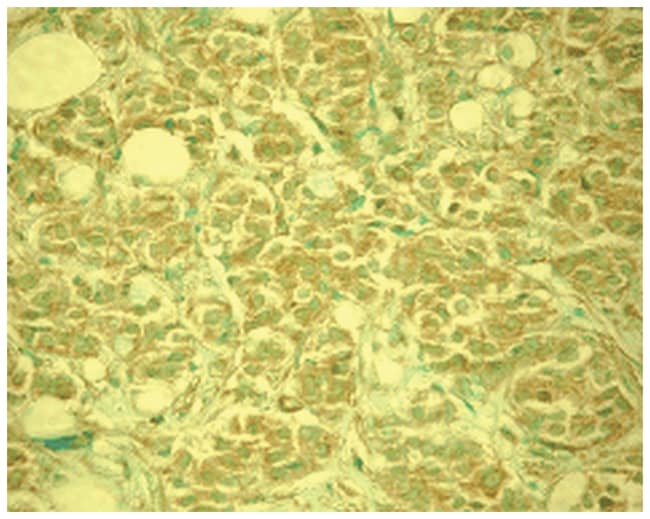
Description
Specifically detects MDM2 Clone: 4B11 in Human, Mouse samples, and it is validated for Immunofluorescence, Immunohistochemistry (Paraffin), Immunoprecipitation
Increased expression of proto-oncogenes due to gene amplification can lead to cellular transformation in the absence of other mutagenic events. Recently, a novel gene termed MDM2, first identified in mouse as a small acentromeric extra-chromosomal element, was shown to become oncogenic upon amplification and tumorigenic when overexpressed in NIH/3T3 and Rat2 cells. The human homolog of MDM2 gene has been isolated and mapped to chromosome 12q13-q14, a region that is found to be amplified in human sarcomas. Sequence analysis of the murine, rat, and human MDM2 genes suggests that MDM2 may be involved in transcriptional regulation. MDM2 contains two putative metal-binding motifs, one of which shares similarity to known zinc finger transcriptional activators. MDM2 also contains a putative nuclear localization signal and an acidic domain of the type found in transcriptional activators. A functional role for MDM2 has recently been identified on the basis of experiments which demonstrate that MDM2 forms a stable complex with p53 in vivo. Furthermore, over-expression of MDM2 inhibits the ability of wild type p53 to stimulate expression of target genes, and this inhibition appears to result from MDM2 binding to the acidic activation domain of p53, thereby preventing p53 from directly contacting the transcriptional machinery. Interestingly, wild type p53 appears to positively regulate expression of the MDM2 gene. MDM2 amplification has been observed in sarcomas, and direct analysis of the MDM2 and p53 genes in sarcomas indicates that one or the other but not both of these genes is mutated in 70% of the tumors. Thus, it appears that genetic alterations in either p53 or MDM2 represent alternative mechanisms for inactivating the same growth suppressive pathway. Regulation of MDM2 expression by p53 also represents a potential feed back control of p53 function.

Specifications
Specifications
| Antigen | MDM2 |
| Applications | Immunofluorescence, Immunohistochemistry (Paraffin), Immunoprecipitation |
| Classification | Monoclonal |
| Clone | 4B11 |
| Conjugate | Unconjugated |
| Formulation | In 50mM sodium phosphate buffer, 50% glycerol. |
| Host Species | Mouse |
| Immunogen | full-length, recombinant human MDM2 |
| Quantity | 100 μg |
| Regulatory Status | RUO |
| Show More |
For Research Use Only
Product Title
By clicking Submit, you acknowledge that you may be contacted by Fisher Scientific in regards to the feedback you have provided in this form. We will not share your information for any other purposes. All contact information provided shall also be maintained in accordance with our Privacy Policy.
Spot an opportunity for improvement?