Learn More

Description
The MC813-70 monoclonal antibody reacts with Stage-Specific Embryonic Antigen-4 (SSEA-4), a carbohydrate epitope on the major ganglioside, but not the neutral glycolipid, of human teratocarcinoma cells. As its name implies, the expression of SSEA-4 is stage-specific and can be used to characterize embryonic cells and monitor their differentiation. However, its expression pattern differs in the human and mouse. In the human, SSEA-4 is found on teratocarcinoma (embryonal carcinoma or EC), embryonic inner cell mass (ICM), and embryonic stem (ES) cells, erythrocytes, and the K562 erythromyeloid leukeumia cell line. As human stem cells undergo differentiation, SSEA-4 expression is lost. In the mouse, SSEA-4 is found on oocytes and early cleavage-stage embryos, and primitive ectoderm, but not on EC, ICM, or ES cells. In some cases, SSEA-4 expression appears upon differentiation of mouse EC or ES cells.
Host Species: Mouse
Clone: MC813-70
Isotype: IgG3, κ
Species Reactivity: Human
Immunogen: Human Teratocarcinoma Cell Line
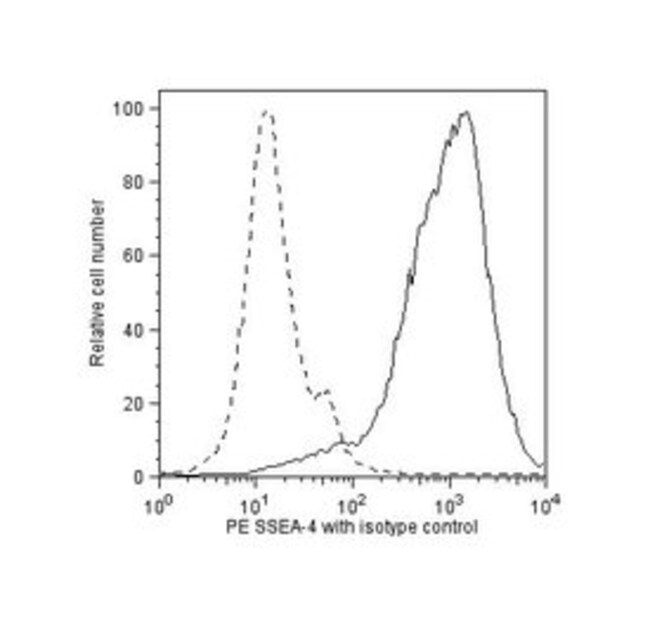
Flow Cytometry

Specifications
Specifications
| Antigen | SSEA-4 |
| Applications | Flow Cytometry |
| Classification | Monoclonal |
| Clone | MC813-70 |
| Conjugate | PE |
| Description | Stage-Specific Embryonic Antigen-4 |
| Formulation | Aqueous buffered solution containing BSA, protein stabilizer, and ≤0.09% sodium azide. |
| Host Species | Mouse |
| Immunogen | Human Teratocarcinoma Cell Line |
| Purification Method | Affinity Purified |
| Show More |
By clicking Submit, you acknowledge that you may be contacted by Fisher Scientific in regards to the feedback you have provided in this form. We will not share your information for any other purposes. All contact information provided shall also be maintained in accordance with our Privacy Policy.