Learn More
Description
TIE2 (Tyrosine kinase with Immunoglobulin-like and EGF-like domains unical Endothelial Kinase), is an endothelial and hematopoietic cell-specific receptor tyrosine kinase (RTK) that is critical to the development and maintenance of the vasculature and highly conserved among vertebrate species. The angiopoietins are ligands of TIE2, and the abnormal vascular growth that often occurs in solid tumors is a result of disruptions in the coordinated actions of the angiopoietins, TIE2, and the closely related TIE1 RTK. Upon activation by angiopoietins, TIE2 autophosphorylates at least 2 tyrosines in its protein kinase domain and at least 3 tyrosines in its C-terminal tail. Phosphorylation at tyrosine 1102 (Y1102) leads to activation of the Akt signal transduction pathway, enhancing endothelial cell survival. The phosphorylated Y1102 also recruits and activates the src homology 2 domain-containing adaptor proteins Grb2 and ShcA, affecting endothelial cell adhesion and motility.
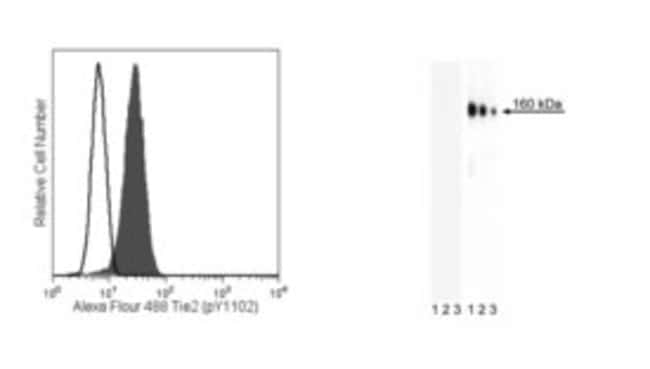
The K93-754 monoclonal antibody recognizes the phosphorylated Y1102 in the C-terminal tail of activated TIE2. The orthologous phosphorylation site in mouse TIE2 is Y1100.

Specifications
Specifications
| Antigen | TIE2 (pY1102) |
| Applications | Flow Cytometry |
| Classification | Monoclonal |
| Clone | K93-754 |
| Conjugate | Alexa Fluor 488 |
| Description | TEK, VMCM, CD202b |
| Formulation | Aqueous buffered solution containing BSA and ≤0.09% sodium azide. |
| Host Species | Mouse |
| Immunogen | Phosphorylated Human TIE2 Peptide |
| Purification Method | Affinity Purified |
| Show More |
Safety and Handling
By clicking Submit, you acknowledge that you may be contacted by Fisher Scientific in regards to the feedback you have provided in this form. We will not share your information for any other purposes. All contact information provided shall also be maintained in accordance with our Privacy Policy.