Promotional price valid on web orders only. Your contract pricing may differ. Interested in signing up for a dedicated account number?
Learn More
Learn More
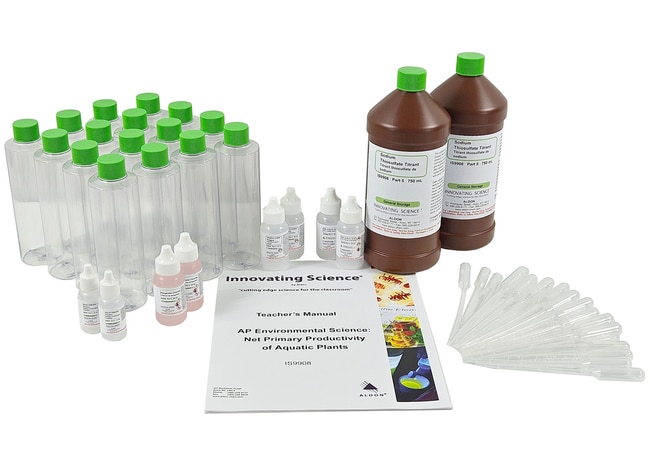
Innovating Science™ AP Environmental Science: Net Primary Productivity of Aquatic Plants

Shop All Aldon Products
Description
Living organisms require energy for growth, respiration, reproduction, and movement. Primary producers such as plants absorb energy from the sun and convert it to biomass via photosynthesis, which is then either used for cellular respiration or passed up the food chain.
- In this activity, simulate the photosynthesis and cellular respiration of an aquatic plant under different conditions to demonstrate when plants need energy for each process.
- This kit contains enough materials for 8 groups of students and comes with a Teacher's Manual and Student Study Guide Copymaster.
- The activity covers AP Environmental Science primary learning objective ENG-1.A.
- It will take a total of about 75 minutes over the course of 3 to 4 days to complete this activity (Day 1: 45 min, Day 3 or 4: 30 min).
Kit contains:
- 2 Manganese Chloride Reagents, 25 mL
- 2 Alkaline Iodide Reagents, 25 mL
- 2 Sulfuric Acid, 50%, 25 mL
- 2 Starch Indicator Solution, 15 mL
- 2 Sodium Thiosulfate Titrant, 0.002 M, 750 mL
- 24 Pipettes
- 16 Sample Bottles with Caps
Needed but not supplied:
- Bucket, 5 Gallon or Similar (for Class Water Sample)
- Graduated Cylinders, 25 mL
- Burettes, 50 mL
- Burette Clamps/Stands
- Funnels
- Erlenmeyer Flasks, 125 mL
- Elodea or Other Aquatic Plant - Can be collected locally
- Scissors
- Paper Towels
- Markers
- Aluminum Foil
- Magnetic Stir Plate and Stir Bar (Optional)
- Grow Light (Optional)
Specifications
Specifications
| Grade Level | High School |
| Grade | 9 to 12 |
| Class Size | 8 Lab Groups |
| Product Type | Net Primary Productivity of Aquatic Plants |
Product Title
By clicking Submit, you acknowledge that you may be contacted by Fisher Scientific in regards to the feedback you have provided in this form. We will not share your information for any other purposes. All contact information provided shall also be maintained in accordance with our Privacy Policy.
Spot an opportunity for improvement?