Learn More
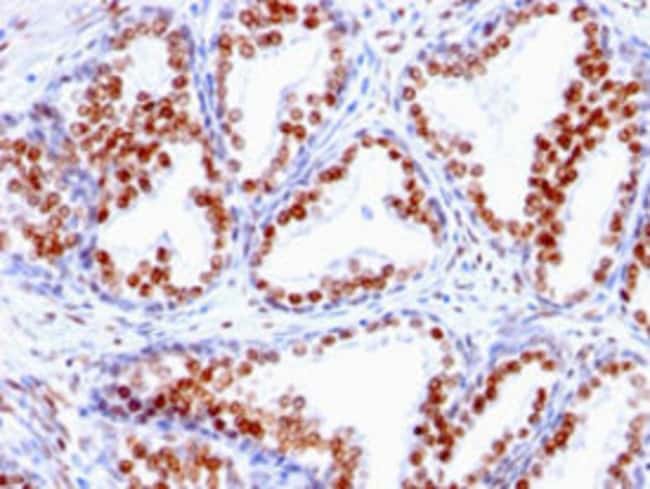
Description
The androgen receptor gene is more than 90 kb long and codes for a protein that has 3 major functional domains: the N-terminal domain, DNA-binding domain, and androgen-binding domain. The protein functions as a steroid-hormone activated transcription factor. Upon binding the hormone ligand, the receptor dissociates from accessory proteins, translocates into the nucleus, dimerizes, and then stimulates transcription of androgen responsive genes. This gene contains 2 polymorphic trinucleotide repeat segments that encode polyglutamine and polyglycine tracts in the N-terminal transactivation domain of its protein. Expansion of the polyglutamine tract causes spinal bulbar muscular atrophy (Kennedy disease). Mutations in this gene are also associated with complete androgen insensitivity (CAIS). Two alternatively spliced variants encoding distinct isoforms have been described. [provided by RefSeq]
Specifications
Specifications
| Antigen | AR |
| Applications | Flow Cytometry, Immunofluorescence, Immunohistochemistry (PFA fixed) |
| Classification | Monoclonal |
| Clone | SPM335 |
| Conjugate | Unconjugated |
| Description | Mouse monoclonal antibody raised against synthetic peptide of human AR. |
| Dilution | Flow Cytometry (0.5-1 ug/106 cells in 0.1 mL) Immunofluorescence (0.5-1 ug/mL) Immunohistochemistry (Formalin/PFA-fixed paraffin-embedded sections) (0.5-1 ug/mL) The optimal working dilution should be determined by the end user. |
| Formulation | In 1mM PBS (0.05% BSA, 0.05% sodium azide). |
| Gene Alias | AIS/DHTR/HUMARA/KD/NR3C4/SBMA/SMAX1/TFM |
| Gene Symbols | AR |
| Show More |
By clicking Submit, you acknowledge that you may be contacted by Fisher Scientific in regards to the feedback you have provided in this form. We will not share your information for any other purposes. All contact information provided shall also be maintained in accordance with our Privacy Policy.