Promotional price valid on web orders only. Your contract pricing may differ. Interested in signing up for a dedicated account number?
Learn More

Invitrogen™ ATG9A Monoclonal Antibody (14F2 8B1)
GREENER_CHOICE

Catalog No. PIMA1149
Change view
Click to view available options
Quantity:
100 μg
1 product options available for selection
Product selection table with 1 available options. Use arrow keys to navigate and Enter or Space to select.
Catalog No. Quantity
PIMA1149 100 μg
Use arrow keys to navigate between rows. Press Enter or Space to select a product option. 1 options available.
1 options
Catalog No. PIMA1149 Supplier Invitrogen™ Supplier No. MA1149
Only null left
Add to Cart
Add to Cart

Armenian Hamster Monoclonal Antibody

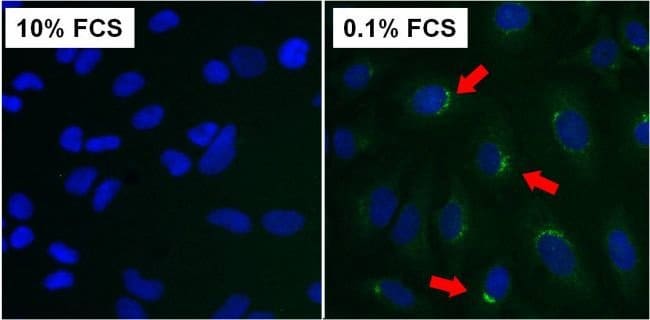
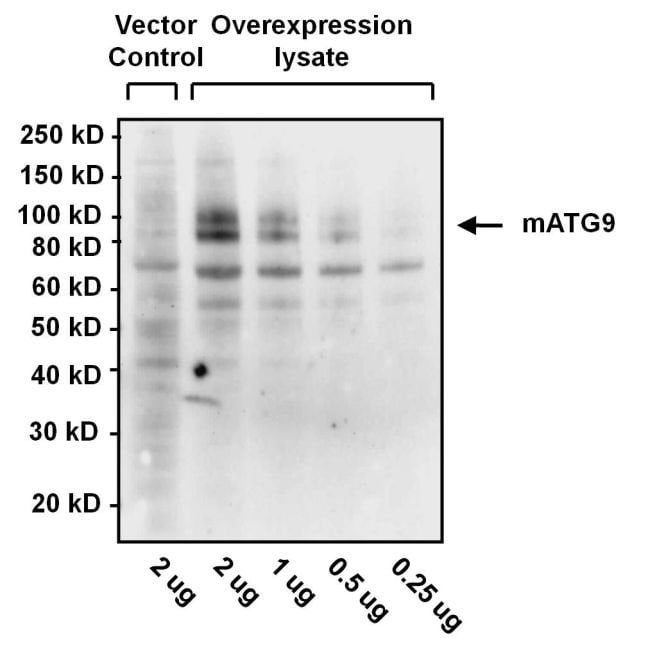
MA1-149 was produced in Armenian hamster and detects ATG9 in human, rat and mouse samples. MA1-149 has been successfully used in Western Blot, Immunofluorescence, and ELISA procedures. Western Blot analysis with MA1-149 shows the detection of a double band at ~85-95 kDa in human ATG9 overerexpression lysates. MA1-149 also detects additional unknown bands at ~40 and ~60 kDa. In Immunofluorescence applications, MA1-149 shows accumulation and redestribution of ATG9 in response to starvation-induced autophagosome assembly.

Macroautophagy is the major inducible pathway for the general turnover of cytoplasmic constituents in eukaryotic cells, it is also responsible for the degradation of active cytoplasmic enzymes and organelles during nutrient starvation. Macroautophagy involves the formation of double-membrane bound autophagosomes which enclose the cytoplasmic constituent targeted for degradation in a membrane bound structure, which then fuse with the lysosome (or vacuole) releasing a single-membrane bound autophagic bodies which are then degraded within the lysosome (or vacuole). Apg9 plays a direct role in the formation of the cytoplasm to vacuole targeting and autophagic vesicles, possibly serving as a marker for a specialized compartment essential for these vesicle-mediated alternative targeting pathways.
TRUSTED_SUSTAINABILITY

Specifications

Antigen ATG9A
Applications ELISA, Western Blot, Immunocytochemistry
Classification Monoclonal
Clone 14F2 8B1
Concentration 1 mg/mL
Conjugate Unconjugated
Formulation PBS with 1mg/mL BSA, 30% glycerol and 0.05% sodium azide
Gene ATG9A
Gene Accession No. Q5FWU3, Q68FE2, Q7Z3C6
Gene Alias Apg9; APG9 autophagy 9-like 1; Apg911; APG9A; APG9L1; APG9-like 1; ATG 9A; Atg9; ATG9 autophagy related 9 homolog A; ATG9 autophagy related 9 homolog A (S. cerevisiae); Atg9a; Atg9l1; AU019532; autophagy 9-like 1 protein; autophagy protein 9; autophagy related 9A; autophagy-related 9A; autophagy-related 9-like 1; autophagy-related protein 9; autophagy-related protein 9A; FLJ22169; mATG9; MGD3208; RGD1310450; zgc:158700
Gene Symbols ATG9A
Host Species Armenian Hamster
Immunogen peptide sequence HPEPVPEEGSEDELPPQVHK of human ATG9A C-terminus.
Purification Method Protein A
Quantity 100 μg
Regulatory Status RUO
Primary or Secondary Primary
Gene ID (Entrez) 245860, 363254, 79065
Target Species Human, Mouse, Rat
Content And Storage -20°C
Product Type Antibody
Form Liquid
Isotype IgG
Show More Show Less
Product Title
Select an issue

By clicking Submit, you acknowledge that you may be contacted by Fisher Scientific in regards to the feedback you have provided in this form. We will not share your information for any other purposes. All contact information provided shall also be maintained in accordance with our Privacy Policy.