Learn More




Invitrogen™ ATP Citrate Lyase Polyclonal Antibody

Description
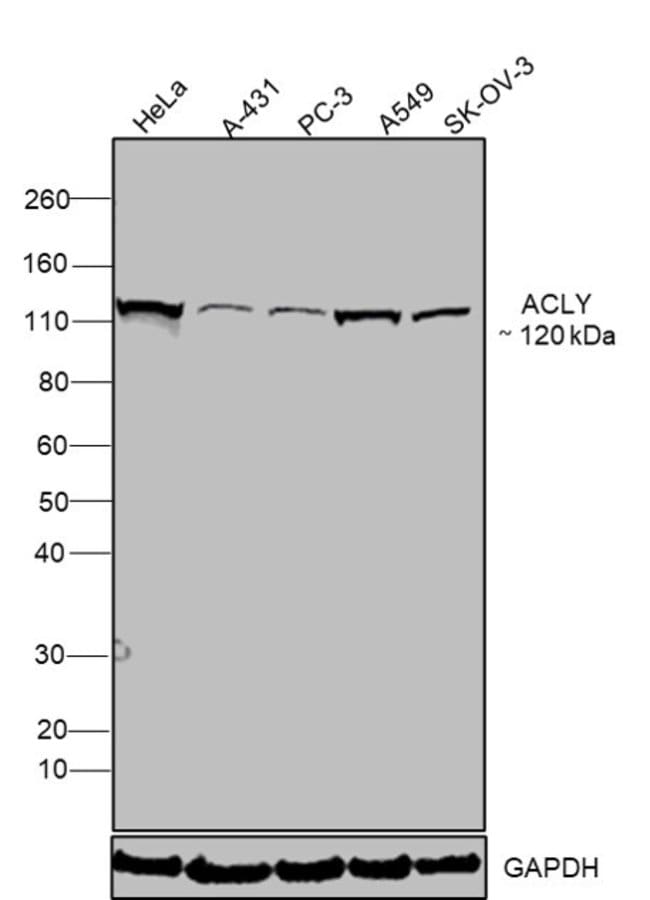
Reconstitute with 0.2 mL of distilled water to yield a concentration of 500 μg/mL. Positive Control - WB: human A549 whole cell, human MOLT4 whole cell, human U87 whole cell, human U251 whole cell, human 293T whole cell, human Hela whole cell, human T47D whole cell, human HepG2 whole cell, rat pancreas tissue, mouse NIH/3T3 whole cell. IHC: human colonic adenocarcinoma tissue, human hepatocellular carcinoma tissue, human laryngeal squamous cell carcinoma tissue, human placenta tissue, human colon cancer tissue, mouse testis tissue, rat testis tissue. ICC/IF: A594 cell. Flow: HepG2 cell.

Specifications
Specifications
| Antigen | ATP Citrate Lyase |
| Applications | Flow Cytometry, Immunohistochemistry (Paraffin), Western Blot, Immunocytochemistry |
| Classification | Polyclonal |
| Concentration | 500 μg/mL |
| Conjugate | Unconjugated |
| Formulation | PBS with 4mg trehalose and no preservative |
| Gene | Acly |
| Gene Accession No. | P16638, P53396, Q91V92 |
| Gene Alias | 17-beta-HSD 10; 17-beta-hydroxysteroid dehydrogenase 10; 17bHSD10; 17b-HSD10; 2-methyl-3-hydroxybutyryl-CoA dehydrogenase; 3-hydroxy-2-methylbutyryl-CoA dehydrogenase; 3-hydroxyacyl-CoA dehydrogenase type II; 3-hydroxyacyl-CoA dehydrogenase type-2; A730098H14Rik; ABAD; AB-binding alcohol dehydrogenase; ACL; ACLY; Ads9; amyloid beta-peptide binding protein; amyloid-beta peptide binding alcohol dehydrogenase; ATP citrate lyase; ATP-citrate (pro-S-)-lyase; ATP-citrate synthase; ATPCL; AW538652; CAMR; citrate cleavage enzyme; CLATP; DUPXp11.22; endoplasmic reticulum-associated amyloid beta-peptide-binding protein; ERAB; HADH2; HCD2; Hsd17b10; hydroxyacyl-Coenzyme A dehydrogenase type II; hydroxyacyl-Coenzyme A dehydrogenase, type II; hydroxysteroid (17-beta) dehydrogenase 10; hydroxysteroid 17-beta dehydrogenase 10; hydroxysteroid dehydrogenase 10; MHBD; Mitochondrial ribonuclease P protein 2; mitochondrial RNase P protein 2; mitochondrial RNase P subunit 2; MRPP2; MRX17; MRX31; MRXS10; SCHAD; SDR5C1; short chain dehydrogenase/reductase family 5C member 1; short chain dehydrogenase/reductase family 5C, member 1; short chain L-3-hydroxyacyl-CoA dehydrogenase; short chain L-3-hydroxyacyl-CoA dehydrogenase type 2; short chain type dehydrogenase/reductase XH98G2; Short-chain type dehydrogenase/reductase XH98G2; Type II HADH; XH98G2 |
| Gene Symbols | Acly |
| Show More |
By clicking Submit, you acknowledge that you may be contacted by Fisher Scientific in regards to the feedback you have provided in this form. We will not share your information for any other purposes. All contact information provided shall also be maintained in accordance with our Privacy Policy.