Promotional price valid on web orders only. Your contract pricing may differ. Interested in signing up for a dedicated account number?
Learn More
Learn More
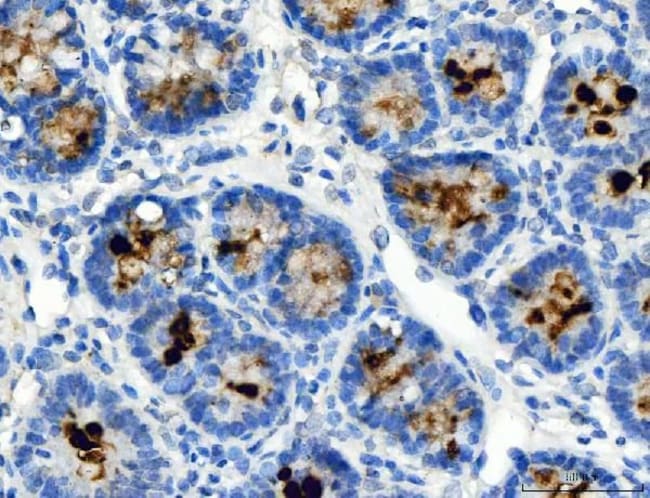
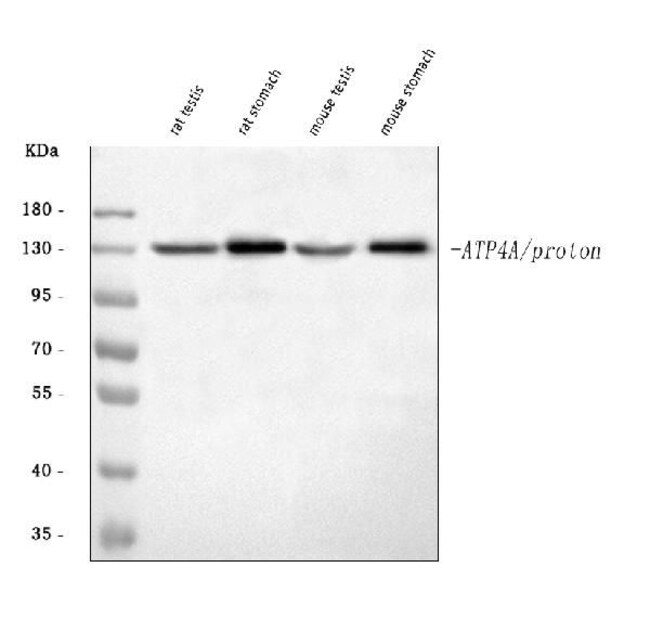


Description
Adding 0.2 mL of distilled water will yield a concentration of 500 μg/mL. Positive Control - WB: rat testis tissue, rat stomach tissue, mouse testis tissue, mouse stomach tissue. IHC: rat stomach tissue. Flow: Daudi cell. Store at -20°C for one year from date of receipt. After reconstitution, at 4°C for one month. It can also be aliquotted and stored frozen at -20°C for six months. Avoid repeated freeze-thaw cycles.
The ATP4A gene encodes the alpha subunit of the gastric H+/K+ ATPase, an enzyme crucial for gastric acid secretion in the stomach. This proton pump resides in the parietal cells of the gastric mucosa and is responsible for exchanging potassium ions (K+) for hydrogen ions (H+), effectively acidifying the stomach contents. ATP4A plays a significant role in maintaining the acidic environment necessary for digestion and defense against pathogens. The ATPase's activity is tightly regulated by various factors, including hormones like gastrin and histamine, to ensure optimal stomach function. Mutations in ATP4A can lead to disorders related to gastric acidity, such as hypochlorhydria (low stomach acid), which can impact digestion and absorption of nutrients. Understanding ATP4A's function and its regulatory mechanisms is essential for developing treatments for conditions like peptic ulcer disease and gastroesophageal reflux disease, where gastric acid secretion is disrupted.

Specifications
Specifications
| Antigen | ATP4A |
| Applications | Flow Cytometry, Immunohistochemistry (Paraffin), Western Blot |
| Classification | Polyclonal |
| Concentration | 500 μg/mL |
| Conjugate | Unconjugated |
| Formulation | PBS with 4mg trehalose and no preservative |
| Gene | ATP4A |
| Gene Accession No. | P09626, P20648, Q64436 |
| Gene Alias | ATP4A; ATP6A; ATPase H+/K+ transporting alpha subunit; ATPase, H+/K+ exchanging, alpha polypeptide; ATPase, H+/K+ transporting, alpha polypeptide; gastric H(+)/K(+) ATPase subunit alpha; gastric H,K-ATPase alpha subunit; gastric H,K-ATPase catalytic subunit; gastric H+/K+ ATPase alpha subunit; gastric hydrogen-potassium ATPase; H(+)-K(+)-ATPase alpha subunit; potassium-transporting ATPase alpha chain 1; Proton pump |
| Gene Symbols | ATP4A |
| Show More |
Product Title
By clicking Submit, you acknowledge that you may be contacted by Fisher Scientific in regards to the feedback you have provided in this form. We will not share your information for any other purposes. All contact information provided shall also be maintained in accordance with our Privacy Policy.
Spot an opportunity for improvement?