Promotional price valid on web orders only. Your contract pricing may differ. Interested in signing up for a dedicated account number?
Learn More

beta GalactosidaseRabbit anti-Bacteria, Polyclonal, Rockland™
SDP

Catalog No. 501990160
Encompass
Encompass_Preferred
Change view
Click to view available options
Quantity:
2 mL
1 product options available for selection
Product selection table with 1 available options. Use arrow keys to navigate and Enter or Space to select.
Catalog No. Quantity
50-199-0160 2 mL
Use arrow keys to navigate between rows. Press Enter or Space to select a product option. 1 options available.
1 options
Catalog No. 50-199-0160 Supplier Rockland Immunochemicals Supplier No. 1004136
Add to Cart
Add to Cart

Rabbit Polyclonal Antibody

Store vial at 4°C prior to restoration. For extended storage aliquot contents and freeze at -20°C or below. Avoid cycles of freezing and thawing. Centrifuge product if not completely clear after standing at room temperature. This product is stable for several weeks at 4°C as an undiluted liquid. Dilute only prior to immediate use. Assay by immunoelectrophoresis resulted in a single precipitin arc against anti-rabbit serum, purified and partially purified Beta Galactosidase [E. coli]. Cross reactivity against Beta Galactosidase from other sources may occur but have not been specifically determined.

Beta Galactosidase is an exoglycosidase which hydrolyzes the beta-glycosidic bond formed between a galactose and its organic moiety. Deficiencies in the protein in humans can result in galactosialidosis or Morquio B syndrome. In E. coli, the gene of beta-galactosidase, the lacZ gene, is present as part of the inducible system lac operon which is activated in the presence of lactose when glucose level is low. E. coli beta Galactosidase is commonly used in molecular biology as a reporter marker to monitor gene expression. Another popular use for beta Galactosidase is in blue/white screening to identify recombinant clones. Beta Galactosidase can be split in two peptides, lacZalpha and LacZOmega, neither of which is active by itself but when both are present together, spontaneously reassemble into a functional enzyme. This property is exploited in many cloning vectors. The presence or absence of an active beta Galactosidase may be detected through addition of artificial chromogenic substrates such as X-gal, fluorescent substrates such as Fluorescein di-beta-D-galactopyranoside (FDG), luminescent substrates and others. Beta Galactosidase activity at pH 6 is an indicator of senescent cells not found in presenescent, quiescent or dividing cells.

Specifications

Antigen beta Galactosidase
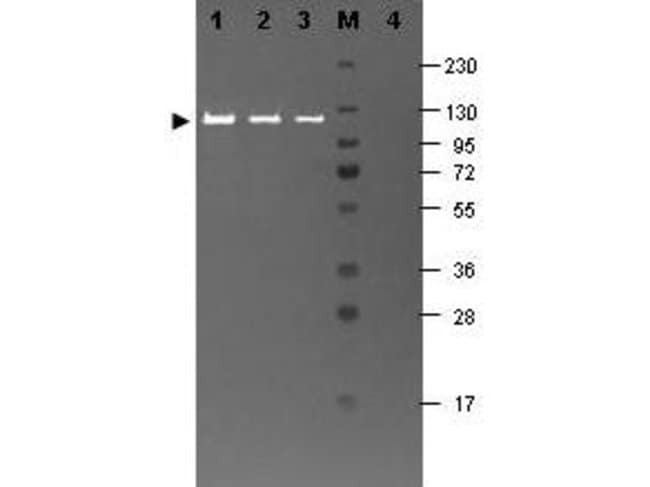
Applications ELISA, Immunohistochemistry, Immunoprecipitation, Western Blot
Classification Polyclonal
Concentration 85 mg/mL
Conjugate Unconjugated
Formulation 0.02M potassium phosphate with 0.15M NaCl and 0.01% sodium azide; pH 7.2
Gene Alias Acid beta-galactosidase; AW125515; betagal; Beta-Gal; Beta-galactosidase; bgal; Bge; Bgl; Bgl-e; Bgl-s; Bgl-t; Bgs; Bgt; C130097A14Rik; EBP; Elastin receptor 1; elastin receptor 1, 67kDa; ELNR1; galactosidase beta 1; galactosidase, beta 1; Glb1; Glb-1; Lactase; lysosomal beta-galactosidase; MPS4B; ßgal; ß-gal; ß-galactosidase
Host Species Rabbit
Immunogen Beta Galactosidase (E.coli)
Quantity 2 mL
Regulatory Status RUO
Primary or Secondary Primary
Target Species Bacteria
Content And Storage Store at 4°C short term. For long term storage, store at -20°C, avoiding freeze/thaw cycles.
Product Type Antibody
Form Lyophilized
Show More Show Less
Product Title
Select an issue

By clicking Submit, you acknowledge that you may be contacted by Fisher Scientific in regards to the feedback you have provided in this form. We will not share your information for any other purposes. All contact information provided shall also be maintained in accordance with our Privacy Policy.