Promotional price valid on web orders only. Your contract pricing may differ. Interested in signing up for a dedicated account number?
Learn More
Learn More
Description
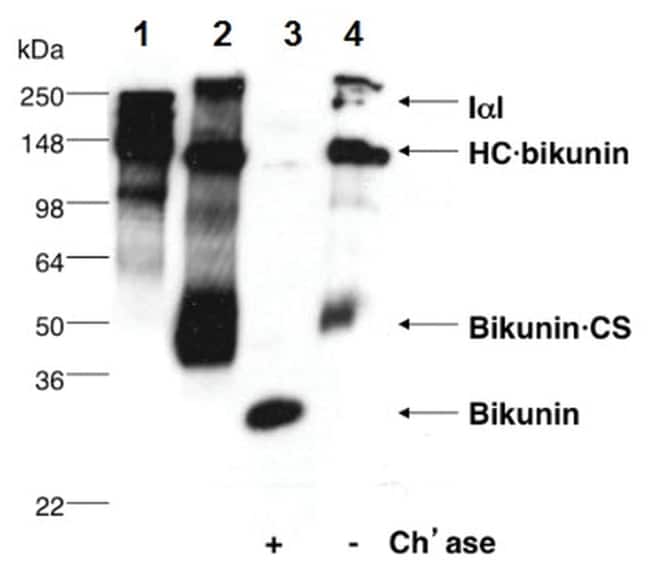
Protein AMBP (UniProt P02760; also known as alpha-1-microglobulin/bikunin precursor) is transcribed from the AMBP (also known as HCP, HI30, IATIL, ITIL, ITILC) gene (Gene ID 259) in human as a precursor protein with a signal peptide (a.a. 1-19), posttranslational cleavages produce Alpha-1-microglobulin (a.a. 20-203; A1M, Alpha-1 microglycoprotein, Complex-forming glycoprotein heterogeneous in charge, Protein HC), bikunin (a.a. 206-352; Inter-alpha-trypsin inhibitor light chain, ITI-LC, EDC1, HI-30, Uronic-acid-rich protein), and Trypstatin (a.a. 284-344). Bikunin is a proteoglycan (PG) that contains a single chondroitin sulfate (CS) glycosaminoglycan (GAG) chain with 27-39 monosaccharides attached to Ser10 of the mature core protein. Bikunin GAG has a non-sulfated domain consisting of 6-22 monosaccharides on the non-reducing end and a sulfated domain of 12-18 monosaccharides on the reducing end, with the sulfation occurring exclusively at the fourth carbon of the GalNAc residues. During the synthesis of bikunin by hepatocytes, C-terminal aspartate residues of ∽80kDa heavy chains (HC1 and HC2) are covalently linked to the sixth carbon of a GlcUA residue on the non-sulfated region of the CS chain, forming pre-inter-α-inhibitor (pre-IαI or PαI) with one HC. A second HC can be attached to the non-sulfated region of the CS to form IαI. IαI is known for its roles in inhibiting serine proteinases, such as plasmin, and as an HC donor for the covalent modification of hyaluronan (HA) to form HC·HA (or SHAP·HA) complexes at sites of inflammation and around the oocyte prior to ovulation. Tumor necrosis factor-stimulated gene-6 (TSG-6) forms a covalent HC·TSG-6 intermediate and subsequently transfers the HC to the sixth carbon of GlcNAc residues of HA in a transesterification reaction that contributes to the cross-linking and stabilization of HA matrices; in some contexts modification of HA with HC has been implicated in the promotion of leukocyte adhesion. In addition, the bikunin·CS chain can accept a single HC from IαI via transfer catalyzed by TSG-6 and that HCs could be swapped from bikunin·CS chain to HA. (Briggs, D.C., et al. (2015). J. Biol. Chem. 290(48):28708-28723).

Specifications
Specifications
| Antigen | Bikunin (CP6) |
| Applications | Western Blot |
| Classification | Polyclonal |
| Concentration | Please refer to lot specific datasheet. |
| Conjugate | Unconjugated |
| Formulation | Rabbit polyclonal antibody serum with 0.05% Sodium Azide. |
| Gene | AMBP, HCP, HI30, IATIL, ITIL, ITILC |
| Gene Accession No. | P02760 |
| Host Species | Rabbit |
| Immunogen | Diphtheria toxoid-conjugated linear peptide corresponding to human bikunin N-terminal sequence. |
| Show More |
For Research Use Only. Not for use in diagnostic procedures.
Product Title
By clicking Submit, you acknowledge that you may be contacted by Fisher Scientific in regards to the feedback you have provided in this form. We will not share your information for any other purposes. All contact information provided shall also be maintained in accordance with our Privacy Policy.
Spot an opportunity for improvement?