Promotional price valid on web orders only. Your contract pricing may differ. Interested in signing up for a dedicated account number?
Learn More

Invitrogen™ CARD14 Polyclonal Antibody
GREENER_CHOICE

Catalog No. PIPA5120462
Change view
Click to view available options
Quantity:
100 μL
1 product options available for selection
Product selection table with 1 available options. Use arrow keys to navigate and Enter or Space to select.
Catalog No. Quantity
PIPA5120462 100 μL
Use arrow keys to navigate between rows. Press Enter or Space to select a product option. 1 options available.
1 options
This item is not returnable. View return policy
Catalog No. PIPA5120462 Supplier Invitrogen™ Supplier No. PA5120462
Add to Cart
Add to Cart
This item is not returnable. View return policy

Rabbit Polyclonal Antibody

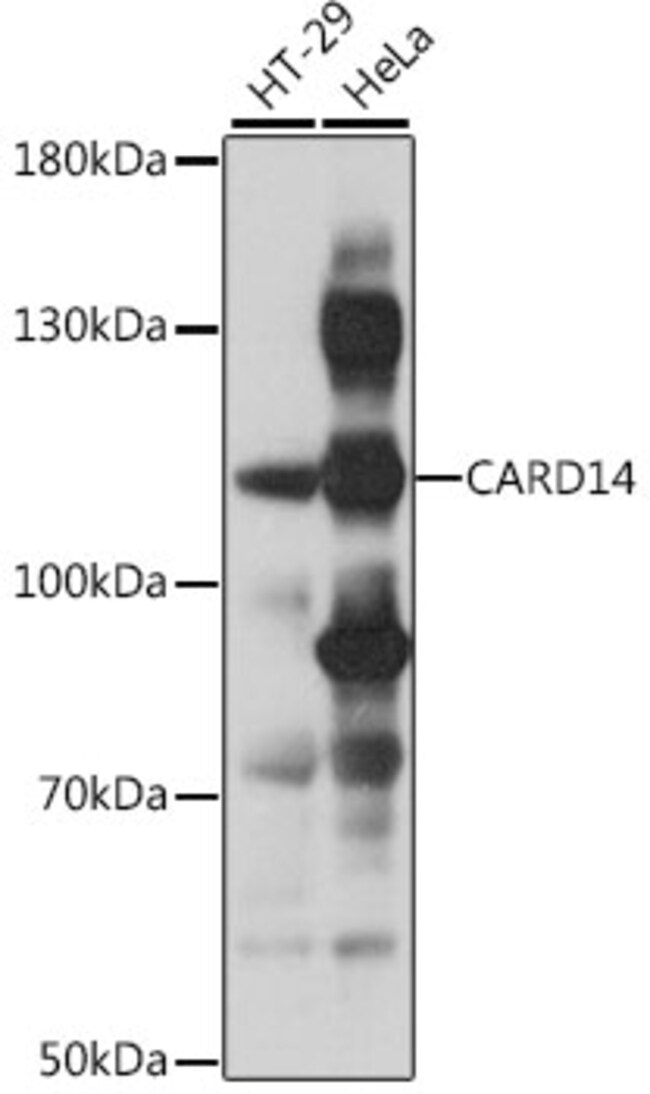
Positive test controls include: HT-29, HeLa. The target is usually found in the following locations: Cytoplasm, Cytoplasm. Immunogen sequence: SLSLHYSNAL QEKELAASRC RSLQEELYLL KQELQRANMV SSCELELQEQ SLRTASDQES GDEELNRLKE ENEKLRSLTF SLAEKDILEQ SLDEARGSRQ ELVERIHSLR ERAVAAERQR EQYWEEKEQT LLQFQKSKMA CQLYREKVNA LQAQVCELQK ERDQAYSARD SAQREISQSL VEKDSLRRQV FELTDQVCEL RTQLRQLQAE PPGVLKQEAR TREPCPREKQ RLVRMHAICP RDDSDCSLVS STESQLLSDL SATSSRELVD SFRSSSPAPP SQQSLYKRVA EDFGEEPWSF S.

Membrane-associated guanylate kinase (MAGUK) family members localize to the plasma membrane and function as molecular scaffolds for the assembly of multi-protein complexes. The MAGUK family includes several mammalian proteins related to the Drosophila tumor suppressor discs-large (dlg) gene product, such as postsynaptic proteins, GKAPs, the tight junction associated proteins (ZO-1-3) and the caspase-associated recruitment domain (CARD) proteins: CARD 6, CARD 8-12 and CARD 14. CARD 14 is a 1,004 amino acid protein consisting of an N-terminal CARD domain, a central coiled-coil domain and a C-terminal tripartite domain comprised of a PDZ domain, an Src homology 3 domain and a GUK domain with homology to guanylate kinase. CARD 14 is expressed in the placenta where it positively regulates apoptosis. CARD 14 also controls NF-kappaB activation by phosphorylating BCL10, a signaling protein that activates NF-kappaB through the I kappaB kinase complex. Epigallocatechin-3-gallate (EGCG) is a polyphenol that induces the expression of CARD 14.
TRUSTED_SUSTAINABILITY

Specifications

Antigen CARD14
Applications ELISA, Immunohistochemistry (Paraffin), Western Blot
Classification Polyclonal
Concentration 2.12 mg/mL
Conjugate Unconjugated
Formulation PBS with 50% glycerol and 0.01% thimerosal; pH 7.3
Gene CARD14
Gene Accession No. Q99KF0, Q9BXL6
Gene Alias Bcl10-interacting MAGUK protein 2; BIMP2; Card14; CARD-containing MAGUK protein 2; Carma 2; CARMA2; caspase recruitment domain family member 14; caspase recruitment domain family, member 14; caspase recruitment domain-containing protein 14; PRP; PSORS2; PSS1
Gene Symbols CARD14
Host Species Rabbit
Immunogen Recombinant fusion protein containing a sequence corresponding to amino acids 200-500 of human CARD14 (NP_001244899.1).
Purification Method Affinity chromatography
Quantity 100 μL
Regulatory Status RUO
Primary or Secondary Primary
Gene ID (Entrez) 170720, 688292, 79092
Target Species Human, Mouse, Rat
Content And Storage -20°C, Avoid Freeze/Thaw Cycles
Product Type Antibody
Form Liquid
Isotype IgG
Show More Show Less
Product Title
Select an issue

By clicking Submit, you acknowledge that you may be contacted by Fisher Scientific in regards to the feedback you have provided in this form. We will not share your information for any other purposes. All contact information provided shall also be maintained in accordance with our Privacy Policy.